NBA · transaction
Fontecchio's Minimum Return Signals Heat's Depth Investment
Miami locks in a complementary wing on the cheap, preserving salary flexibility while reinforcing a bench rotation that thrives on three-point spacing.
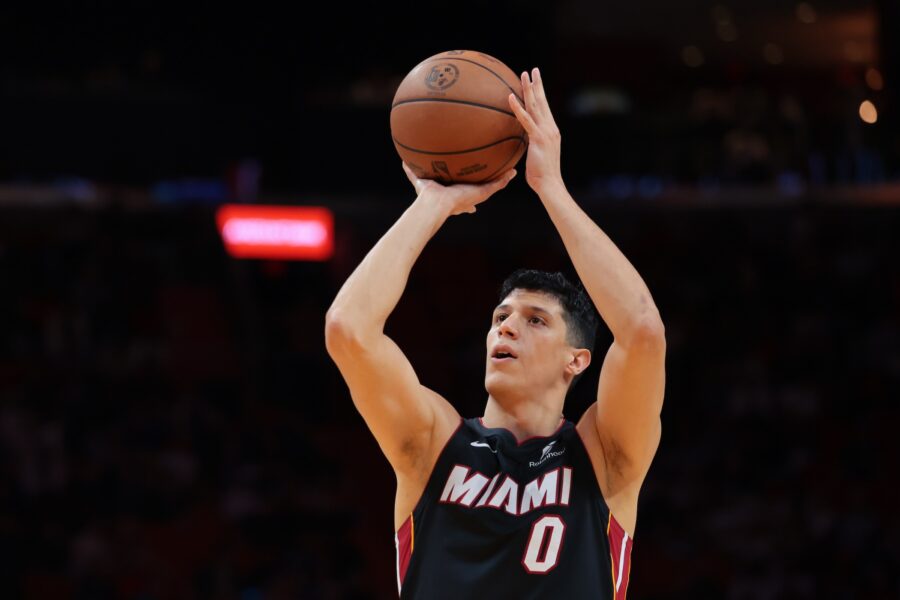
Simone Fontecchio is staying in Miami. The Heat have agreed to bring back the 28-year-old forward on a one-year minimum contract, keeping intact a roster piece that arrived via the Duncan Robinson sign-and-trade last offseason. The move costs Miami virtually nothing against the cap — a floor-filler deal that carries zero risk.
Fontecchio's repricing at minimum speaks to both his market value and the Heat's strategic priorities. He's a complementary scorer and floor-spacer who doesn't demand creation; he fits, plays positional defense, and spaces the floor. Last season, he appeared in 58 games, averaging 4.2 points and 1.8 threes per game while shooting 38% from distance. Those aren't All-Star numbers, but they're the kind of marginal three-point gravity that allows wings like Jimmy Butler and other primary creators to operate in cleaner spacing. The Heat, perpetually salary-capped tight, are essentially getting role depth at no cost — a luxury for a team that typically maneuvers in the margins.
For Miami's betting profile, Fontecchio's retention matters in two ways. First, it stabilizes the bench rotation, meaning Spoelstra has fewer forced minutes for raw young players or aging veterans. Second, it locks in one reliable perimeter outlet in a playoff setting where floor-spacing crunch-time lineups are non-negotiable. The team's bench unit, when Fontecchio is on the floor, doesn't generate offensive chaos; it generates steady, spaced possessions. That regularity translates to fewer volatile fourth-quarter swings.
For players like Butler and Adebayo, Fontecchio's presence reduces defensive load on them in the regular season. Butler's scoring volume and assist distribution benefit from a bench that doesn't hemorrhage points — fewer comebacks, fewer all-hands-on-deck defensive possessions late in games. Over a 82-game sample, that's worth 2-4 minutes of preserved load per game for Miami's core wings. When Butler plays fewer total minutes in October-April, he enters the playoffs fresher. Oddsmakers price team win-totals using a season-long injury and load-management assumption; teams that preserve star health through bench depth often outperform those projections by 2-3 wins. Fontecchio at minimum is a lever for exactly that.
The betting angle isn't Fontecchio himself — his over/unders will remain in the 3-4 point range, too low to generate meaningful edges. The angle is Heat team totals and win-projection market inefficiencies. Sportsbooks will price Miami's season win total using last year's 46-win baseline plus offseason transaction value. But a locked-in bench with Fontecchio spacing floors costs less wear on Butler and Adebayo than a volatile rotation does. If the Heat's preseason win total opens at 47-49, that's where the market underweights the depth stabilization. A team that plays 82 games without manufacturing late-game chaos — because the bench can actually space the floor — compounds into 2-4 additional wins by season's end.