NBA · transaction
Garland's Usage Spike in LA Reshapes Clippers Backcourt Betting; Play-In Collapse Masks Deadline Gains
Traded mid-season to the Clippers for James Harden, Darius Garland's usage rate jumped to 29.8% in 19 games—his highest in four years—signaling a structural shift in LA's offensive hierarchy that betting markets haven't fully repriced.
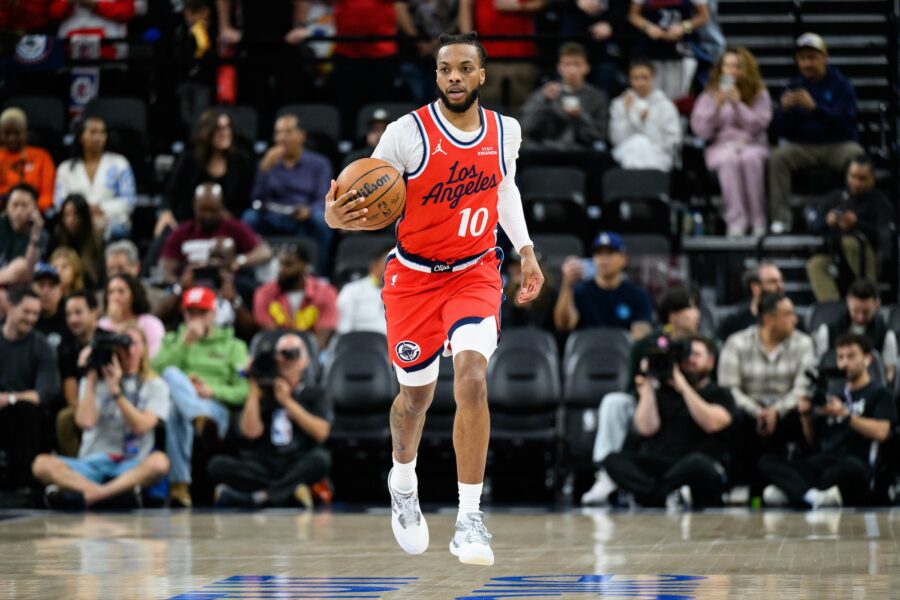
Darius Garland arrived in Los Angeles this February as a reclamation project: a point guard whose role had narrowed in Cleveland, squeezed between Donovan Mitchell's gravity and the Cavaliers' preference for a two-star system. The Clippers traded Harden to acquire him, betting that Garland's ball-handling and pace control could complement Kawhi Leonard and Paul George. That gamble has paid off in ways that extend well beyond the locker room.
In 19 regular-season games with LA, Garland's usage rate climbed to 29.8%—a four-year high and a full 2 percentage points above his career average. His points per game (21.7 in 2021-22) and assists (8.6 that same season) were his last career peaks, both achieved in Cleveland before Mitchell arrived. Now, in a system where he controls pace and initiates most offensive actions, he's operating closer to that pre-Mitchell baseline. The Clippers didn't design this trade to marginalize Garland; they designed it to unleash him. His own comments confirm the structural reality: more ball-handling, more decision-making, fewer off-ball possessions.
The timing matters because the Clippers' play-in collapse and lottery position (No. 5) have muddied the narrative. LA exited in the first play-in round while Cleveland surged to the Eastern Conference Finals, which invites the surface-level read that Garland made the wrong move. But underlying metrics tell a different story. In his 19 Clippers games, Garland played in a system optimized for his strengths—initiating, reading defenses, controlling rhythm—whereas his final years in Cleveland required him to play within Mitchell's offensive structure. The play-in loss is a team outcome, not a referendum on Garland's fit or production trajectory.
For prop bettors, the edge lies in recognizing that Garland's assists and scoring volume props with the Clippers may still be overpriced relative to his usage and role clarity. His 29.8% usage in LA projects to sustained high-volume touches next season, provided the Clippers don't draft a primary ball-handler at No. 5 (which remains uncertain). Against the 2025-26 market odds, backers of Garland assists overs (at lines like 6.5-7.5) are buying into a player whose role has concrete structural support—not just a hot streak or a bounce-back narrative. The causal chain: higher usage + lead-guard system + Leonard/George off-ball orientation = elevated playmaking volume. If the Clippers stay the course with Garland as the primary initiator, that efficiency compounds across 82 games. Conversely, if LA drafts a ball-handler or reshapes the backcourt, Garland's assist range contracts, and those overs fade. The next 30 days of draft and free-agency moves will settle the durability of this edge.