NBA · roster-move
Wade's Market Stands at Midnight: Cleveland's Tax Gamble as Free Agency Opens
Dean Wade hits the market in hours, but the Cavaliers' second tax apron squeeze may force them to choose between retaining their 3-and-D wing and staying under the financial ceiling.
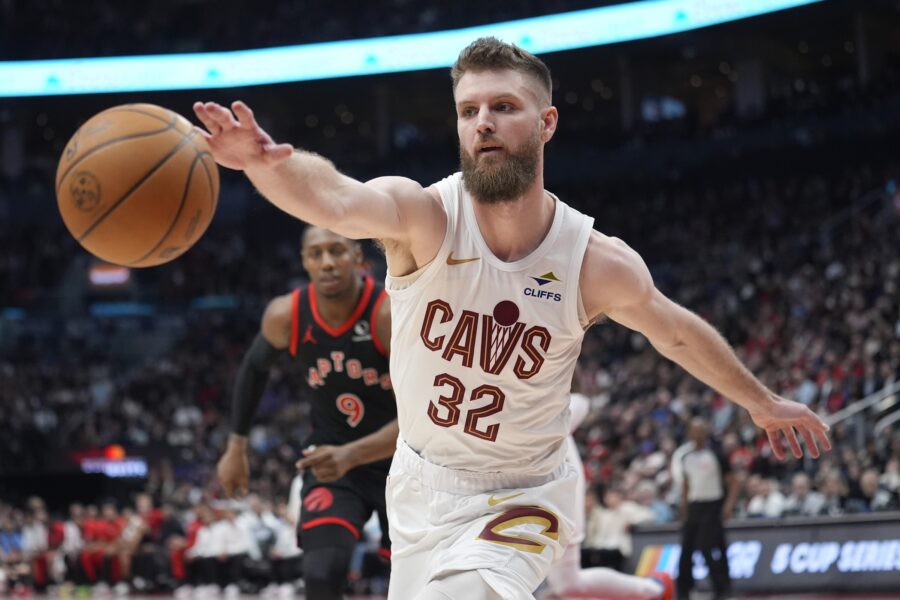
Free agency begins at 5 p.m. CT today, and Dean Wade remains unsigned—a rare position for a complementary wing that Cleveland has long coveted. The Cavaliers are still in "ongoing negotiations and dialogue" with Wade, per Chris Fedor of Cleveland.com, but the crux isn't sentiment. It's arithmetic. Cleveland is fighting to stay under the second tax apron after flirting with it last season, and retaining Wade at his market rate may force a hard decision: shed salary elsewhere or let him test the open market.
Wade's value in today's NBA is straightforward. He spaces the floor credibly (38% from three last season), plays stout perimeter defense, and orbits the weak side without demanding usage. Those skills fit seamlessly into Cleveland's offense, which centers on Donovan Mitchell's driving and Evan Mobley's interior gravity. In a market where wings who defend and shoot are permanent sellers, Wade should command multiple suitors if he opens talks freely—likely in the $6-10 million annual range depending on term. The Cavaliers' hesitation is not about whether Wade can return. It's about whether they can afford him while maintaining their salary flexibility.
The timing of this impasse matters because it bleeds into the Cavaliers' broader roster construction. Cleveland has already built a deep, balanced rotation; adding Wade on reasonable terms strengthens their Finals probability. But the second tax apron is punitive—teams lose flexibility, trade optionality, and mid-season maneuvering room. If Wade signs elsewhere today at his market value and the Cavaliers pivot toward a different mid-priced signing, their depth shifts. If Cleveland relents and pays the second apron penalty to keep Wade, their future options narrow. Neither outcome is catastrophic, but both carry opportunity cost.
From a prop perspective, Wade's potential departure carries implications for Cleveland's offensive distribution. Mitchell's assist rate and shot diet won't change materially, but role-player three-point attempts may scatter across a replacement wing or converted forward. If Wade stays, his minutes and three-point volume remain stable—around 30-32 minutes per game and 2.1 threes per night based on recent seasons. If he leaves, Cleveland becomes less predictable in its perimeter shot-generation, and bench wing scoring becomes a volatility variable. This is not a headline-level edge because it depends on the outcome of today's negotiations, but it's worth monitoring once Wade's destination is known. Backing Cleveland's three-point total carries mild caution if Wade departs; it stabilizes if he returns.