Game 5 Inflection: Wembanyama's Dominance Resets Spurs-Thunder Series Math
By Justin Erickson ·
Victor Wembanyama's 33-point explosion in San Antonio's Game 4 win has flipped the Western Conference finals into a coinflip, and the historical precedent for Game 5 winners is too stark to ignore.
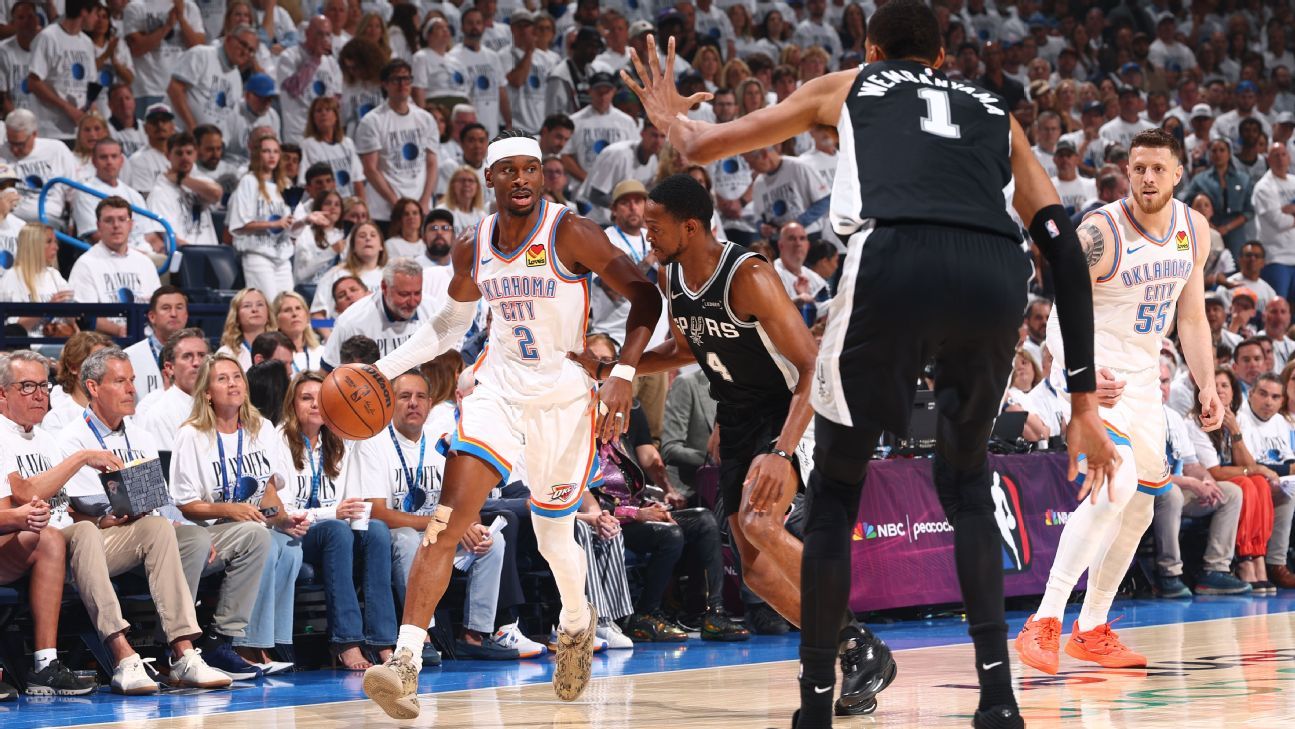
The series is tied 2-2. San Antonio's 103-82 demolition of Oklahoma City on Sunday was a complete recalibration—Wembanyama posted 33 points, eight rebounds, and five assists, a performance that placed him in rare historical company (Bill Walton, 1977) for postseason output in a player's first playoff run. Oklahoma City managed its lowest scoring output since December 2021, a season-spanning drought that signals more than random variance. Shai Gilgeous-Alexander, the back-to-back MVP, managed just 19 points on 6-of-15 shooting, snapping nine straight road playoff games with 20-plus points. The Thunder didn't simply lose Game 4—they misfired across the roster, a signal that the Spurs' perimeter intensity and interior presence created genuine execution problems.
The mechanics of Game 4's blowout hinge on Wembanyama's positional versatility. When he's guarding Gilgeous-Alexander in pick-and-roll situations, OKC's most reliable action becomes compromised. Gilgeous-Alexander's scoring relied heavily on mid-range and three-point hunting in Games 1-3; Game 4's defensive assignment forced him into contested looks and fewer touch opportunities in the flow offense. Wembanyama's 7'4" frame also disrupted Oklahoma City's spacing, collapsing drives that typically generate open corner threes. De'Aaron Fox's playmaking, highlighted in recent coverage as the Spurs' stabilizing force in these playoffs, creates secondary motion that keeps the ball moving away from OKC's shot-making rhythm.
But here's where the narrative gets sharper: Game 5 is historically the series inflection point. Teams winning Game 5 in a tied 2-2 series have advanced 82% of the time (198-44), a meta-pattern that transcends single-game noise. The Spurs already demonstrated this in their semifinals matchup against Minnesota, winning Game 5 before closing out the series. The Thunder, however, are still the higher-seeded, higher-talent roster on paper. Gilgeous-Alexander's scoring regression is the single weakest data point in his season; his true talent remains elite, and a 19-point game is an outlier that markets will price as revertible. Oklahoma City's bench and guard depth remain superior to San Antonio's on a per-minute basis.
The prop implication centers on two competing forces: Wembanyama's points and assists lines face upward adjustment in the market because Game 4 was dominant, yet the Thunder's Game 5 spot situationally favors a corrective performance from Gilgeous-Alexander. If oddsmakers have moved Wembanyama's points line to 28-30 based on the 33-point explosion, that's a recency bump without a mechanism. His Game 4 output was driven by specific defensive matchups and OKC's offensive collapse—conditions that can repeat but aren't guaranteed. Conversely, Gilgeous-Alexander at higher-than-normal lines (if books have dropped him below 22 points after his Game 4 dud) represents value because his role hasn't fundamentally changed; Game 4 was execution-based underperformance in a single contest, not a shift in role or usage. The Spurs' interior defense remains stout, but the Thunder have correctable offensive spacing issues that don't persist across every game.
Game 5 also carries the 82% historical weight—teams that win Game 5 in a series tied 2-2 don't just eke out the next game, they often advance cleanly. That gravitational pull doesn't move point totals directly, but it should inform which side of Gilgeous-Alexander's line offers the sharper value. A rebound game from him (22-26 points) is more probable than his continued 19-point performances, and the market's adjustment to Game 4 may have overshot the downside.