Kuminga-Cavaliers Deal Hinges on Sign-and-Trade Math; Harden's Offseason Hangs in the Balance
By Justin Erickson ·
Cleveland's pursuit of Jonathan Kuminga after LeBron's departure to Philadelphia reveals a hard salary-cap constraint that could determine whether James Harden stays in wine and gold.
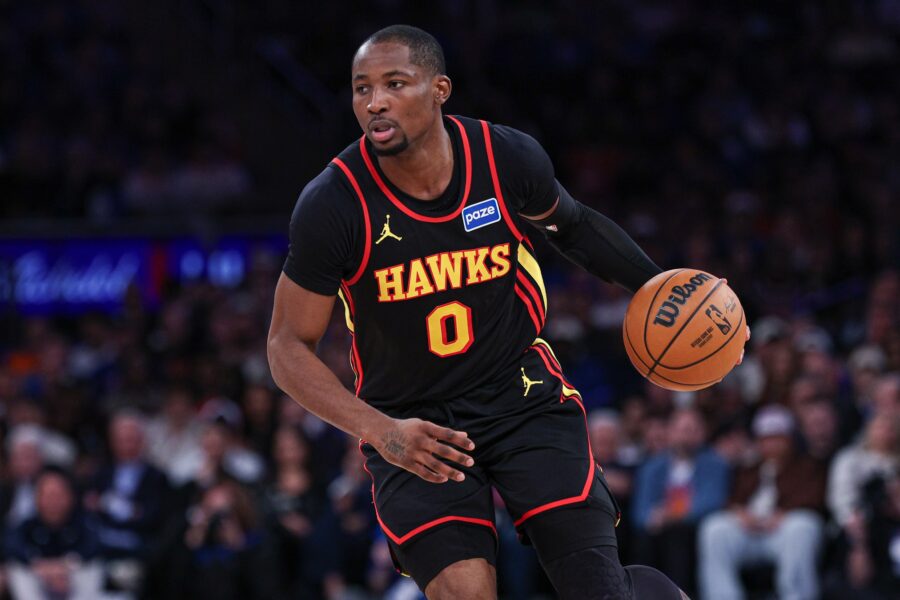
The Cavaliers and Jonathan Kuminga have mutual interest in a reunion, per sources speaking to The Athletic, setting up a July free agency subplot with real implications for how Cleveland shapes its championship roster. Kuminga, 23, declined the Hawks' $24.3MM qualifying offer in June and is now exploring his options on the open market. Cleveland has been in active communication with the forward and his agent throughout the window, and both sides see alignment: Kuminga respects coach Kenny Atkinson from their shared time in Golden State, Donovan Mitchell has endorsed him, and Kuminga himself trained in Cleveland during last offseason and views the market favorably.
The mechanics, though, create a ceiling. The Cavs currently sit $25.3MM beneath the first tax apron and roughly $38MM below the second. Using the taxpayer mid-level exception—a $6.1MM starting salary that hard-caps the club at the second apron—Cleveland could acquire Kuminga while preserving enough flexibility to retain James Harden on a competitive deal. Any offer exceeding that MLE threshold automatically hard-caps the team at the first apron, a constraint that would force cost-cutting moves and likely price Harden out of a re-signing. That's the arithmetic Cleveland is fighting: Kuminga wants $20-23MM annually on a sign-and-trade, well above the MLE floor.
The path forward requires Atlanta's cooperation. The Hawks declined Kuminga's option precisely because they're open to deals, and Cleveland's potential trade package (linked to Max Strus and Dennis Schröder) is believed more palatable to Atlanta than Los Angeles' earlier proposals. But the Hawks also haven't ruled out a short-term reunion with Kuminga themselves, introducing competitive tension. The Lakers remain in the mix as well, though they've been less creative in their sign-and-trade scenarios.
For prop players, this situation matters most for how the Cavs will deploy roster ballast around Mitchell and their big three if Kuminga lands. Strus and Schröder are ball-movers and spacing threats; losing either one would shift assist distribution and three-point volume within Cleveland's core. If Harden departs (the worst-case outcome for the Cavs' championship window), Kuminga's role expands into primary playmaking and shot creation on nights when Mitchell rests. A sign-and-trade that clears salary room keeps the Cavs in contention for bench depth, which suppresses Mitchell's assist volatility and keeps his scoring load predictable. Conversely, if Kuminga falls through and the Cavs can't retain Harden on reasonable terms, Mitchell's assist and scoring props become more volatile because secondary creators evaporate.
The betting angle is timing-dependent: monitor whether Kuminga lands in Cleveland, Atlanta, or Los Angeles in the coming days. If Cleveland acquires him via sign-and-trade without surrendering Harden, Mitchell's assists and team totals stabilize at reasonable outs because spacing and secondary playmaking are intact. That's a fade volatility on Mitchell's assist line for the 2026-27 season. If the deal breaks down and Harden leaves, Mitchell's workload balloons unpredictably—a lean over on his scoring and assists through October until the Cavs' true backcourt shakes out. The sign-and-trade outcome, not just Kuminga's arrival, is what moves the betting model.