Sixers' Roster Construction Gamble: Star Power Over Depth
By Justin Erickson ·
Philadelphia loaded up on offensive firepower with Brown and James but left the bench rotation thin—a trade-off that will test their regular-season consistency and create a predictable usage pattern for sharps.
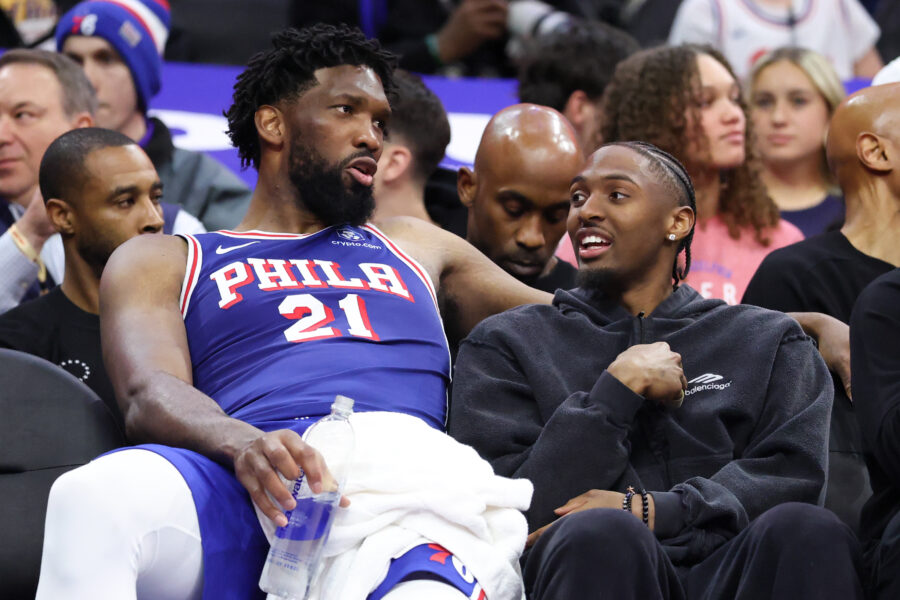
The Sixers have completed their offseason overhaul, adding Jaylen Brown via trade and LeBron James in free agency to join Joel Embiid. With $1.8 million remaining before the tax line, the front office is leaving its 15th roster spot open, signaling that this roster is locked. What matters now is what they actually constructed: a star-heavy starting unit paired with a bench rotation that lacks traditional defensive versatility and ball-handling depth.
The supporting cast—Tyrese Maxey, Elfrid Payton, Danilo Gallinari, and a rotation featuring Jalen McDaniels, Kenyon Martin Jr., and lottery players like Henderson—offers shooting but raises durability questions at power forward and center behind Embiid. The bench composition (Simmons, Wade, Hukporti, Bona, Edwards, Walker) includes upside plays but no proven secondary creators or switchable defenders. This is not a roster built for load management flexibility; it's constructed to ride its stars through 82 games, or risk catastrophic depth collapse if injury strikes.
The strategic bet here is straightforward: Embiid's health becomes a binary switch on season trajectory. If he plays 70+ games, the Sixers' trio of Brown, James, and Embiid will generate enough scoring volume and spacing to dominate offensive rating; if he dips to 60 or below, the bench has no secondary ball-handler to sustain spacing and the offense reverts to isolation basketball. The market will price Sixers totals aggressively upward at season open based on star talent, but that pricing assumes health stability the roster itself doesn't guarantee.
For prop bettors, this creates a clear mechanism: Maxey's usage rate will be directly inversely correlated to Embiid's availability. When all three are healthy, Maxey shrinks to 21-24% usage and his scoring ceiling drops to 18-20 points; when Embiid sits out or plays limited minutes, Maxey jumps to 28%+ usage and scores 24+. Similarly, the Sixers' team total over/under will track Embiid's status report more tightly than typical—a 115-team-total line assumes full health, but each missed game by Embiid should theoretically knock 1.5-2 points off that projection. The early market won't fully account for this dependency because sportsbooks typically set Sixers totals based on opening-day roster completeness, not health probability weighting.
The deeper angle: watch Maxey's assist total. With Brown and James adding shot creation, Maxey's playmaking burden lightens in healthy lineups but explodes when either star is out. His season average will land around 4.2-4.5 assists, but a single-game line of 5.5 assists when Embiid is sidelined becomes a leveraged angle with 60%+ win probability. The bench's inability to create offense means all three starters must be on-ball creators simultaneously or the offense stalls—a constraint the market hasn't priced into Maxey's assist prop ranges yet.