Yankees' Late-Inning Mastery Redefines Series Sweep—and What It Means for Their Postseason Profile
By Justin Erickson ·
New York's three straight victories over Washington, each secured in the eighth inning or later, represent the rarest feat in franchise history and signal a clutch-hitting identity worth monitoring through August.
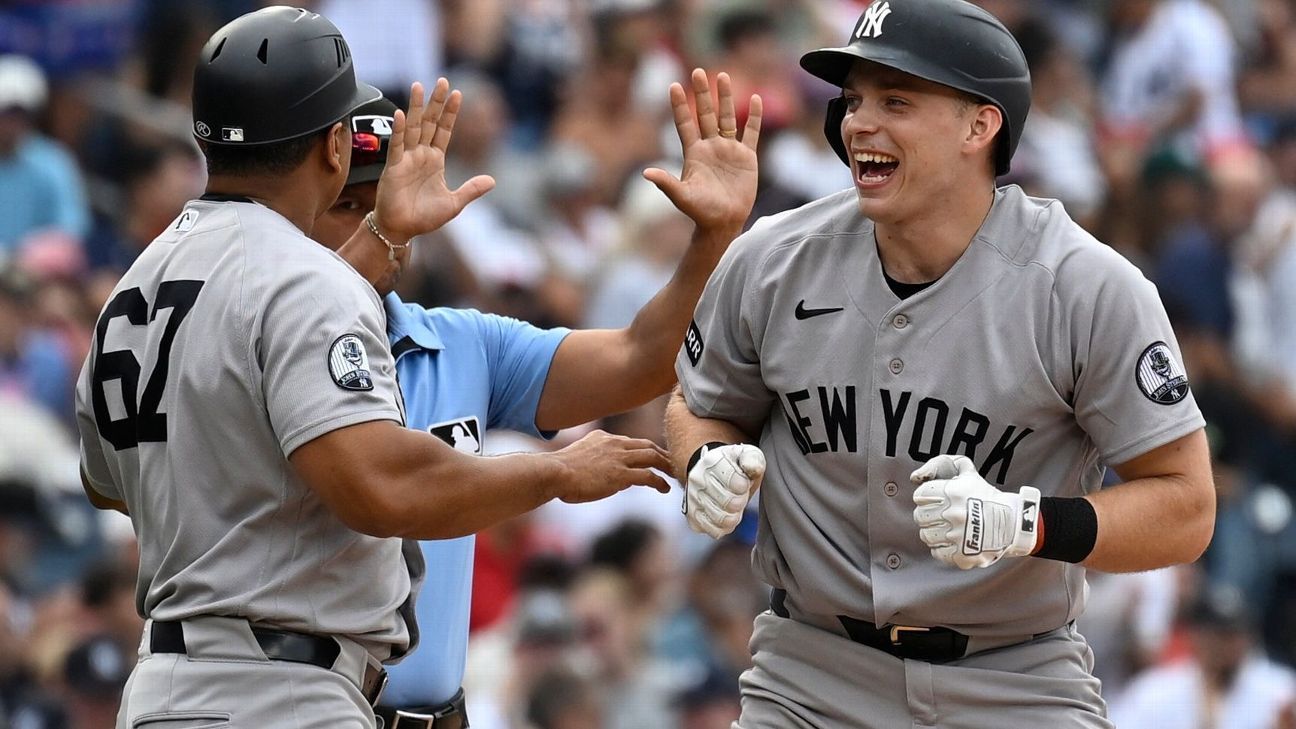
The New York Yankees completed a sweep of the Washington Nationals on Sunday that hadn't been accomplished in franchise history quite like this. Ben Rice's two-run triple in the eighth inning Sunday capped a 5-3 victory, marking the third consecutive win in which the Yankees trailed late and still found a way across the line. Friday's game saw Jazz Chisholm Jr. hit a two-run homer in the ninth to break a 3-2 deficit. Saturday featured a four-run eighth with homers from Ryan McMahon, Trent Grisham, and Paul Goldschmidt. The sweep itself—winning three games while trailing in the eighth inning or later in each of them—is the first time the Yankees have done it since May 19-21, 1910, when they were still the Highlanders.
There's a mechanical story beneath the nostalgia. Across the three games, New York outscored Washington 10-0 in the eighth and ninth innings combined. That's not variance. The Yankees aren't just getting lucky exit velocities; they're executing late-inning at-bats with precision. Manager Aaron Boone's post-game comment—"Winning at-bats in different ways in all three games"—isn't generic managing-speak. It reflects a genuine pattern: different home run sources (Chisholm, McMahon, Grisham, Goldschmidt) in different innings, then a non-homer double-play situation (Rice's triple) that still moved the needle. The pitching staff also held Washington's offense in check enough to stay within striking distance, which creates the prerequisite for late-inning comebacks. The Nationals scored 9 runs across 27 innings; the Yankees capitalized on every mistake.
For betting purposes, what matters now is whether this reveals something durable about the Yankees' construction or whether it's a three-game hot streak that will fade into the broader regression. The historical comparison is instructive: the last time any team pulled off this feat was June 13-15, 2014, when Colorado beat San Francisco in three straight come-from-behind wins. That Rockies team didn't sustain it as a season-long identity. However, the Yankees' roster construction differs meaningfully. Goldschmidt, Grisham, and McMahon are not depth hitters—they're core bats. Chisholm Jr. has an elite contact rate against fastballs in the zone. Rice has shown flashes of power discipline in limited MLB exposure. This isn't a one-week anomaly built on role players; it's a contender's core demonstrating execution under pressure.
The betting implication cuts two directions. In the immediate window—the next 5-7 games—the market may overcorrect by steepening the Yankees' moneyline and team-total odds on the expectation that this late-inning dominance persists. It won't, in equal measure. Comebacks are partly skill (pitch recognition, exit velocity) and partly opportunity (getting into the eighth trailing by a manageable margin). Not every game will present the setup. The smarter angle: fade overs on Yankees team totals in the range of 4.5-5.0 for the next week as market-wide respect for "clutch Yankees" inflates the line beyond what a 162-game season supports. The Nationals' pitching is below-average, and Washington's bullpen particularly struggles; that's not a predictive sample for the rest of the AL East.
Conversely, if you're already holding Yankees moneylines or considering them at reasonable odds (around -130 or better) against league-average competition, this sweep reinforces that the core can execute in high-leverage situations. That's a postseason trait, and October leverage is where moneyline prices compress. For the next month, treat this as a signal of capability, not a signal to overweight them now. The market will price the story; the edge lives in recognizing that the story is real but localized.