Tucker's Breakout Game Masks a Deeper Dodgers Problem
By Justin Erickson ·
One three-hit night doesn't fix a $240 million contract underperforming at a 0.8 WAR pace 83 games into the season.
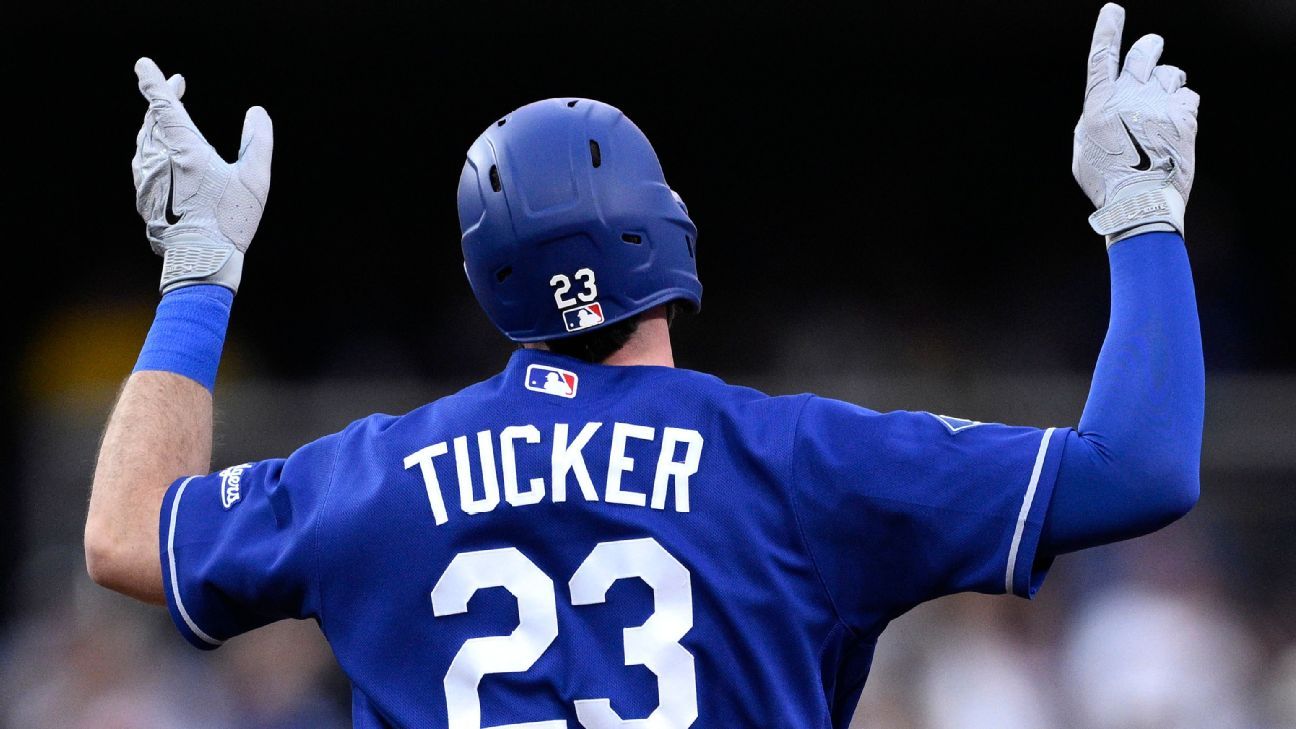
Kyle Tucker went 3-for-6 with a home run Saturday night in the Dodgers' 15-3 rout of the Padres at Petco Park, his fifth three-hit game of the season and a moment of offensive clarity after three months of frustration. But the broader context is what matters for bettors: Tucker is slashing .238/.334/.384 through 83 games, carrying a .719 OPS that ranks 100th among qualified hitters. For a player consuming $55 million in payroll this season, those numbers are not noise. They are the baseline.
Tucker arrived in Los Angeles as a five-tool prospect with a proven track record, yet has generated only 0.8 FanGraphs wins above replacement. The Dodgers moved him from second in the lineup (between Ohtani and Betts) to seventh by Saturday, a demotion that speaks to how thoroughly he has underperformed expectations. Even in his own postgame comments, Tucker acknowledged the mechanics of his struggles—reaching deeper counts, not putting early swings on the barrel—rather than claiming a sudden recalibration. A single three-hit game, no matter how timely, does not reverse a 83-game trend of swing-and-miss and reduced power.
The Dodgers' 53-30 record entering Sunday tells a different story: they are winning despite Tucker's absence from the equation, with Ohtani, Betts, and their rotation (when healthy) shouldering the load. This resilience actually reinforces the underperformance narrative. When your highest-paid new outfielder is a below-average contributor by OPS and WAR, and you are still 53-30, it means the rest of your roster is substantially better than the market initially priced.
For prop bettors, Saturday's game offers a cautionary tale about sample size and recency. Tucker's strikeout rate (he struck out twice in the same game he went 3-for-6) and his sub-.720 OPS suggest that isolated three-hit nights are more likely than sustained improvement at this stage of the season. The market may have already adjusted his over/unders downward after months of underperformance, but any tick back up following a single blowout win is a prime fade. His hit and RBI totals are likely to revert toward the 83-game mean rather than cluster around Saturday's spike. The Dodgers will keep winning, but Tucker will remain a below-replacement-level bat unless the mechanical corrections he described actually translate to multiple weeks of production.