Alcantara's Innings Explosion: How Volume Masquerades as Ace Performance
By Justin Erickson ·
Sandy Alcantara is on pace to throw more innings than any pitcher in baseball by a historic margin, but his per-inning value has deteriorated so sharply that workload alone is masking a fundamental decline.
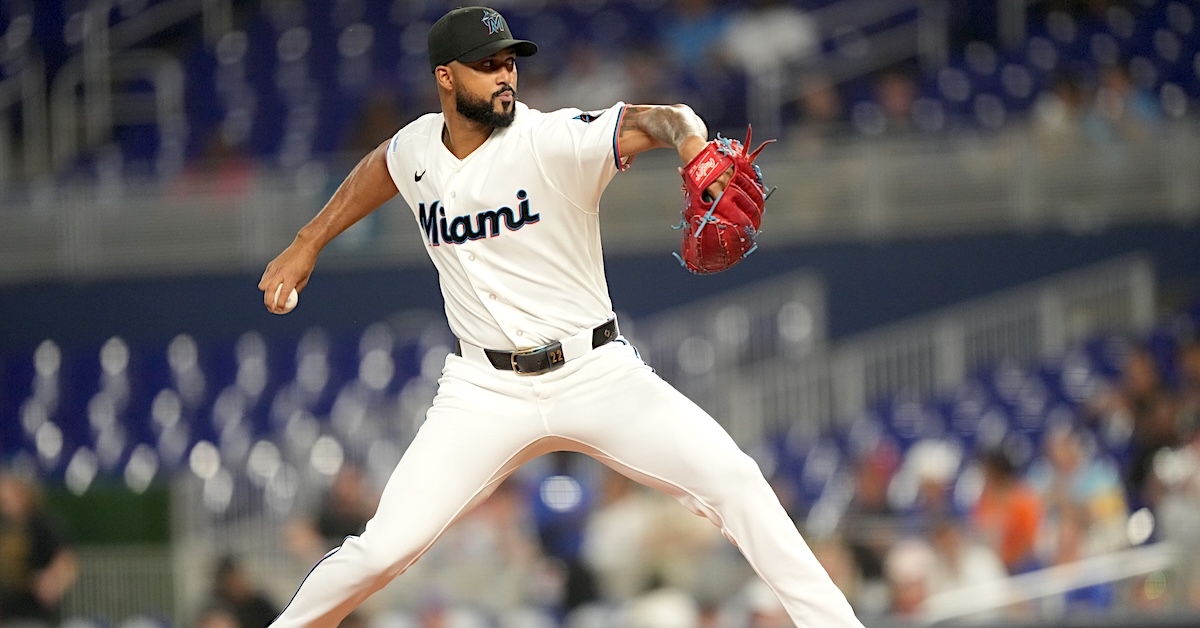
Sandy Alcantara will lead Major League Baseball in innings pitched by the widest margin in years. As of mid-September, the Marlins' right-hander has completed six innings in 26 of his 31 starts—a mark no other qualifier approaches—and he's accumulated 13 seven-inning starts, double the next-closest pitcher. He's posted a 4.01 ERA with xERA and FIP marks in the low 4.00s over his last 21 outings since late May, a span that reveals the actual trajectory of his recovery from elbow surgery: he's not the 2022 Cy Young winner, and the workload numbers mask the mechanics that have shifted beneath them.
The 2022 version of Alcantara operated from a minimalist blueprint—low arm angle, elite changeup, three fastballs at different velos, zero fastball spin gimmicks. That simplicity yielded the second-best ERA in the National League despite a 20th-ranked strikeout rate because his volume (268.2 innings) and contact profile (near-zero homers, 47% groundballs) turned quantity into dominance. This year, Alcantara has rebuilt himself as a different pitcher entirely. He's deployed a seven-pitch arsenal that includes three breaking balls, traded velocity for movement complexity, and watched his strikeout rate crater to 20th in the National League among qualified starters. The Marlins have handed him longer leashes—allowing him to pitch through trouble with a 4.48 ERA in his second look at opposing lineups, compared to a 2.91 ERA the first time through—but that's not a feature. It's a warning flag being misread as patience.
The market has not fully priced the collapse in per-inning quality. Alcantara's 2026 strikeout rate of roughly 7.2 K/9 is nearly two full ticks below his career 9.1 average and sits in the bottom fifth of qualified starters. His velocity decline is real and structural; he's not recapturing the 94-95 mph fastball that paired with his out-of-the-zone movement. The groundball rate has held, but his second-inning vulnerability—.317 wOBA against, 4.48 ERA—suggests the new breaking-ball approach isn't generating the early-count dominance his old changeup provided. When books price Alcantara props on strikeout volume, they're buying the innings guarantee while ignoring the per-inning collapse. That's a mismatch worth exploiting on the short side.
The innings-pitched edge is durable and will persist; the Marlins have shown willingness to stretch him deeper than any other organization, and barring injury, he'll hit 260+ innings by season's close. But strikeout props face a structural headwind that single-game or weekly markets haven't fully adjusted for. A pitcher who completes seven innings 13 times will ring up big strikeout totals in some games simply by accumulation, but his 7.2 K/9 baseline means that strikeout-per-inning value sits roughly 15-20% below the 9.0+ expected from a true ace. Over a 260-inning season, that differential compounds into a material miss. Fading Alcantara strikeout overs in the 5.5-6.5 range—particularly in games where he doesn't start with an obvious velocity advantage—captures the mechanics deterioration that volume disguises.