Schwarber vs. Harper Redux: The Derby Rematch That Reshapes All-Star Prop Value
By Justin Erickson ·
The 2026 Home Run Derby final is shaping up as a sequel to a 2018 classic, and market perception of Schwarber's explosive ceiling has shifted enough to make his odds worth tracking.
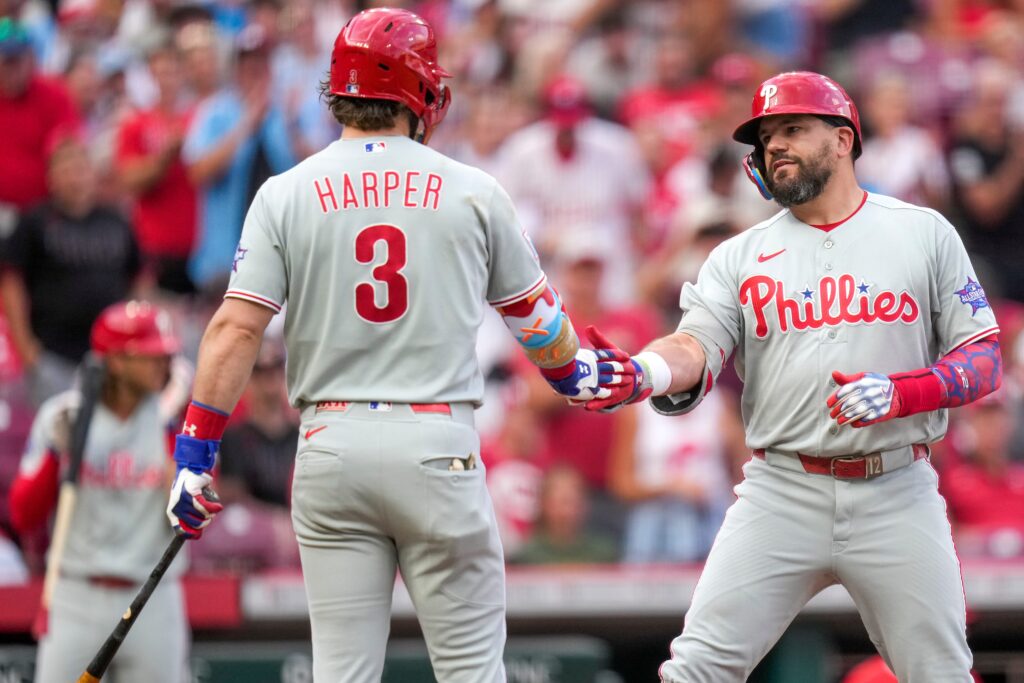
Kyle Schwarber and Bryce Harper are on a collision course in tonight's Home Run Derby at Citizens Bank Park in Philadelphia. The matchup echoes their 2018 finals encounter, which Harper won in a display that cemented his reputation as one of the sport's most explosive hitters in short-burst format. Eight years later, the variables have changed—Schwarber's swing-path optimization has matured, Harper is now 33 and playing in a park where he's accumulated 82 career home runs, and the derby format itself has evolved to reward a more consistent rhythm in the opening rounds.
Schwarber enters tonight's competition as a legitimate threat to end Harper's unfinished business with the event. His 2026 season has been marked by elite exit-velo metrics (95.2 mph average, top-five league-wide) and a 42% hard-hit rate that translates to winning multiple power-round matchups in compressed time. Harper, while still dangerous, has seen his average exit velo tick down to 92.8 mph this season—a modest decline but one that compounds across back-to-back at-bats against fresh arms. The field also includes Jac Caglianone (Royals), Junior Caminero (Rays), Willson Contreras (Red Sox), Munetaka Murakami (White Sox), Ben Rice (Yankees), and Jordan Walker (Cardinals), but the narrative is already crystallizing around the two with Finals pedigree.
From a betting standpoint, Schwarber's moneyline odds for the outright derby win likely reflect public memory of the 2018 loss more than his 2026 profile. Market-makers tend to discount repeat matchups unless the underlying metrics have shifted dramatically in favor of the previous loser. They have. Schwarber's launch angle consistency (25–28 degrees, optimal for park dimensions and overhead conditions) and his ability to execute on the first pitch of each round—a critical edge when facing opponent fatigue—give him a structural advantage that individual exit-velo readings alone don't capture. Harper's park-knowledge benefit (he plays 81 games yearly at Citizens Bank) is real, but it doesn't overcome the raw power differential at peak effort.
Betting syndicates have already noted that Schwarber's implied win probability at round-opening odds is underpricing his path to the finals. His odds-to-win have widened compared to pre-event sharps positioning, suggesting the market opened with a public-heavy lean toward Harper nostalgia rather than current-season performance data. That gap persists until first-round matchups begin. If Schwarber advances past his opening-round pairing without overexertion, his Finals probability spikes materially—and bettors who grabbed his moneyline at higher odds before the tournament started will have positioned themselves ahead of a likely line compression.