Hassell's Demotion Signals End of Juan Soto Trade Window—and a Deeper Nationals Problem
By Justin Erickson ·
Robert Hassell III's assignment to Triple-A Rochester marks the clearest admission yet that Washington's outfield construction has failed, and it reshapes the offensive math for the rest of the season.
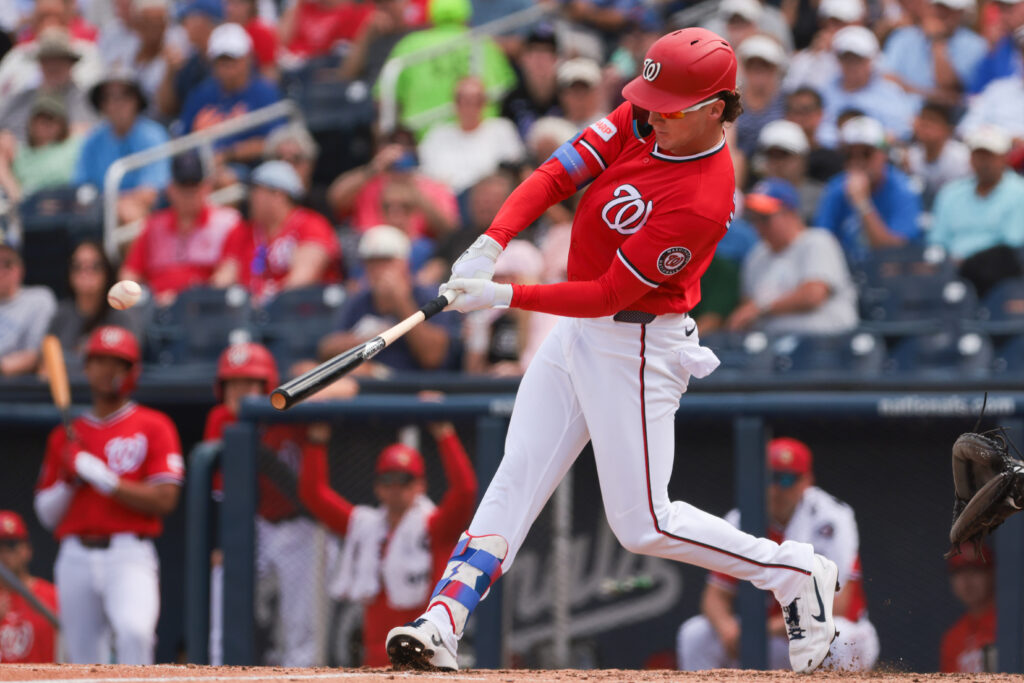
The Nationals announced Sunday that outfielder Robert Hassell III cleared waivers and has been outrighted to Triple-A Rochester. As a sub-one-year service-time player with no prior outright assignments, Hassell had no choice but to accept. The 24-year-old, who turns 25 next month, was the centerpiece of Washington's return when San Diego dealt Juan Soto to the Mets last offseason—a trade that was supposed to inject prospect capital and future production into the franchise. Instead, it has become a monument to organizational miscalculation.
Hassell arrived in the majors with pedigree: a first-round pick, an upper-minors performer graded as a legitimate top-100 prospect. The Nationals envisioned him as a productive corner outfielder with speed-power tools that could stabilize left field for the next half-decade. Through mid-July, he has hit .214 with a .647 OPS over 86 plate appearances in 2026. Power has been absent. Contact has been a problem. There is no sugar-coating the gap between the prospect projection and the big-league reality. When a team outrights a player with his profile barely two seasons into his tenure, the front office is conceding not just that the player underperformed, but that the architecture of the deal itself was flawed.
What matters for the Nationals' betting profile is that this move clarifies their offensive ceiling for the remainder of the season. Hassell was nominally in the lineup most days; his benching or outright removal means Washington will cycle younger prospects or veteran depth pieces into left field. Neither cohort carries the offensive tier that Hassell was supposed to provide. The Nationals entered July already struggling to generate consistent run production—a team total in the low-to-mid 3.8 range was justified by their 3.76 runs per game average through early July. With Hassell off the roster, that production floor dips. Opposing pitchers no longer have to account for even a possibility of an elevated-exit-velo threat in the middle of the order; the lineup becomes more uniform in its reliance on a small core of established hitters. Teams that lose offensive optionality, even when that option has underperformed, lose lineup flexibility and tend to underperform in close games where late-inning run creation becomes critical.
For prop bettors, the immediate implication is directional: Washington's team totals over the next 3-4 weeks should be approached with caution until the team clarifies who replaces Hassell in regular play. Unders on Nationals game totals carry less variance risk than overs, and any day-to-day lineup uncertainty (which always accompanies outright reassignments) adds friction to scoring projection models. If Hassell's replacement is a prospect still acclimating to big-league velocity, expect lower contact rates and wider swing-and-miss profiles—precisely the conditions that compress run totals. The Soto trade, sold to Washington fans as a retooling opportunity, has instead become a pressure valve release. Hassell's exit accelerates the timeline to a full-scale rebuild.