MLB · milestone
Nationals' Power Surge Pressures Unders as Littell Steadies the Rotation
Washington's second consecutive six-run performance in Arizona signals sustained offensive momentum that challenges traditional betting lines.
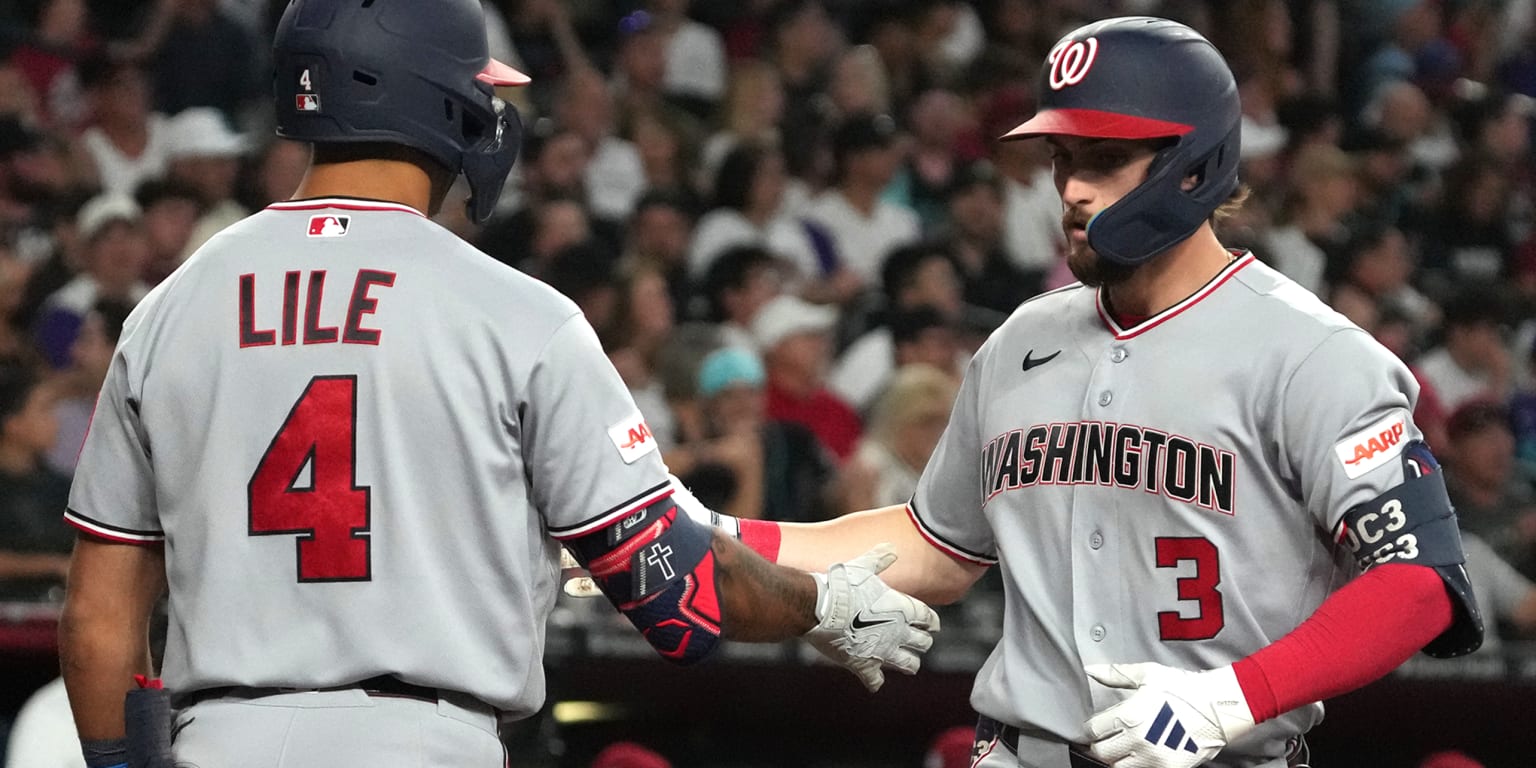
The Nationals backed Zack Littell's season turnaround with six runs on Saturday afternoon at Chase Field, extending a power display that had already produced four home runs in Friday's series opener. Curtis Mead's early two-run shot—a 411-foot exit at 104.3 mph—gave Littell the lead before he needed it. Dylan Crews followed with a personal-distance record, driving a first-pitch fastball 432 feet to left-center, extending his homer distance to the farthest of his career.
What matters here is pattern, not noise. The Nationals don't hit four homers one night and six runs the next as a coincidence. This is a team that has arrived at peak offensive efficiency—second consecutive game with multiple home runs, early-inning scoring (both games featured two-run shots in the second), and clean swings against Colorado-quality fastballs. Littell's contribution is equally significant: four hitless innings with an early cushion allowed him to pitch without stress, a luxury that historically props up ERA and K-rate for rotation anchors recovering from poor stretches.
The market is likely pricing the Nationals' run production as volatile—a hot streak that corrects within days—rather than as the output of a lineup that has developed into a consistent scoring engine. The two-game sample against Arizona provides useful texture: they're hunting early fastballs and converting them to distance. That's repeatable. Littell's ability to benefit from an offense that scores early and often is also repeatable, especially if the rotation depth holds.
For betting purposes, the key mechanical shift is the team-total threshold. A Nationals offense that can produce 6 runs on consecutive nights—and do so without relying on bunched baserunning or late-inning miracles—begins to shift the under/over needle on games where their implied total sits at 4.0 to 4.5 runs. The under becomes a fade, not a lean, when the opponent also fields a middle-tier rotation (as Arizona does) or below. Even against stronger pitching, the consistency of early-inning two-run production reduces variance in the tail of the distribution. The 6-1 scoreline Saturday wasn't a outlier eruption; it was the outcome of a team executing a repeatable offensive strategy.
Littell's role in this also merits attention for pitching props. A starter who receives a two-run lead by the second inning and pitches into the fifth without yielding damage is a candidate for elevated strikeout volume in subsequent starts, assuming the offense performs similarly. Littell's workload and confidence level both expand when he doesn't have to pitch from behind. The Nationals' consistency over these two games raises the floor for his next outing's K prop.
MLB Intelligence — Baseball intelligence beyond the box score. Open MLB Intelligence →