Guerrero's Exit Velocity Crater Rewrites Blue Jays Power Projections
By Justin Erickson ·
A 1.5 mph year-to-year decline in hard-hit ability signals something systemic—and it's depressing Blue Jays power output when they need it most.
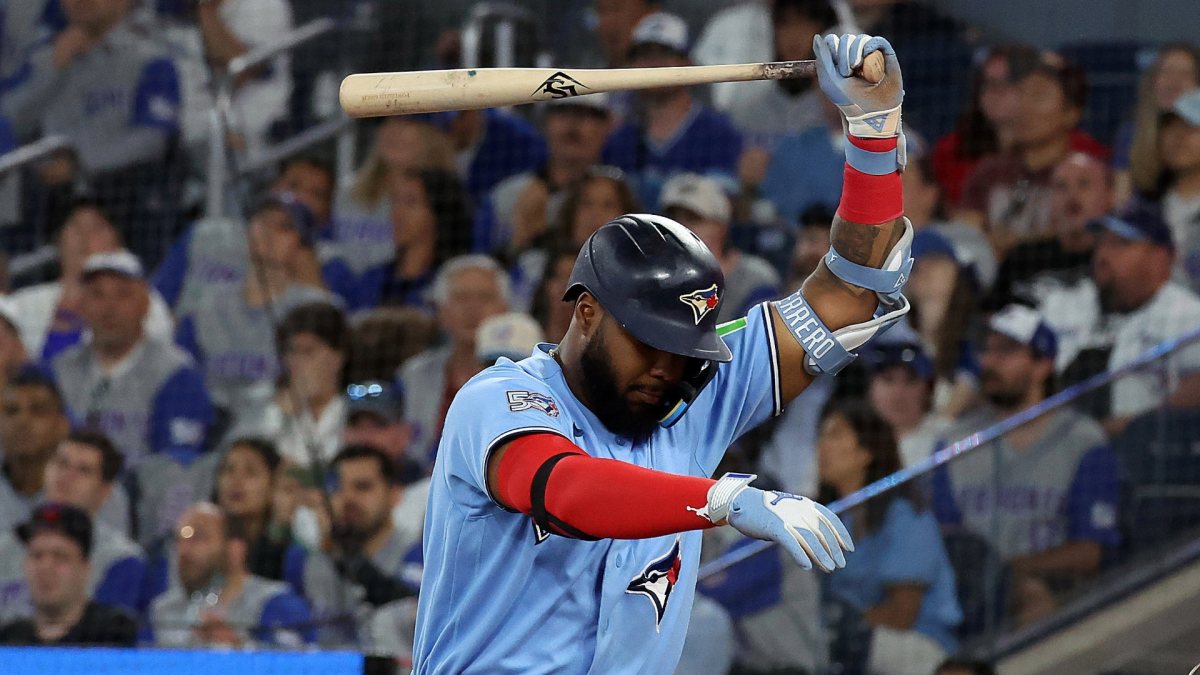
Vladimir Guerrero Jr. has hit three home runs in 66 games this season. Three. As we approach the June 24 All-Star break, the Blue Jays' franchise centerpiece—the $500 million man in Year 1 of a 14-year extension—is operating at a level of offensive dysfunction that demands examination beyond the surface-level narrative of slump.
The raw data tells a story of structural deterioration. Guerrero's average exit velocity has fallen to 90.4 mph, down from 93.8 mph in 2024 and 92.0 mph in 2025. His 90th percentile exit velocity sits at 108.7 mph, the weakest mark in that window. More damaging: his sweet-spot rate—the percentage of batted balls hit at optimal launch angles (8-32 degrees)—has collapsed to 29.5%, a full 5.6 percentage points below the league average. Meanwhile, ground-ball rate has inflated to 49.5%, the highest of his career. The math is clean: solid contact at deteriorating angles plus more earth-bound contact equals vanished power. This isn't a random dry spell. This is a mechanical regression wearing a 27-year-old's uniform.
What's driving it? The back issue that caused him to miss games last weekend is the most obvious culprit, but the hitting-on-the-ground trend predates that setback by weeks. Recent footage suggests Guerrero is chasing pitches at elevated rates, a tell-tale sign of a hitter pressing when results disappear. A player known for ground-ball production his entire career—even in his MVP-caliber years—has somehow found ways to hit even more grounders. That combination, compounded by a noted uptick in chase rate, paints a portrait of a player pressing through mechanical inefficiency, not just battling through minor injury.
For bettors, the implication is severe and durable. Guerrero's home-run line (currently sitting in the 0.5–1.5 range across books depending on opponent) has been structurally underpriced all season because the market assumed regression-to-mean power output. Instead, we're witnessing something closer to a mechanical departure. His sweet-spot rate isn't tracking toward a 33% league average; it's persisting below 30%. That means his HR prop—both single-game and multi-game rolling—should remain faded regardless of matchup or venue until we see a measurable uptick in either exit velocity or launch-angle distribution. The back issue may resolve in a week. The swing mechanics may take longer.
Toronto's power-dependent lineup cannot afford a full-season dead-arm from its anchor. If Guerrero's exit velo stays below 91 mph through July, the Blue Jays' postseason odds should compress by 3-5 percentage points. Books haven't fully priced that scenario. His under on home-run props is the highest-conviction fade on Toronto's roster for the next 14 days, minimum.