McLean's Command Collapse Signals Deeper Trouble for Sinking Mets Rotation
By Justin Erickson ·
Nolan McLean has abandoned the control that made him a prospect in just nine starts, and the Mets' inability to stabilize their youngest starter mirrors their larger structural decay.
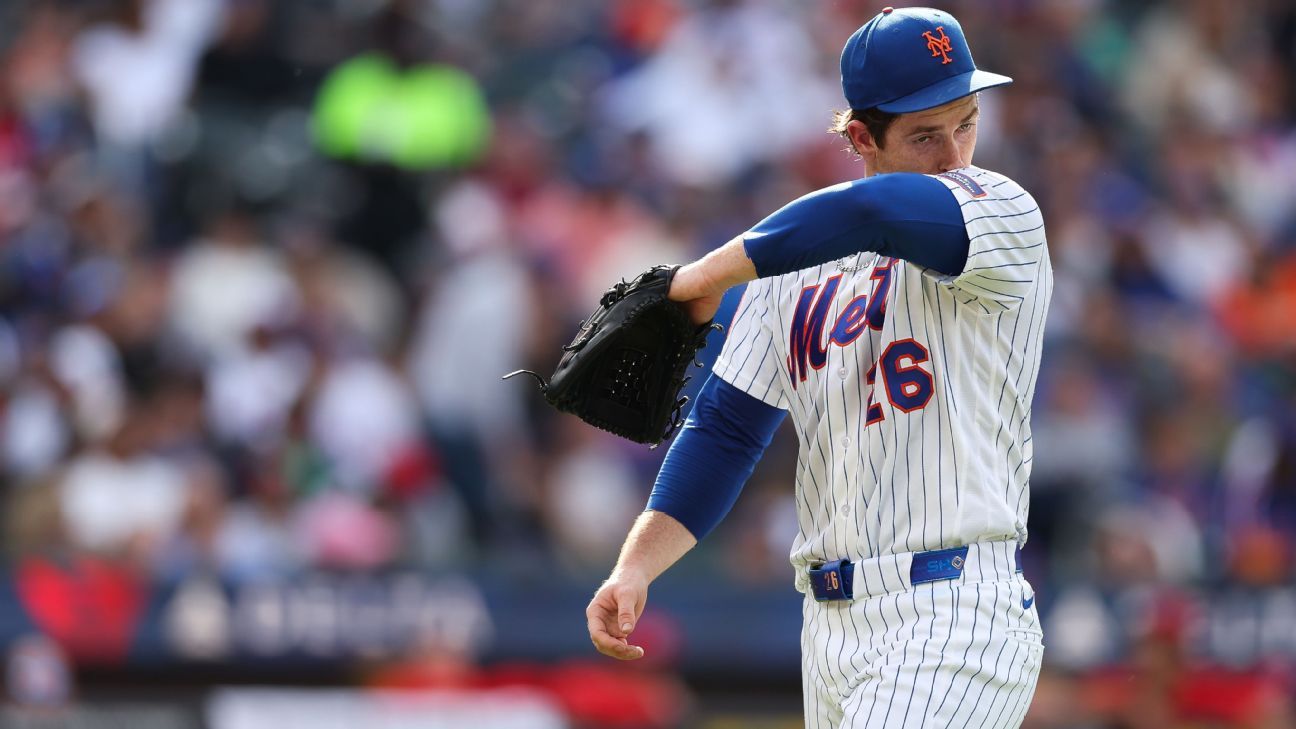
The Mets' rotation unraveled Monday in Cincinnati. Nolan McLean, the 24-year-old right-hander who arrived in 2025 as a promising young arm after posting a 2.06 ERA over eight starts last August, imploded against the Reds—allowing seven runs in 3⅓ innings, the worst outing of his young career. His ERA ballooned from 2.92 to 4.40 in a single start. New York lost 7-2, its fourth straight defeat, dropping to 22-32 and ten games under .500 with just a third of the season played.
McLean's decline isn't noise. He's 1-4 in his last nine starts, a record that undercuts the velocity and command metrics that first caught scouts' attention. The mechanical breakdown is obvious: he threw just 47 of 78 pitches for strikes Monday, including eight of 23 sweepers. Manager Carlos Mendoza acknowledged the secondary stuff is missing its target. Batters are hitting .296 with runners on versus .166 with the bases empty—a 130-point split that suggests McLean loses composure the moment pressure intensifies. His own explanation—overwork between starts, excessive mound touches leading to fatigue—rings hollow for a pitcher whose job is to execute under load.
More damaging is what this reveals about the Mets' talent evaluation. McLean earned a World Baseball Classic roster spot on the strength of last year's abbreviated sample. The organization bet rotation depth on a teenager running a 2.06 ERA over 47 innings. Nine starts into 2026, that ERA has evaporated, and there's no Plan B. The Mets also lost Tyrone Taylor to injury Monday, piling onto an already crippled roster—Juan Soto missed his second straight game with illness. The team is 60-87 since last June 13, when they were 45-24. That's a 24-month collapse masquerading as a season-long malfunction.
For bettors, McLean's next start becomes a critical tell. The secondary pitches aren't landing for strikes; opposing batters are loading counts early and attacking fastballs. Expect elevated strikeout totals from hitters facing him—not because he's dominant, but because he's predictable under duress. More immediately, any Mets game with McLean on the mound shifts toward the over side of team totals. A pitcher surrendering contact at a .296 clip with runners in scoring position will leak runs, and Cincinnati's 7-run explosion is not an outlier but a baseline expectation. The mechanical issues are fixable in a lab, but mid-season, they're an asset decay signal. Fade confidence in Mets rotation depth for the next four weeks until the organization either corrects the mechanics or turns to alternative arms.
The broader Mets problem—perpetual injury, youth hitting the wall, an inability to stabilize behind star power—won't resolve in a single bullpen session with Mendoza and a video room. This is organizational architecture failing under pressure, one mediocre young pitcher at a time.