Mariners' Deadline Gamble: Kirby's Split Splits the Trade Case
By Justin Erickson ·
George Kirby draws multiple suitors with two days until the deadline, but his home-road split exposes why Seattle may be reluctant to move him.
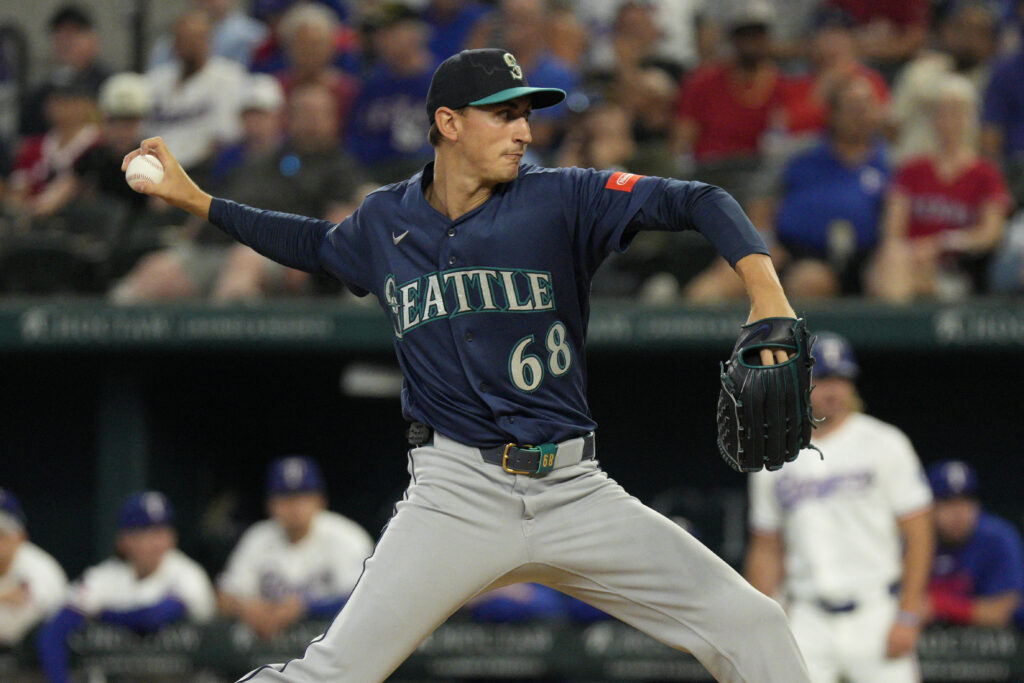
George Kirby is on the market. Multiple teams believe the Mariners' 26-year-old right-hander is available ahead of the Aug. 3 trade deadline, according to ESPN's reporting. For a Seattle rotation anchored by postseason aspirations, shipping out a controllable arm under contract through 2027 would signal either aggressive seller repositioning or a front office convinced the rotation can't carry a playoff push. Neither narrative fits cleanly with where the Mariners stand—middling in the wild-card hunt, not firmly sellers, not bullish buyers either.
But the real tell lives in Kirby's splits. At home in T-Mobile Park, he pitches like a staff ace: 1-2 ERA territory, commanding his fastball and slider against familiar sightlines. On the road, the numbers crater. A 3-4 ERA spread between home and away isn't typical volatility—it's a structural vulnerability that intensifies under trade scrutiny. Any acquiring team would inherit those road numbers as baseline performance, not exception. A contender three days from the deadline can't absorb a mid-tier starter disguised as a front-liner; the cost to pry Kirby loose would demand ace-caliber consistency, not park-dependent results.
This is why a trade remains unlikely despite the noise. Seattle's internal calculus has probably already accounted for the split: Kirby's home dominance carries enough leverage to hold trade value, but not so much that a buyer overpays. The Mariners' reluctance to move him in-season signals they believe the second half belongs to the road-dominant version—a reversion possibility if variance or mechanics align. Randy Arozarena, the other name floated in trade talks, offers cleaner separation from that risk; a corner outfielder moves the needle on immediate contention without the conditional workload questions.
For bettors, this split matters immediately. Kirby's road starts over his next five games carry depressed strikeout totals and elevated walk rates compared to his home-field strikeout lines. Markets pricing his road K props as interchangeable with his home ones are mispricingthe underlying mechanics. If Seattle holds him through the deadline and he pitches on the road, lean unders on his strikeout props; the split is durable, not a small-sample artifact, and reflects the reality that away from T-Mobile Park, his command tightens and his fastball velocity flattens slightly—a recipe for fewer whiffs and more contact.
The deadline passes Sunday night. If Kirby doesn't move, his value as a hold clarifies itself in every road start over the final two months. The market's uncertainty about whether he stays or goes is actually certainty about his true performance band once that uncertainty clears.