Cease's Early Exit Exposes Toronto's Injury Cascade—and a Bullpen in Survival Mode
By Justin Erickson ·
Dylan Cease's hamstring discomfort in the fifth inning adds another arm to Toronto's ER intake; the deeper problem is that the Blue Jays' rotation depth has become a liability, not a reserve asset.
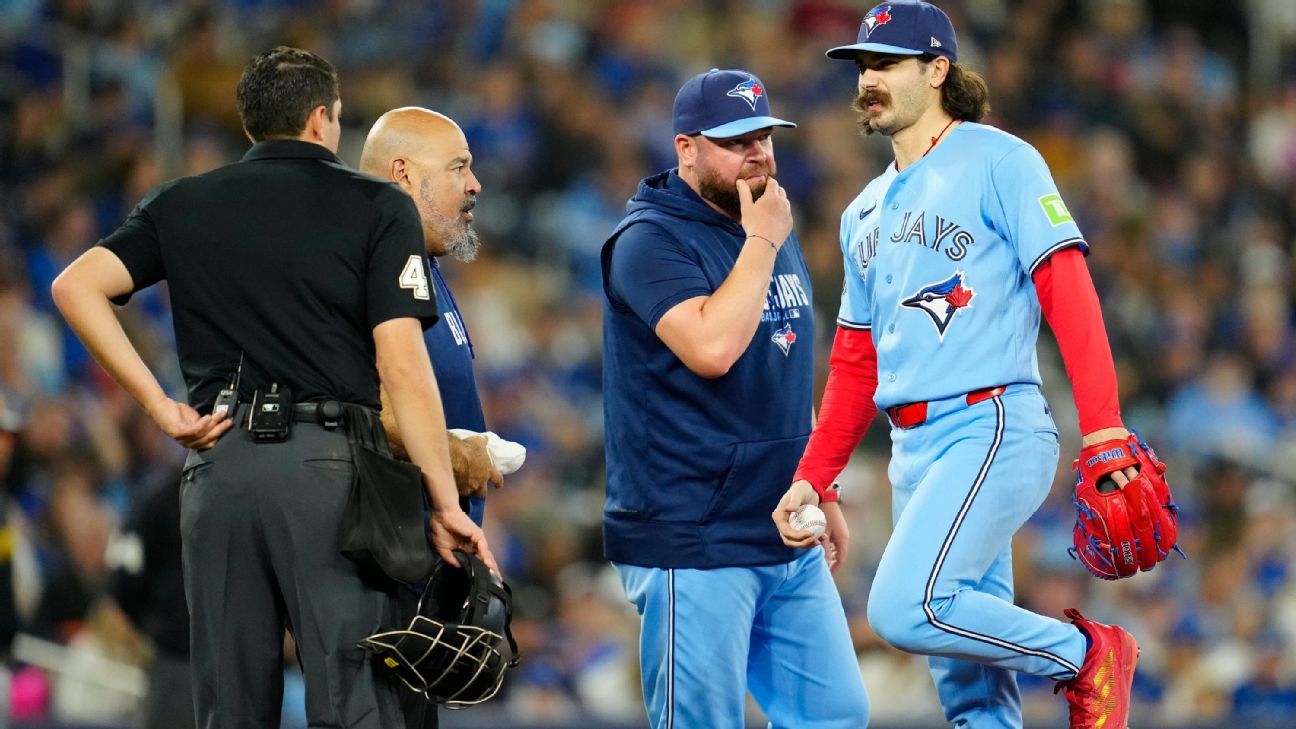
Dylan Cease departed Sunday's game against Pittsburgh in the fifth inning with left hamstring discomfort, continuing a pattern that has hollowed out the Blue Jays' starting rotation. Vladimir Guerrero Jr. also exited after absorbing a pitch to the right elbow—X-rays came back clean, but the casualty itself is immaterial; Toronto now has 13 players on the injured list, with five starting pitchers unavailable. Cease faced Spencer Horwitz after feeling the strain, retired him, and was replaced by Mason Fluharty. He allowed two runs on four hits in 4⅔ innings, with eight strikeouts and one walk. The line stayed competitive despite the early hook.
What's material is Cease's rarity value evaporating in real time. He signed a seven-year, $210 million deal last December—the rotation anchor Toronto needed after years of turnover. Yet he's now failed to complete five innings in two of his last 11 starts. That's a 2% league-wide rate for pitchers with 30+ starts in a season; Cease has achieved it twice. The durability floor is cracking, and the Blue Jays have no margin for error. Bieber (elbow), Berríos (elbow), Francis (elbow), Scherzer (forearm), and Ponce (knee) are all sidelined. The team leaned into Cease as a foundational piece; a hamstring issue that recurs or lingers transforms him from $30 million annual asset into a conditional liability.
The bullpen impact is immediate and sharp. Mason Fluharty is now in line for 2+ innings of work in a mid-May game—not a playoff spot where depth is rationed ruthlessly, but a regular-season Sunday where the Pirates had no particular offensive leverage. Manager John Schneider is forced to burn relief innings at a rate that ballparks suggest inefficient. Over the next 10-14 days, if Cease requires a skipped turn or a ramped re-entry, Toronto's bullpen usage will creep toward exhaustion territory. That doesn't show up in Vegas moneyline movement on Tuesday's game; it shows up in aggregate leverage over a two-week window.
For prop bettors, the angle is structural, not reactionary. Cease's strikeout rates have remained elite—8 K in 4⅔ innings Sunday maintains a pace of 15.4 per nine—but his ability to pitch deep into games is now in question. In contests where the Pirates (or similar weaker offenses) don't jump early, Cease can accumulate strikeouts in shorter bursts, which keeps under-5.5 K props attractive against low-octane lineups. The inverse trap is betting overs on his pitch count or innings pitched; a hamstring nag in May often precedes a cautious management approach, where he pitches 4-5 innings on reduced workload for 2-3 weeks before returning to form. If he takes another turn in Toronto's rotation before the injury is fully cleared, fade any props requiring him to log 6+ innings.
The Guerrero injury, by contrast, is cosmetic. A negative X-ray on an HBP contusion typically means he plays the next day unless swelling spikes overnight. His absence in the game flow doesn't alter his prop trajectory; his baseline run/RBI rates remain pegged to his plate appearance volume. The real cost to Toronto is the pitching depth. In a season where division races tighten, five rotation members on IL is catastrophic. Cease's hamstring becomes the canary; if it requires rest, the Blue Jays pivot to a four-man rotation or promote stretched minor-leaguers. That's when team totals and spread expectations shift.