Schwarber's 66-Homer Pace Masks a Deeper Betting Problem: Early-Season Volatility
By Justin Erickson ·
Kyle Schwarber is tracking toward a historic 66 home runs through May, but 20 homers in 49 games tells us almost nothing about where the finish line actually is.
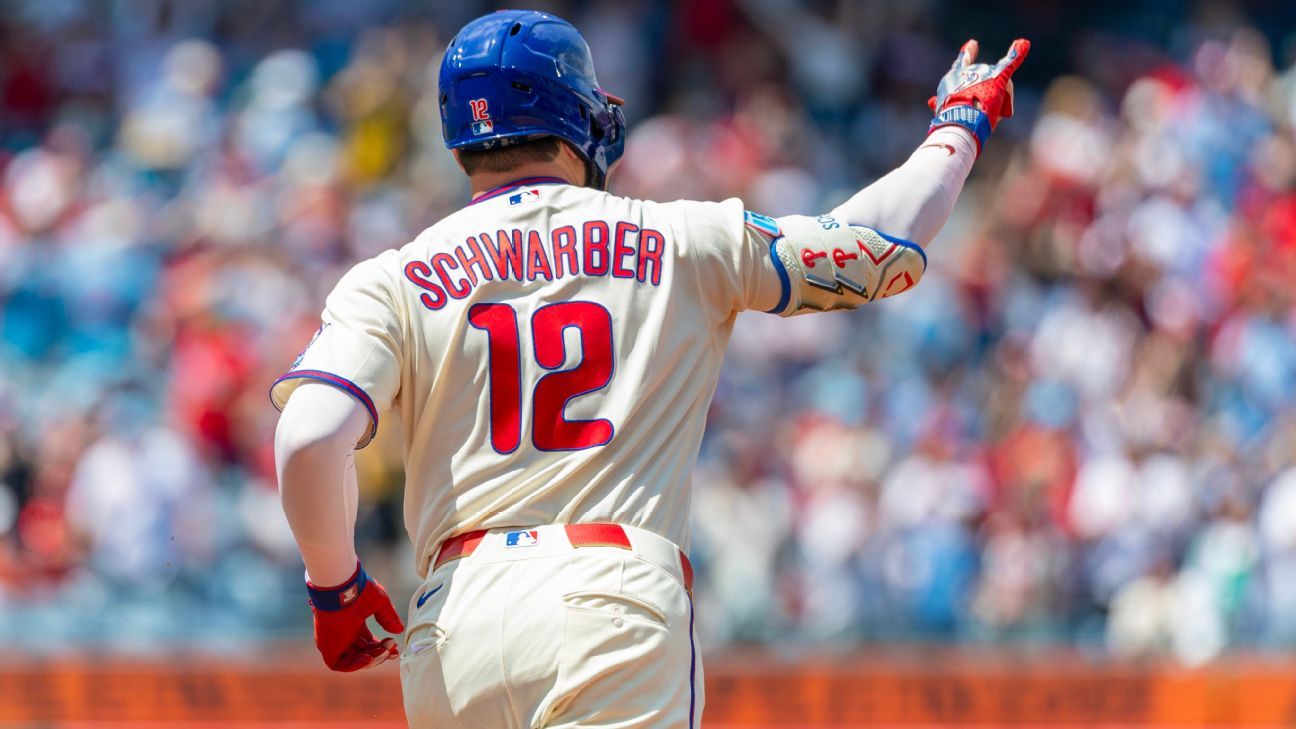
Kyle Schwarber has hit 20 home runs in the Phillies' first 49 games, putting him on pace for 66 on the season. That would rank third all-time, behind Barry Bonds (73) and Mark McGwire (70), and it's the kind of headline that gets bookmakers scrambling to adjust season-long home run props within hours of publication. But here's the problem with annualized pace projections: they collapse the moment a hitter cools off, and baseball's calendar is built for cooling off.
Schwarber is 33 years old. Last season he hit 56 home runs—an elite total that still drew less national attention than Cal Raleigh's march toward 60 and Aaron Judge's AL-record 62. That 56-homer season is the real baseline for what to expect from him over a full year, not a rate built on his best 49 games. The mechanics that produced 20 homers in May will meet pitchers who've adjusted, fatigue that compounds into July, and the simple fact that no hitter sustains a 66-homer pace over 162 games—not in the era of sub-.250 league batting averages and fastballs averaging 94.5 mph.
The Phillies' managerial change to Don Mattingly has coincided with this hot start, which creates a second-order confusion in the market. Better lineup construction and strategic coherence matter, yes. But they don't suspend the laws of variance. Schwarber's first 49 games represent roughly 30% of the season. If he regresses to his recent-season average (he hit 56 in 2025 and 46 in 2024), his pace from May forward would drop to roughly 48–52 homers, not 66. That's still above-average production—well above. But it's also 14–18 homers below the extrapolated headline.
For bettors, the trap is obvious: early-season home run props on Schwarber are priced assuming either that May sustains (it won't) or that the market has already corrected for regression (it hasn't fully, because 66-homer seasons are now culturally normalized by Raleigh, Judge, and Ohtani). If you're looking at a season-long home run total for Schwarber set above 56, you're buying into a pace that only the top 0.5% of hitters maintain. His individual-game home run props and monthly totals should carry higher variance going forward; expect Schwarber to produce 3–4 homers per month from June onward, not the 5+ monthly rate he's running. The sharper angle is to fade overs on his season-long HR line if it's pegged above 56, and to hunt unders on May-to-end projections once the initial pop of news fades and reality reasserts itself.
Schwarber's 207 home runs since joining the Phillies in 2022 are second only to Aaron Judge—that's legitimate staying power in the long ball department. But elite production and unsustainable pace are not the same thing. The market is conflating them right now.