Carroll's Triple Surge Reveals a Speed Asset the Market Still Undervalues
By Justin Erickson ·
Corbin Carroll's eighth triple of the season—paired with elite sprint velocity and a 12-game hitting streak—exposes a pricing gap in his speed-based prop lines.
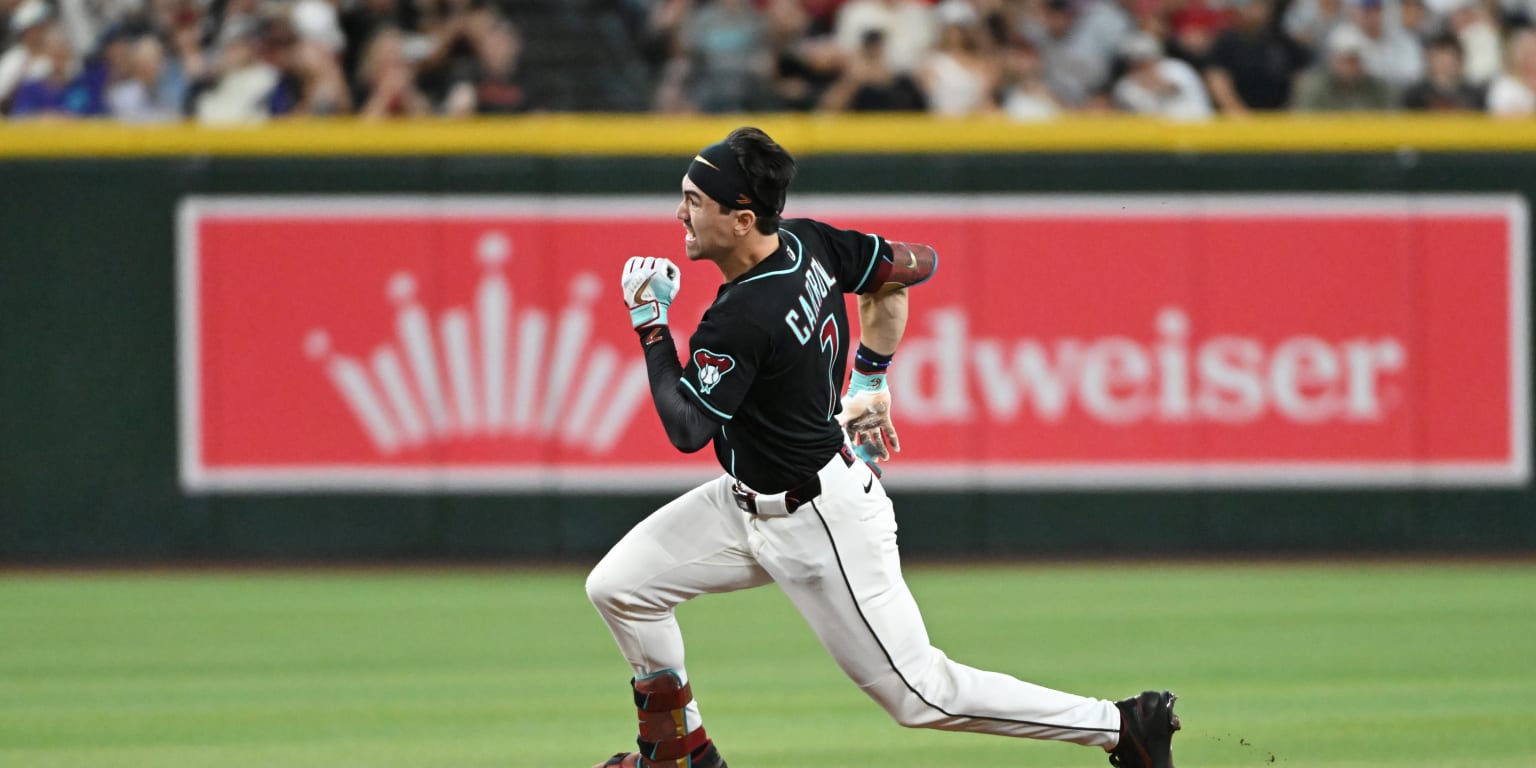
Corbin Carroll went 4-for-4 against Colorado on Sunday, collecting his second triple of the afternoon and his eighth of the season—double the output of any other Major League hitter. The Diamondbacks routed the Rockies 9-1 at Chase Field, marking Arizona's seventh win in eight games and their best home-stand efficiency (18-10) since 2017. But the individual stat line obscures a more actionable pattern: Carroll's speed profile is delivering triples at a rate the market has not yet fully priced into his stolen-base and hit-total props.
The mechanics are concrete. Carroll's two triples on Sunday registered home-to-third sprint times of 11.05 and 11.36 seconds—times that rank third and fourth among all triples hit in MLB this season. He now owns five of the top 13 home-to-third velocities league-wide, a concentration that signals neither variance nor novelty. On the first triple, he turned an out-of-zone breaking ball (108.9 mph exit velo) into a three-bagger, proving he's not chasing speed opportunistically; he's creating it from quality contact. That matters. A hitter who reaches base on balls in play and sprints at elite velocity is generating stolen-base and extra-base opportunities that don't depend on pitcher control or baserunning recklessness.
Carroll's 12-game hitting streak extended into Sunday's first inning. Over that window, he's maintained his league-leading contact rate and sprint speed—a pairing that compounds. The hitting streak keeps him on base; the speed converts singles and errors into extra bases. His eight triples already double the second-place finisher (Chandler Simpson, four), and we're only at the calendar point where most seasons hit the all-star break. At 25 years old and 537 games into his career, Carroll has already reached 50 triples and 80 home runs faster than all but Lou Gehrig (461 games). That trajectory suggests the gap-to-gap power and sprinting velocity aren't cyclical fluke—they're structural.
For prop bettors, the edge surfaces in two spots. First, Carroll's stolen-base line is likely still anchored to pre-season forecasts that didn't account for a hitting streak of this duration or a triple rate this extreme. A hitter who reaches base in 12 consecutive games at a .400+ on-base rate generates more steal opportunities than baseline models assumed. Second, his total-hits prop remains undervalued at standard juice lines because the market weights home-run power over the speed-and-contact combination that actually drives his value. He's not a slugger; he's a table-setter who sprints to first base like he's running down fly balls. The Rockies' porous pitching didn't create Carroll's edge—his speed did. Future opponents won't be as forgiving, but the sprint mechanics don't change.
The franchise context reinforces the durability of this trend. Carroll is now one triple away from Stephen Drew's franchise record (52), which took Drew seven seasons and 2,900 at-bats to accumulate. Carroll will likely approach that mark within the next two seasons, implying an annualized triple rate of 5-6 per 162 games. That's elite and persistent, not a hot streak. Books have started to respect his power ceiling, but they've been slower to adjust the speed and gap-hit angles where his actual advantage lives.