Three Right-Handed Bats Exploit Wednesday's HR Window: Bohm, Langeliers, Mayo
By Justin Erickson ·
A 10-out-of-10 home run index and three favorable platoon matchups create a rare convergence of conditions for Wednesday's home run props.
Wednesday's 15-game MLB slate arrives with atmospheric conditions that sharply favor fly-ball outcomes—the home run index sits at its maximum of 10, meaning borderline exit velocities that would normally die in deep outfield real estate have a realistic chance of leaving the yard. This is the rare day when weather becomes a first-order variable in home run betting, not a secondary consideration.
Three hitters stand out not because they're simply swinging hot bats, but because their spray patterns and pitcher assignments align in specific, measurable ways. Shea Langeliers enters against Angels right-hander Jack Kochanowicz hitting .328 with a .994 OPS against RHP this season, having driven nine of his 12 home runs off right-handed arms. Kochanowicz has bled four home runs in five starts and surrendered 14 earned runs over his last three outings. For Langeliers, the matchup isn't abstract—it's a clean split where he's built equity against the opposing pitcher's arm.
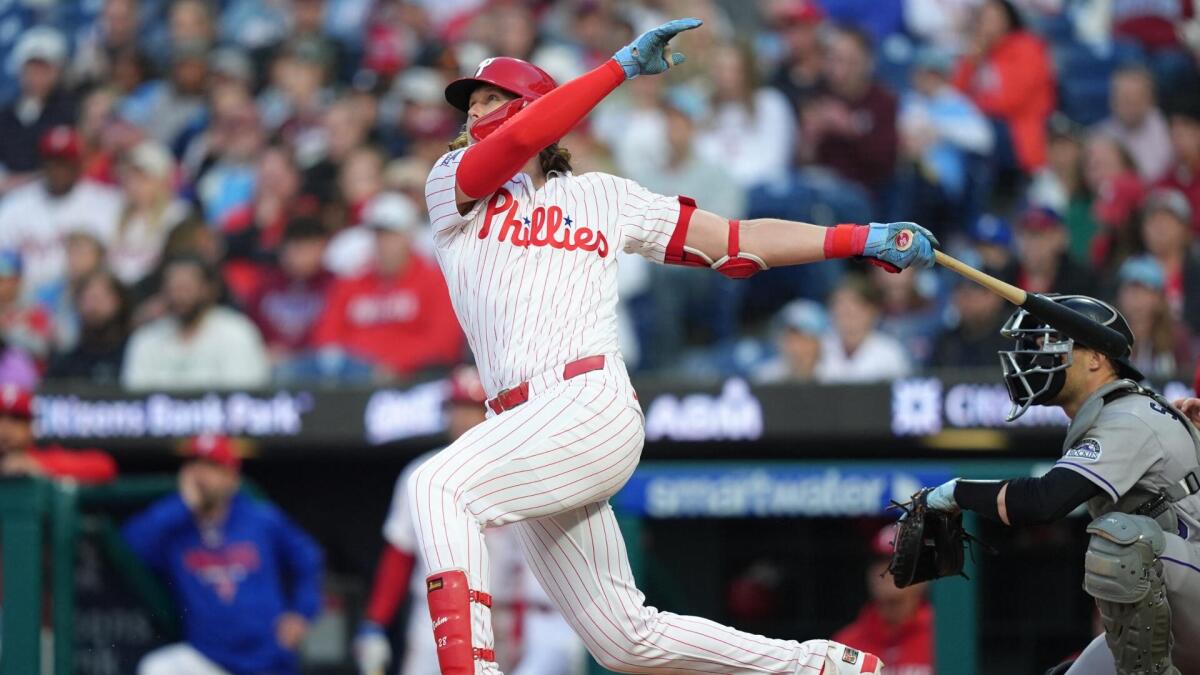
Alec Bohm presents a tighter case. He's 3-for-4 with two extra-base hits career against Reds starter Andrew Abbott, and while Abbott has posted a 0.54 ERA in his last three turns, that efficiency came against a smaller sample and doesn't reflect his vulnerability to right-handed power. Abbott has yielded four of six home runs to RHB. Bohm has also genuinely heated up over his last 10 games, batting .421, which isn't noise—it tracks a sustained offensive run that precedes this specific matchup. The weather multiplier simply increases the probability that his elevated exit velocity translates to distance. Coby Mayo rounds out the slate with an even starker split: .879 OPS against LHP compared to a .453 OPS against RHP, with three of five home runs coming off lefties. Steven Matz has allowed five of six home runs to right-handed batters, making this a direct mismatch favoring Mayo's strength.
The betting angle here hinges on the convergence of three durable inputs: platoon splits that reflect genuine tactical or physical advantages (not single-game variance), pitcher exposure to home runs in their profile, and a weather environment that materially shifts the threshold for a home run from "elite exit velo" to "well-struck line drive." Each of these conditions persists for exactly one day, making the edge time-bound. Markets have priced some of this in—Bohm sits at +820, Mayo at +492—but the 10-out-of-10 home run index is a relatively rare occurrence that squeezes the probability distribution upward across the day. The angle isn't that these hitters will suddenly outperform their baseline; it's that baseline power output becomes a live home run bet when environmental conditions stop filtering out well-struck contact.
A parlay combining all three offers north of 230-to-1 return, which reflects the compounding of three independent events each carrying elevated edge. The risk is obvious: home run props remain binary and high-variance. One called strike at 1-2 with a runner on first and Bohm swings through a fastball, or Langeliers pops up a fastball middle-in, and the entire premise collapses. But the convergence of matchup + form + weather doesn't happen every week. When it does, the line prices don't always adjust fast enough to account for the full weight of the index shift.