Three Home Run Angles for Thursday's 11-Game Slate: Wood's Platoon Edge, Machado's Rebound Window, Hicks' Hot Streak
By Justin Erickson ·
SportsLine's Jacob Fetner identifies three HR props with favorable matchups—none requiring a league-wide correction, all exposing specific pitcher-batter asymmetries.
Thursday's 11-game MLB card delivers three home run propositions with clean mechanical foundations, per SportsLine analyst Jacob Fetner, who posted a 50-unit gain on HR picks last year. The slate spreads across the full day, giving bettors time to verify matchup data before lock—a critical advantage when trading edges built on small samples or recent form swings.
James Wood of the Nationals faces Reds righty Chase Burns, a pairing where the platoon math runs decidedly in Wood's favor. Wood is hitting .257 with a .986 OPS against right-handed pitchers this season, having driven nine of his 12 home runs off RHP arms. Burns has coughed up five of his six surrendered home runs to left-handed batters despite posting a sharp 1.42 ERA over his last three starts. Left-handed hitters are averaging .259 with a .846 OPS against Burns this season. The edge here hinges on Burns' volatility against same-side hitters—he looks sharper in aggregate ERA than he performs in the platoon split, which suggests the market has not fully priced the LHB advantage. At +330, Wood carries the lowest ask of the three plays.
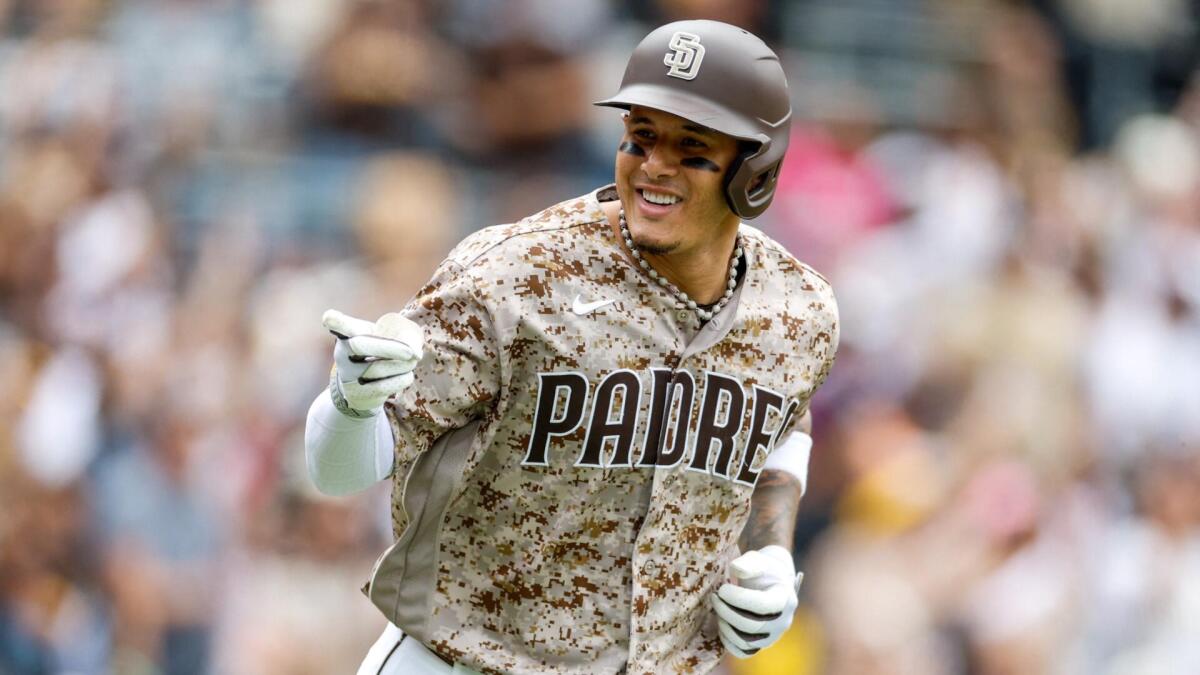
Manny Machado presents a different architecture: a recency fade with a matchup tailwind. The Padres third baseman has stumbled to a .103 average over his last 10 games, the kind of slump that can depress price and create surface-level hesitation. However, his season split against left-handed pitchers is robust—.333 average, 1.032 OPS—and he draws Brewers southpaw Kyle Harrison on Thursday. Small sample noise intrudes: Machado is 1-for-8 career against Harrison, but that single was a home run. The mechanism at work is platoon dominance meeting depressed expectation. If the market has factored his recent cold spell into his +489 odds without fully crediting his reverse-split strength, there is valuation slack. This edge assumes the sportsbook has overweighted recency and underweighted seasonal platoon splits—a common market behavior when a star player enters a visible rut.
Liam Hicks of the Marlins rounds out the card against Reds righty Zebby Matthews, and here the edge runs through two independent signals. Hicks is hitting .311 with a .955 OPS against right-handed pitchers, having homered eight times in nine of his home runs off RHP. He has also accelerated recently, launching four home runs over his last 10 road games—a form spike that suggests late-inning leverage and confidence. Matthews, conversely, has deteriorated sharply: he allowed 15 earned runs in 14⅔ innings over his last three starts, including two home runs, and his career split against left-handed hitters is bleak—.316 average, .908 OPS, a 247-point differential versus right-handed hitters. At +630, Hicks offers the highest odds and the most compressed ceiling, but the compounding of hot recent form, seasonal platoon edge, and pitcher decline makes the risk-reward attractive for bettors hunting parlay value.
All three plays trade on matchup specificity rather than league-wide overvaluation. None requires a macro bet that home run totals are systematically too low. Instead, each isolates a pitcher vulnerability—Burns' LHB leakage, Harrison's small-sample 1-for-8 history with a seasonal .333 platoon hitter, Matthews' three-start meltdown and reverse split—that the market may not have fully adjusted. The parlay proposition over 150-1 carries substantial variance, but the individual angles are tradable at posted odds if the underlying matchup data holds.