Tatis's 239-PA Home Run Drought Reveals a Mechanical Problem—Not a Talent One
By Justin Erickson ·
Fernando Tatis Jr. finally broke through Saturday, but his power outage wasn't about lost ability; it was about a swing adjustment that suppressed his pull-side authority.
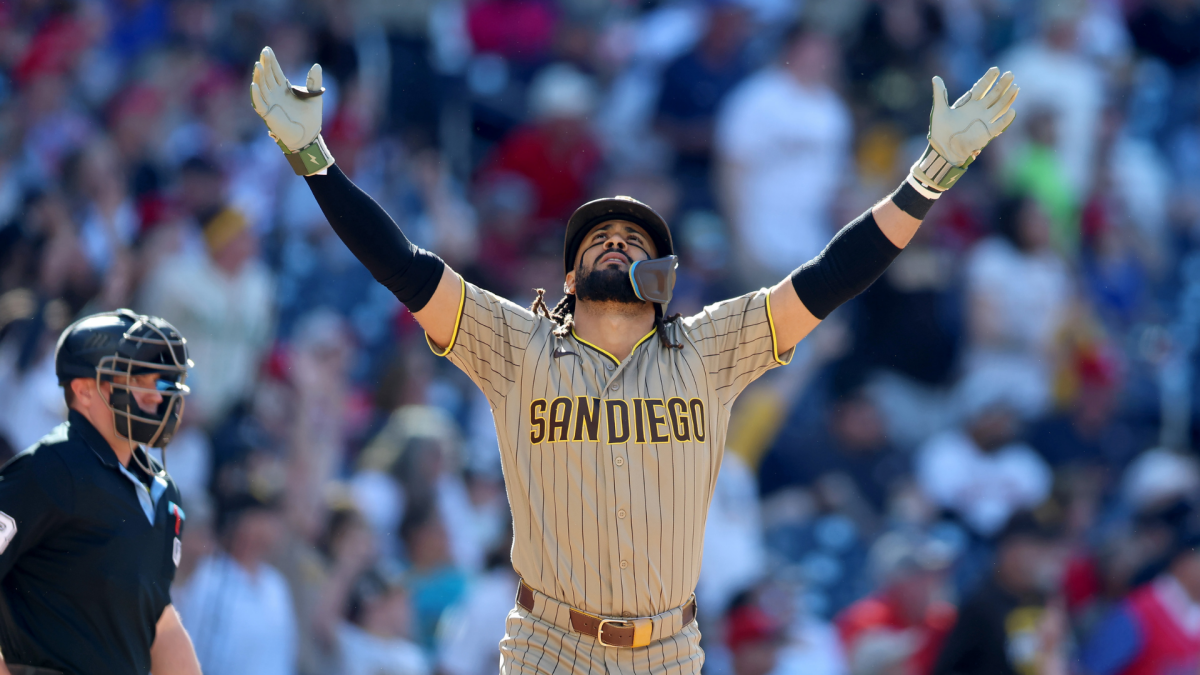
Fernando Tatis Jr. smashed his first home run of 2026 on Saturday at Nationals Park—a 451-foot bolt off Washington lefty Foster Griffin that arrived in his 239th plate appearance, the longest power drought among qualified sluggers this season. The home run was no accident. The ball exploded off his bat at 90th-percentile exit velocity, the kind of contact Tatis has been producing consistently despite his power drought. What changed, though, was direction.
The mechanical story is straightforward: Tatis has been pulling the ball in the air only 6.9% of the time this season, third-lowest among qualified hitters and nearly three times below the 16.8% league average. That pull-rate collapse is where his 24-homer annual average (2022–25) vanished. He's maintained his elite hard-hit rate and exit velocity—hallmarks that power hasn't eroded—but he's been channeling that force to the opposite field with remarkable consistency. Saturday's blast came to left field, his pull side, a reminder that when Tatis does operate his natural leverage, the results are violent and immediate.
What caused the mechanical shift remains unclear from the available data, but the timing is instructive: Tatis took a .268/.345/.307 line into Saturday with contact quality (hard-hit %, xBA components) tracking normally while power vanished wholesale. His on-base percentage sits at .345, virtually identical to his 2022–25 mark of .344, confirming that plate discipline and contact haven't eroded. The slugging percentage—.307—is the only dimension that collapsed, and it maps directly to pull-rate suppression. This wasn't a slump born of injury or mechanical instability across the board; it was a specific constraint on one directional plane.
For prop players, the Saturday breakthrough carries limited forward significance on its own. One home run off a pull doesn't signal a reversion to his 29-HR/162-game pace; that would require sustained pull-rate recovery over multiple weeks. However, the fact that Tatis generated that exit velo and timing despite the pull-rate constraint suggests the potential for a rapid correction if the mechanical tendency loosens. Watch his next 10–15 games for signs of increased pull-side fly-ball frequency. If that rate climbs back toward league average (16%+), his homer-rate projections compress and his season totals could spike from the current pace. The market has likely priced Tatis conservatively given the drought; a mechanical fix that restores his natural leverage is a persistence edge, not a single-game outlier.
The key for bettors: the drought was opportunity suppression, not talent suppression. Tatis has been hitting the ball hard; he's just been directing it the wrong way. Once that directional imbalance corrects—and his Saturday exit velo suggests the capability is intact—his power profile will snap back toward historical norms. Monitor pull rates and wait for confirming multi-game patterns before loading up on his home run props, but the underlying story is one of release, not decline.