Bratt's Command Breakthrough Exposes Arizona's Starter Strategy Against San Diego
By Justin Erickson ·
A rookie left-hander's dominant seven-inning performance against Casey Mize vindicates Mike Hazen's calculated gamble on internal development over deadline acquisitions.
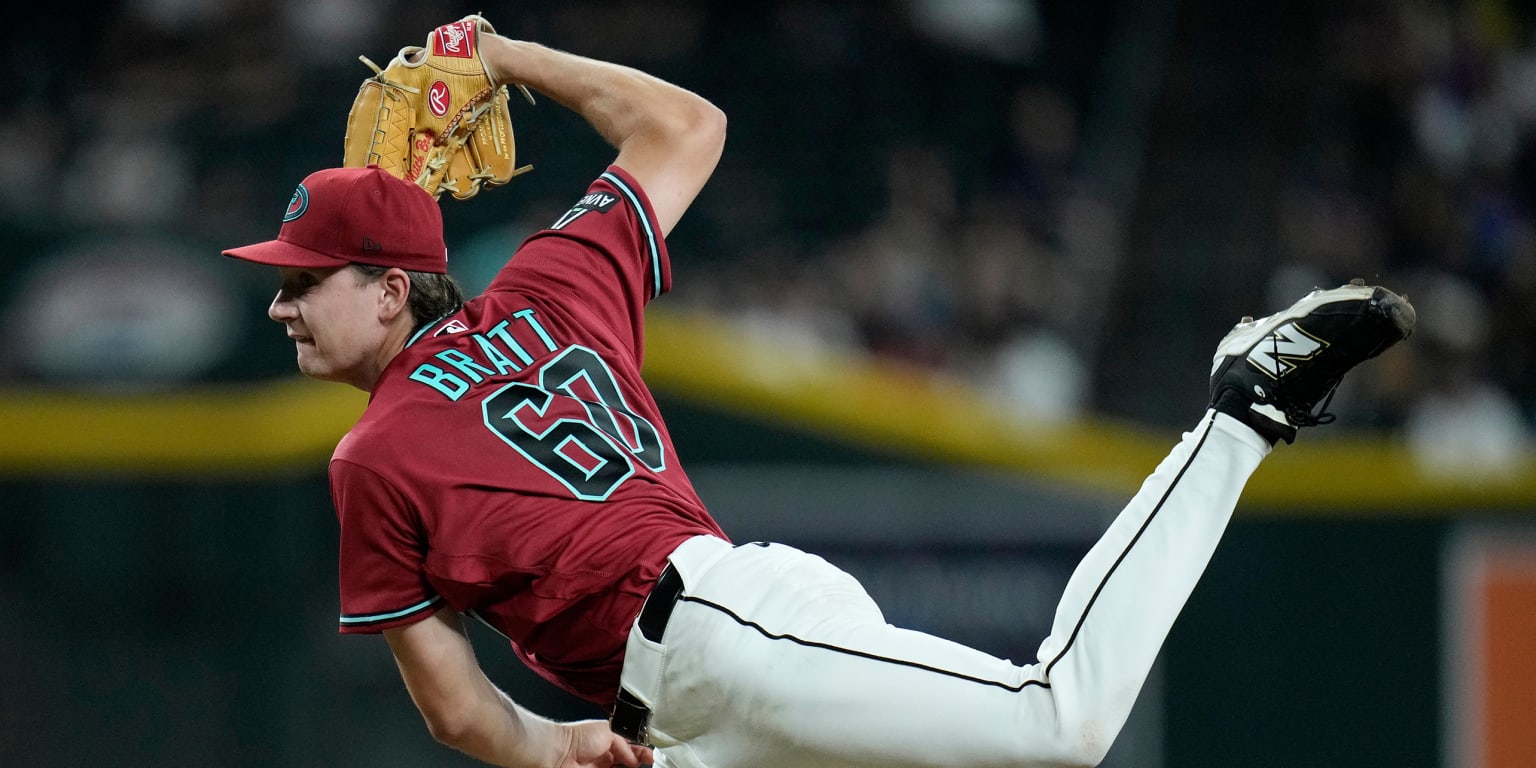
Mitch Bratt threw seven innings on one hit Wednesday night, striking out nine and walking three in the Diamondbacks' 10-4 win over the Padres in Phoenix. It was his first Major League victory in his sixth start, and it came in direct opposition to Casey Mize's underwhelming debut for San Diego—a result that immediately reshapes the narrative around Arizona's deadline inaction. When Hazen declined to pursue a top-tier starter in the July trade market, criticism was swift and predictable. The Padres had just acquired Mize and Robbie Ray; the Diamondbacks countered with internal options, banking on rookies Bratt and Kohl Drake—both acquired last year in the Merrill Kelly deal—to hold the rotation together until injured starters (Zac Gallen, Corbin Burnes, Ryne Nelson, Michael Soroka) returned. That calculus looked questionable on paper. One game doesn't change organizational strategy. But Bratt's performance does reveal something more granular about the matchup: the Padres' offense, which looked formidable on the headline, was helpless against Bratt's pitch sequencing.
The 23-year-old entered with a 5.23 ERA and a walk rate (15 BB in 5 prior starts) that suggested control issues. Wednesday told a different story. Bratt mixed his low-90s fastball with breaking balls in ways that consistently put Padres hitters on their heels. Catcher James McCann's pitch-calling was credited explicitly—throwing offspeed when San Diego was hunting fastballs, disrupting timing. The Padres' manager Craig Stammen acknowledged the mismatch: "His fastball was getting on us. It was a lot harder than what the scoreboard said it was." This wasn't a blowout against a bad offense; it was a methodical dismantling of a team that had invested real capital in starting pitching depth. The Diamondbacks pounced on Mize early, scoring two in the third and exploding for six runs in the fourth on a sequence of five straight hits.
From a betting lens, two immediate angles emerge. First, the strikeout prop for Bratt in future starts becomes a potential weak-side opportunity. His 9 K's on Wednesday broke a pattern: he'd struck out 12 total across his prior five starts (2.4 K/game average). If the market prices his next start using his season-long 2.4 K average as a floor, take the over on any line at 5.5 or higher. The command improvement—9 K's and 3 walks versus his prior 12 K's and 15 walks ratio—suggests a material shift in how he's executing. McCann's presence in the catcher's spot and Lovullo's confidence in his pitch mixing should be priced as a persistent advantage, not a single-game spike. Second, Arizona's team total over should be the primary angle going forward. The Diamondbacks moved into a tie with Philadelphia for the second Wild Card and are now two games ahead of San Diego. Their starting pitcher depth crisis has become a non-issue for short-term matchups if Bratt and Drake can replicate this form. Against inferior opponents over the next week, Arizona's lineup (which scored 10 runs on Wednesday) has room to exploit pitching uncertainty across the division. San Diego's acquisition of Mize was supposed to be a statement; instead, it highlighted how closely margins matter at the deadline.