MLB · milestone
Chandler Simpson's Swing Is a Betting Anomaly—and It Just Qualified for the Batting Title
The Rays' contact-only hitter has become a statistical outlier so extreme he's reshaped what's possible in modern baseball.
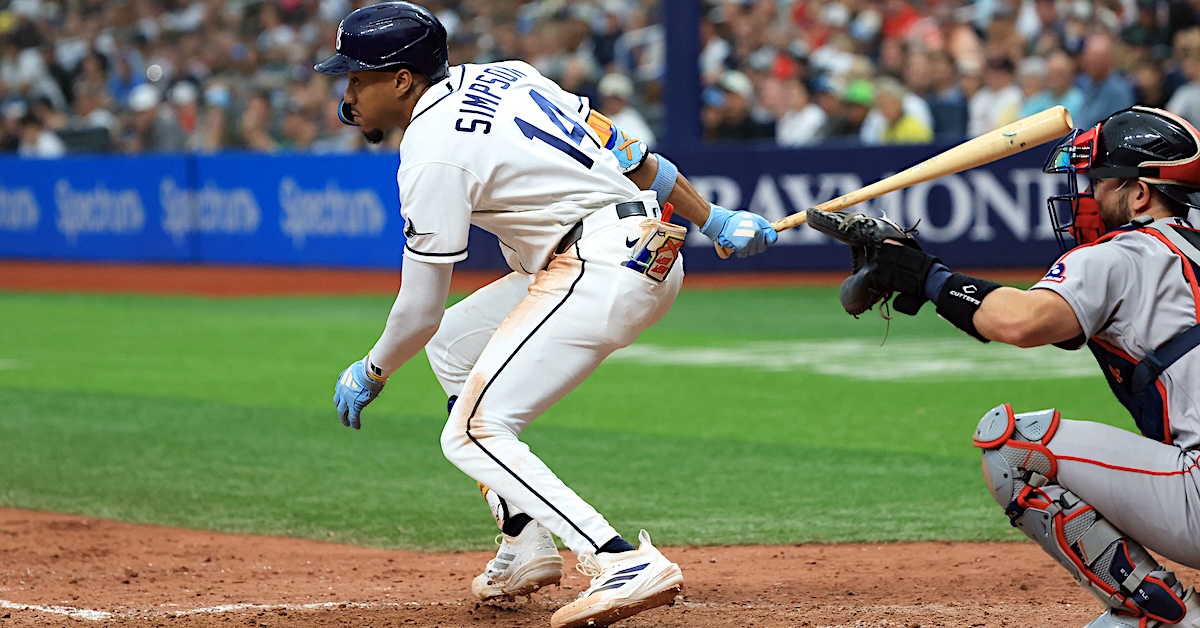
Chandler Simpson has already qualified for the batting title with zero home runs—a feat that hadn't been accomplished since 2012. The Rays outfielder's swing mechanics are so divorced from modern power pursuit that he has never recorded a barrel in over 1,041 batted ball events spanning his major and minor league career. His ISO of .050 ranks last among all qualifiers; his average exit velocity sits second-to-last. He is, by every traditional offensive yardstick except batting average and speed, playing a fundamentally different game than everyone else.
What makes Simpson playable is the inverse of how baseball has evolved. While contact hitters like Luis Arraez and Steven Kwan maintain their spot in lineups by hitting doubles and the occasional home run—supplementing their low strikeout rates with enough gap power to justify regular at-bats—Simpson has engineered a swing built entirely around avoiding the air. His six triples and 16 doubles this season came on ground balls and line drives; his longest hit was a 355-foot double. He routinely goes more than a week without lofting a ball 300 feet. This is not the product of circumstance. It is architectural choice. The Tampa Bay organization has committed 600 plate appearances to a hitter whose entire offensive profile rests on contact and speed, banking that his ability to avoid strikeouts (and thus accumulate enough at-bats to reach the batting title threshold of 502 PA) outweighs the absence of extra-base power that typically anchors offensive value.
For bettors, Simpson's profile creates an immediate friction with conventional prop pricing. Team total overs that factor in his spot in the lineup assume some baseline of gap power and occasional home run upside. Strikeout props on opponents he faces underestimate the contact rate his swing generates. And batting average lines priced against his season-to-date mark assume regression toward league norms—a dangerous assumption when applied to a hitter whose entire strategy is asymmetric contact. Over his 600 plate appearances, he has struck out 29 times. His strikeout rate sits around 4.8%, a full three standard deviations below the league mean. That is not variance; that is by design.
The practical edge for prop players lies in understanding that Simpson's batting average will not regress toward .300 because his swing is not built to generate home run fluctuation. His floor is higher, his ceiling lower, and both are narrower than traditional contact hitters. When he appears in a Rays lineup, team total unders become more viable because his spot represents dead weight in the power calculation. When opponents face him, strikeout props on their pitchers should fade slightly—he puts the ball in play too consistently to reward K-heavy arms. His stolen base props, conversely, carry edge: a hitter who rarely walks and never homers is less likely to face pitchouts, giving his speed a cleaner lane. These edges are durable because they flow from architecture, not from short-term performance anomalies. They will persist for as long as the Rays keep him in the lineup.