Bryce Miller's Velocity Spike Is Real—And It's Reshaping Strikeout Projection
By Justin Erickson ·
Twenty-three days into his 2026 season, Miller has transformed from injury-ravaged to elite, and the strikeout market hasn't fully caught up.
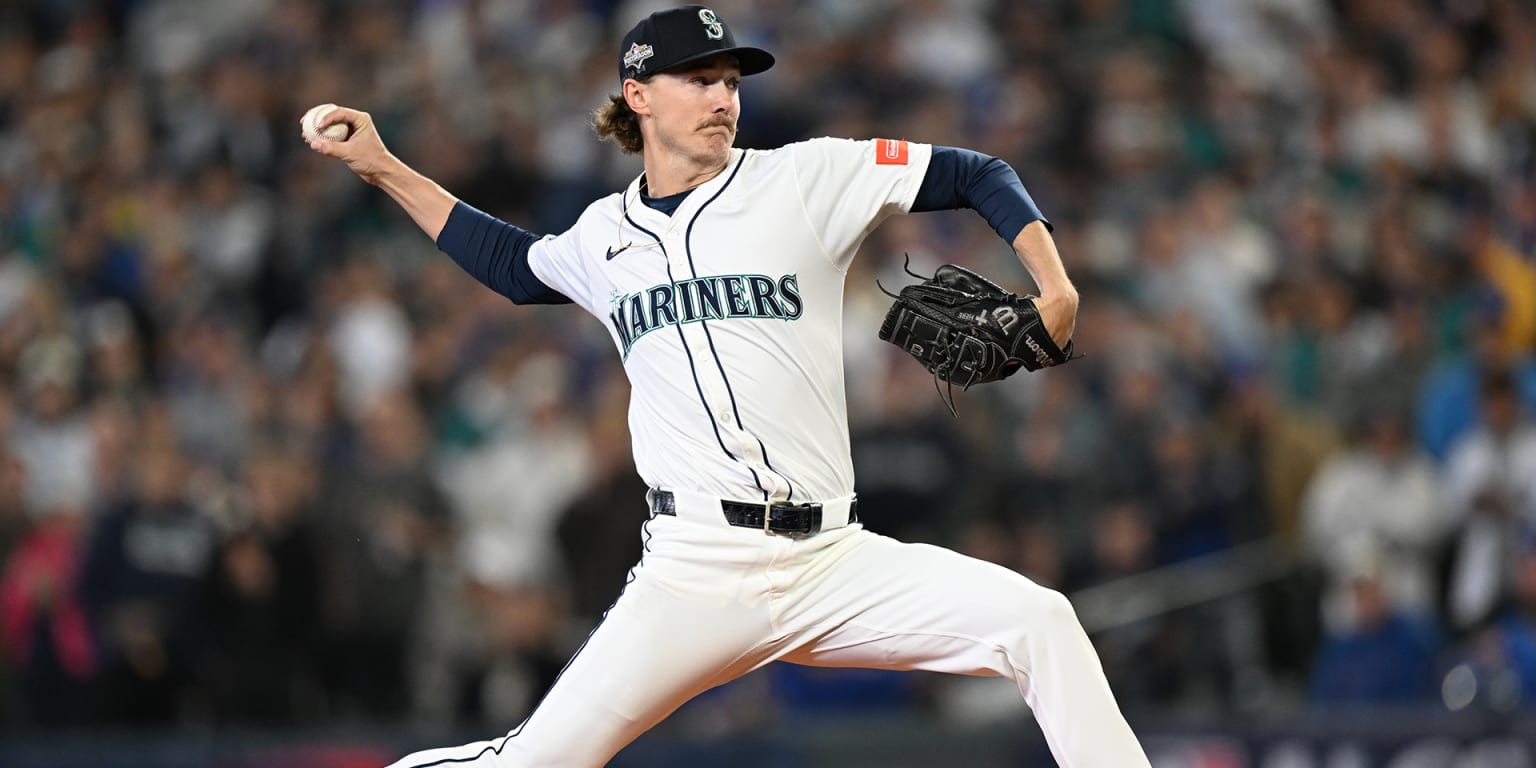
Bryce Miller debuted on May 13 after missing the season's start with an oblique strain—23 days ago. What he's done since rewrites the narrative entirely. In four starts spanning 21 innings, the Mariners right-hander owns a 1.71 ERA, a 20-3 strikeout-to-walk ratio, and a 25.3 percent strikeout rate that would stand as a career high. This isn't a small sample fluke riding an unsustainable walk rate; it's a fundamental reconstruction of his arsenal.
The mechanical core is velocity, and it's tangible. Miller's four-seamer sits at 96.7 mph this season versus 94.8 mph last year—a 1.9 mph gain that compounds through his entire pitch mix. His slider climbed from 85.6 to 87.9 mph. His splitter from baseline to 85.8 mph. When every offering gets faster, batters' timing windows collapse, and whiff rates expand accordingly. His fastball is generating a 22.3 percent whiff rate against a .226 average—elite territory. The slider, deployed on 33 percent of pitches, is whiffing 45 percent of swings. His splitter (31.6 percent whiff rate) has become a legitimate third offering. What makes this sustainable, not a hot streak, is Miller's command infrastructure. His walk rate dropped to 3.8 percent from 8.7 last season. His strike rate (69.1 percent) is a career best, even though his zone rate is a career-worst 50.5 percent—meaning he's generating whiffs out of the zone, a sign that stuff quality, not location desperation, is driving results. His chase rate of 36.2 percent ranks in the 93rd percentile; hitters are lunging at pitches they shouldn't.
The contact quality shift may matter more. Miller's barrel rate collapsed to 3.6 percent (92nd percentile) from 9.4 percent last year, while his hard-hit rate dropped to 25.0 percent from 48.6 percent. He's not just striking out more—he's inducing weaker, less damaging contact when he does allow contact. This is the trifecta: better stuff, better command, better contact outcomes. None of these three improvements independently would be shocking; all three together signal a pitcher who has genuinely recalibrated.
The betting angle hinges on market lag. Strikeout prop lines on Miller have likely adjusted upward since his May 13 return, but the adjustment is typically gradual and reactive rather than predictive. A pitcher carrying a 25.3 percent strikeout rate over a full month, with elite chase rates and sub-3.8 percent walk rates, should be generating strikeout totals in the 8.5-to-10+ range depending on opponent and venue. If the market is still pricing him on his season aggregate (which includes zero pre-May results) or is anchoring to his 2025 disaster (5.68 ERA, two IL stints due to bone spurs), there's an edge favoring strikeout overs on his next few starts. The edge is persistent but timing-sensitive: it survives line movement because it rests on a multi-start pattern and mechanical durability, not a single outlier game. However, oddsmakers are sharp; expect compression within 7-10 days as more data rolls in and sharps recalibrate their models.
Miller's 2024 season (2.94 ERA, 171 strikeouts in 31 starts) established that he can sustain elite-tier performance when healthy and confident. He's now healthier and demonstrably more talented than that version. The oblique strain cost him four months, but it didn't damage the tissues underneath—it cleared them out. The bone spurs from last year are gone. The velocity is legitimately higher. For the next 1-2 weeks, before the market fully reprices him into the elite tier where he belongs, strikeout overs represent the cleanest edge.