Brandon Woodruff's Velocity Crash Lands Him on the IL — And It Changes Milwaukee's Rotation Math
By Justin Erickson ·
When a pitcher's fastball drops seven mph overnight, the injured list is just the beginning of the problem.
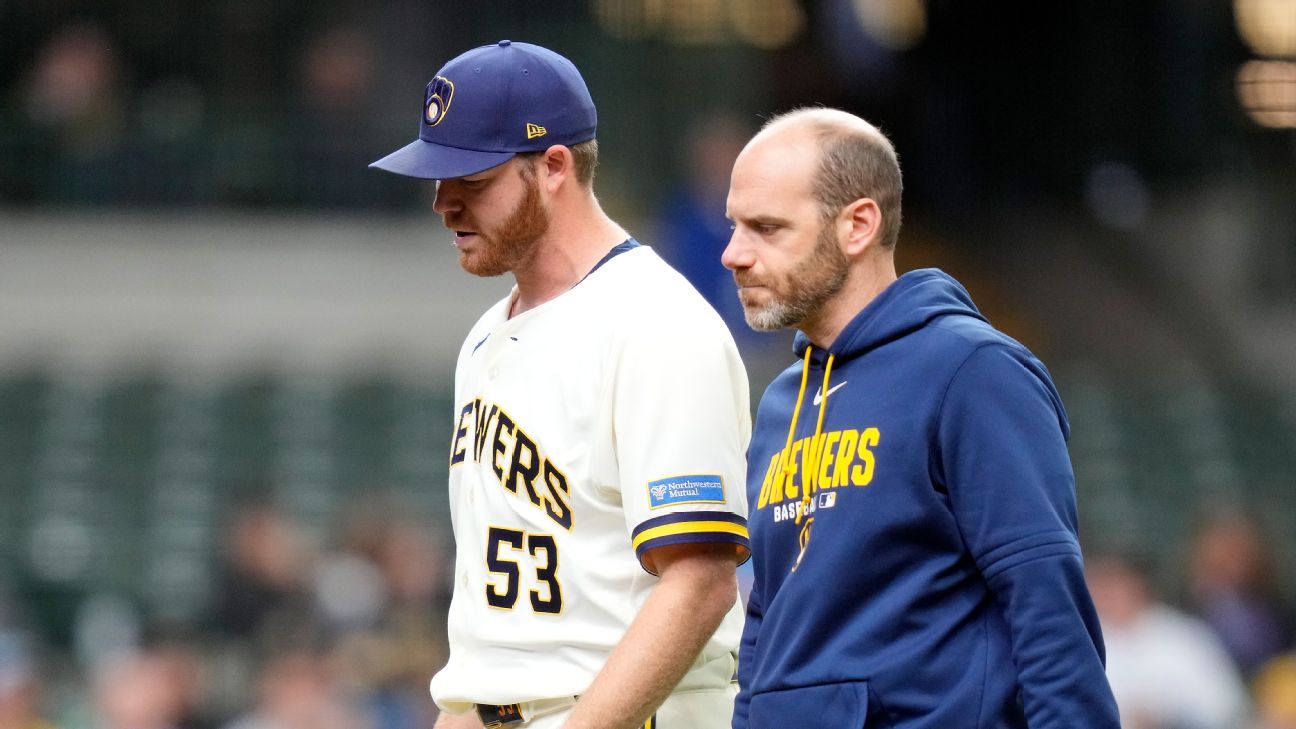
As ESPN reported, the Milwaukee Brewers placed two-time All-Star Brandon Woodruff on the 15-day IL Friday with right shoulder inflammation, one day after he threw 21 pitches — none faster than 86.9 mph — before being pulled in the second inning of a blowout win over Arizona. The MRI came back clean, no structural damage, and Woodruff himself called it encouraging. But the velocity number tells a more complicated story than the optimistic quotes coming out of Washington.
Woodruff averaged 92.5 mph on his fastball this season. Against the Diamondbacks Thursday, he was sitting 85.4 — a 7.1 mph collapse that has no comfortable explanation even without a torn labrum or rotator cuff finding. For context, this is a pitcher who was touching 96 as recently as 2023, then missed all of 2024 following shoulder surgery. He came back last season and was legitimately sharp — 7-2, 3.20 ERA in 12 starts — which bought him credibility and a $22 million qualifying offer. But the shoulder has now flickered twice: the 2023 surgery, then a lat strain that kept him off the postseason roster last fall, and now this. The injury history is no longer a footnote; it's a pattern.
Easton McGee gets recalled from Triple-A Nashville to fill the rotation spot, but he's not a meaningful upgrade on paper — 6.39 ERA in eight Nashville starts this year. The Brewers are going to absorb real rotation stress during Woodruff's absence, and Milwaukee's pitching depth isn't the kind that masks a top-of-rotation void. The club is already navigating a competitive NL Central and has limited margin for error in terms of run prevention.
For bettors, Woodruff's IL stint shifts the math on Milwaukee team totals and first-five-inning lines in the immediate term, but the longer shadow is what it means for games he's slated to start when he returns. If he comes back with velocity still suppressed — even in the 89-90 range rather than 92-plus — his strikeout rate, which has always been tied to the life on that fastball, will erode quickly. His K/9 dropped noticeably compared to his pre-surgery peak, and another tick down makes him a pitcher opponents can put the ball in play against far more consistently. Any start Woodruff makes post-IL return warrants a close look at opposing team totals and under pressure on his strikeout props — particularly if the velocity tracker in warmups shows anything below 91.
In the interim, Milwaukee's team totals deserve a slight upward lean for games McGee or a replacement-level arm absorbs. The Brewers' offense is not a lineup that covers weak pitching starts easily — they rank in the middle of the pack in runs scored — meaning this is less about Milwaukee blowing up and more about opponent totals looking more attractive. Watch the first-five-inning lines specifically; without Woodruff anchoring early innings, opponents get a meaningful edge in the opening half of ballgames Milwaukee was previously winning on the mound.