MLB · injury
Brewers Cut Kuhnel After Three-Month Trial: Bullpen Churn Signals Reliever-Market Weakness
Milwaukee's quick exit on a June acquisition reveals how fast organizational patience erodes when a reliever can't keep the ball on the ground.
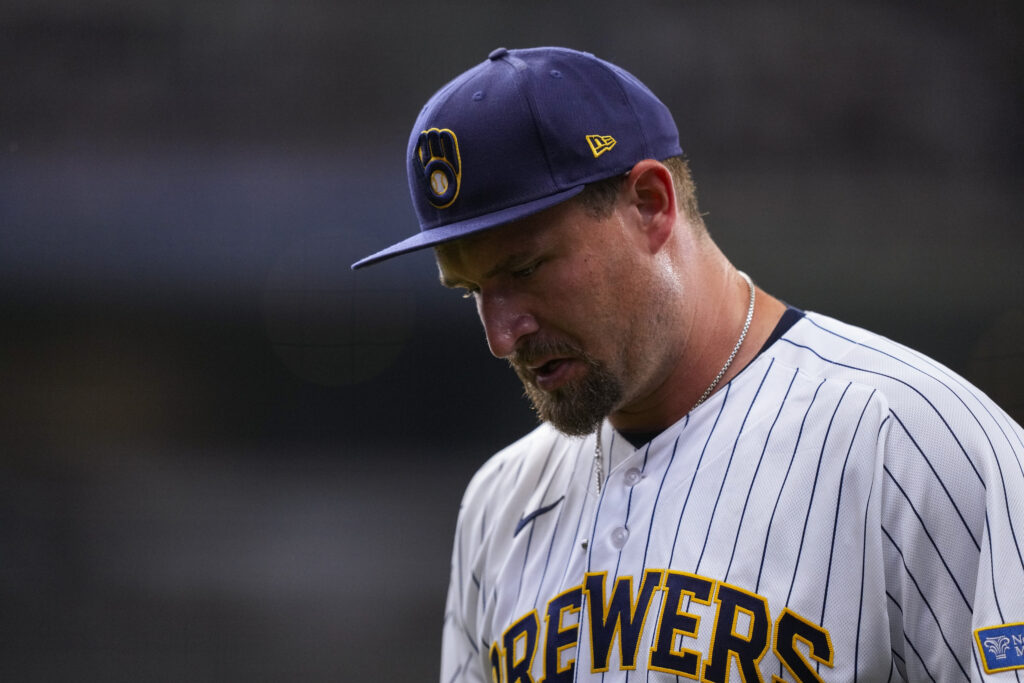
The Brewers designated right-hander Joel Kuhnel for assignment on Wednesday after reinstating him from the injured list, ending a three-month experiment that never gained traction. The 31-year-old was brought in on a cash deal from Oakland in June with a ground-ball pedigree, but produced seven earned runs across ten appearances—a 7.00 ERA in limited work that left no margin for error in a late-season roster squeeze.
Kuhnel's profile relied on inducing weak contact; that skill set has theoretical value in short relief, but execution matters more than taxonomy. Over his ten outings, he allowed the ball to carry further than his trade tape suggested, and Milwaukee faced the familiar bullpen calculus: hold the roster spot for a pitcher whose best days may be behind him, or clear the roster space for depth or a call-up with upside. The organization chose urgency. This is not a star losing his job to a prospect—it's organizational depth recycling itself, the kind of transaction that barely registers in the standings but tells you something about how teams value incremental bullpen relief in September.
From a roster-construction angle, this move reflects a broader truth: late-summer relief acquisitions—especially ones made on cash or minor-league filler—rarely stick. Kuhnel entered with a 4.67 ERA across 2025 and 2026 in Oakland, and the Brewers' gamble was that a change of scenery plus fresh leverage might unlock something. It didn't. The team now has a roster spot to deploy on either a rookie call-up, a waiver claim, or a September bench bat, signaling they believe their bullpen depth chart is better served elsewhere than with a 31-year-old reliever who couldn't lower his ERA in a new uniform.
For bettors, this has limited direct prop consequence—Kuhnel's usage was already marginal, and his outing rate (ten appearances over three months) meant few games featured him in high-leverage spots. However, the move illuminates the Brewers' bullpen state as the calendar flips to September: they are not comfortable with their current roster, and they will continue to shuffle arms. Any reliever who has not cemented a role in Milwaukee should be faded on high-leverage props through the end of the month. Conversely, if a fresh arm arrives via waiver claim or recall, early-season oddsmakers will often price him as equivalent to the pitcher he's replacing, creating a soft edge for sharp bettors who recognize that young relievers or reclamation projects carry higher variance than established names—and that variance usually prices long-term, not game-to-game.