MLB · injury
Anthony's Hand Injury Clouds Red Sox Wild Card; Boston's Offensive Crisis Deepens
Roman Anthony's recurrence of a hand injury that cost him four months sidelines the Red Sox's best offensive option in a must-win Game 2, forcing manager Chad Tracy to rebuild an already-depleted lineup.
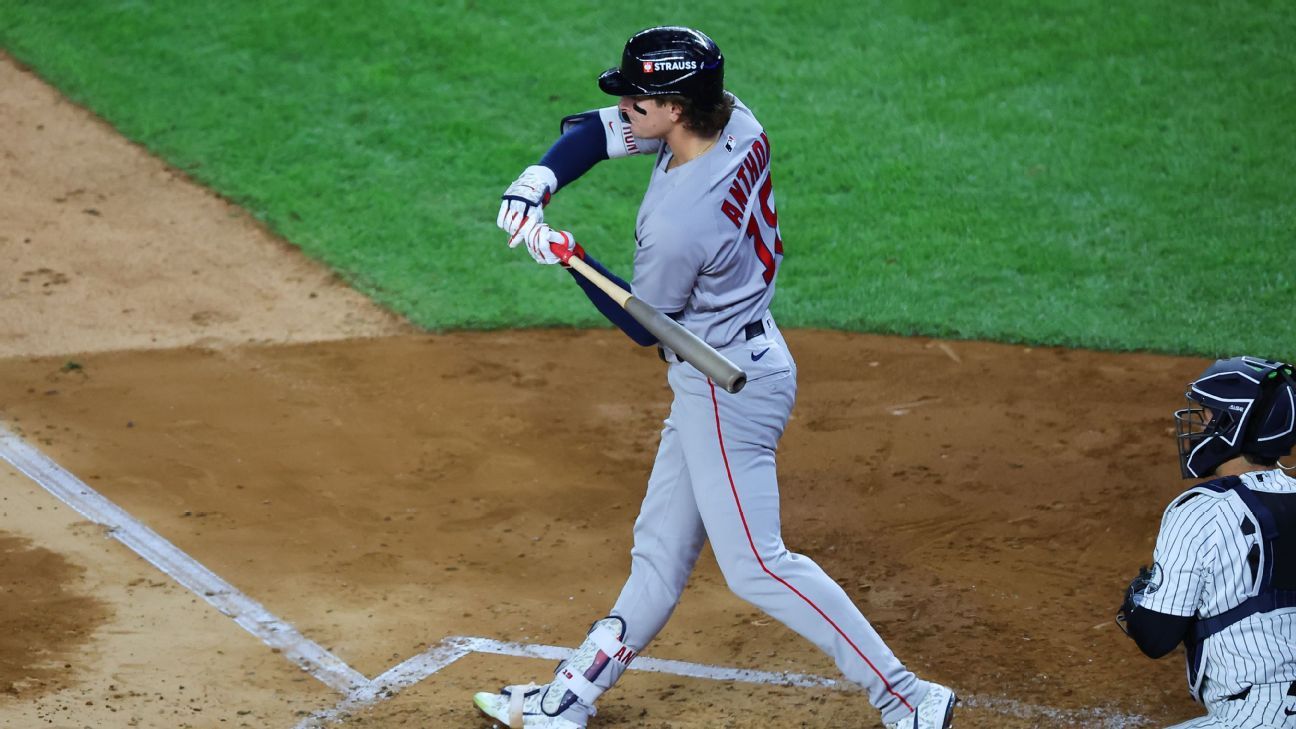
Roman Anthony exited Game 1 of the AL Wild Card Series with a hand injury to the same digit that shelved him from early May through late August, leaving his status for Game 2 against the Yankees uncertain. Anthony, pinch-hit for in the sixth inning after multiple check swings against Yankees ace Cam Schlittler triggered discomfort, did not address reporters as he left Yankee Stadium. Manager Chad Tracy declined to commit to Anthony's availability Wednesday, noting that "some stuff happened that was more serious and was uncomfortable" compared to typical in-game aches.
The timing could not be worse for Boston. The Red Sox were blanked 9-0 in Game 1, a defeat that echoed last year's wild-card elimination at the hands of the same Schlittler, who authored another near-shutout performance (6⅓ innings, 10 strikeouts, two hits). That loss compounded a September collapse in which Boston produced a major-league-low 71 runs—a stark illustration of an offense that has underperformed all season. Anthony, acquired to address that power void, returned from his initial hand injury in late August and posted a .262/.321/.476 line across 25 regular-season games with four home runs and 10 RBIs. He was slotted as the leadoff DH Tuesday specifically to generate early momentum against Schlittler.
The injury itself—a partially torn tendon in his right ring finger suffered in early May—was not initially graded as severe, yet immobilized him for roughly four months. The recurrence carries heightened risk: repeated trauma to the same structure tends to lengthen recovery windows and raises the possibility of structural instability. If the Red Sox place Anthony on the postseason roster after Game 2, he becomes ineligible to return until the ALCS, meaning a Game 2 removal would functionally end his wild-card series.
From a betting standpoint, Anthony's absence or severely limited availability shifts Boston's offensive architecture in measurable ways. His leadoff spot and DH role create a cascading effect: Andruw Monasterio, who pinch-hit for him, is not a power asset and carries a .211 career postseason average. The Red Sox offense already ranked among baseball's weakest; losing Anthony removes one of the few reliable sources of extra-base production and compounds the vulnerability that Schlittler (and the Yankees' bullpen) exploited so effectively. Game 2 totals priced around 7.5–8.0 runs were likely calibrated with Anthony in the lineup. A Boston lineup without him shifts the dynamic sharply toward the under, particularly given that the Yankees' bullpen depth remains intact and Boston's September run-production collapse suggests structural offensive problems, not outlier performance.
Watch the pregame injury report closely. If Anthony is ruled out or limited to bench duty, fade overs on the Red Sox team total and game total; if he plays, the prior line values hold. The uncertainty itself may create early-market inefficiency as sharps wait on confirmation before repositioning. Given Boston's broader offensive crisis and the fact that they will face additional Yankees arms beyond Schlittler if the series extends, Anthony's status is not merely a roster note—it's a proxy for whether the Red Sox can generate any offensive pressure in a must-win scenario.
MLB Intelligence — Baseball intelligence beyond the box score. Open MLB Intelligence →