Acuña's Early Return to Power Form Signals Braves' Offensive Depth as Cincinnati Unravels
By Justin Erickson ·
A pair of back-to-back tape-measure homers and Harris's three-hit night expose the gap between Atlanta's lineup firepower and Cincinnati's bullpen desperation.
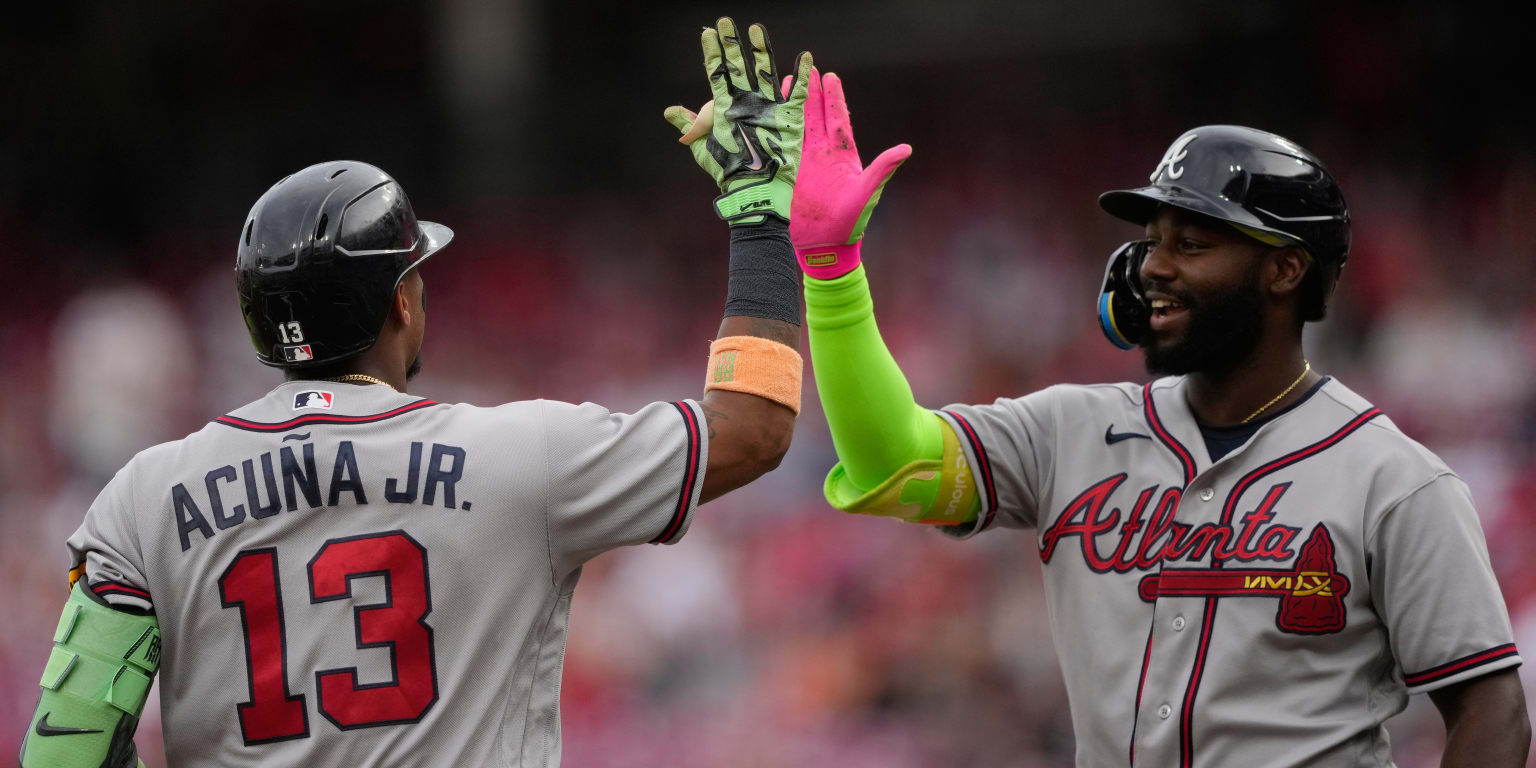
Ronald Acuña Jr. continued his explosive re-entry into the Braves' lineup Friday, launching a 429-foot home run off Chris Paddack's hanging curve to lead off the contest. The blast—carrying 113 mph exit velocity—marked his fourth homer in limited action, a velocity profile that matters: Acuña is making hard contact immediately, not gradually working back into form. Michael Harris II reinforced the offensive dominance with three hits and three RBIs, including a pair of crucial knocks in Atlanta's four-run sixth inning that turned a one-run lead into an 8-3 rout. The Braves are now 39-14, the best record in baseball.
What makes this win mechanically significant is not the final score—it's what Cincinnati's roster construction revealed. After Graham Ashcraft went down with a UCL sprain, the Reds called up Yunior Marte for his first MLB appearance, and he promptly allowed three more runs in the sixth inning. Grant Holmes, Atlanta's starter, was vulnerable too—he gave up back-to-back solo homers to JJ Bleday and Nathaniel Lowe—yet the Braves still built enough early cushion to absorb the damage. This is a team that can weather mediocre starting pitching because the offense's baseline is sufficiently high.
The prop angle here tracks Acuña's exit-velocity trajectory. He's now smashed two consecutive games with 110+ mph contact; his pre-injury career average on homers was 94 mph, meaning he's operating at elite tier. For the Braves' next three games, his home run line should be treated as underpriced if it hasn't already adjusted upward. The market will likely overshoot—this is one outlier trend that fades within 48 hours—but the underlying signal is clean: when a player rebounds from injury and immediately demonstrates power output above his pre-injury standard, the bookmakers often lag by one or two games before repricing the prop upward. Harris's three-hit performance is less durable as a predictive signal (3-for-5 is variance-prone) but his 43.5% hard-hit rate over his last 10 games suggests he's in a legitimate hot phase, not a one-game spike. His RBI props over the next week should reflect that increased offensive aggressiveness.
Cincinnati's bullpen construction also matters for Braves unders-bettors going forward. If the Reds continue to lean on relievers like Marte—inexperienced, unpredictable, prone to mistakes—Atlanta's team totals should stay elevated. The Braves scored four runs in the sixth on nothing exotic: a lead-off hit, a wild pitch, a double, a single, and another single. Against a bullpen that has to improvise mid-series, that offensive fluency compounds. For the rest of this series, Braves team totals in the 4.5-5.5 range warrant overestimating Atlanta's ceiling, given Cincinnati's pitching depth chart is now compromised.
The Acuña power trajectory is the headline, but it's a short-lived edge. The Harris offensive consistency and Reds' bullpen vulnerability are the deeper angles with staying power across this series.