Wild Gamble on Shabanov After Islanders Pass: A Cheap Depth Play With Real Risk
By Erik Schwartz ·
Minnesota pays $1.6M for an untendered winger who produced at a pace that would suggest marginal NHL value, but the contract structure leaves room for upside if the coaching change unlocks something the Islanders didn't.
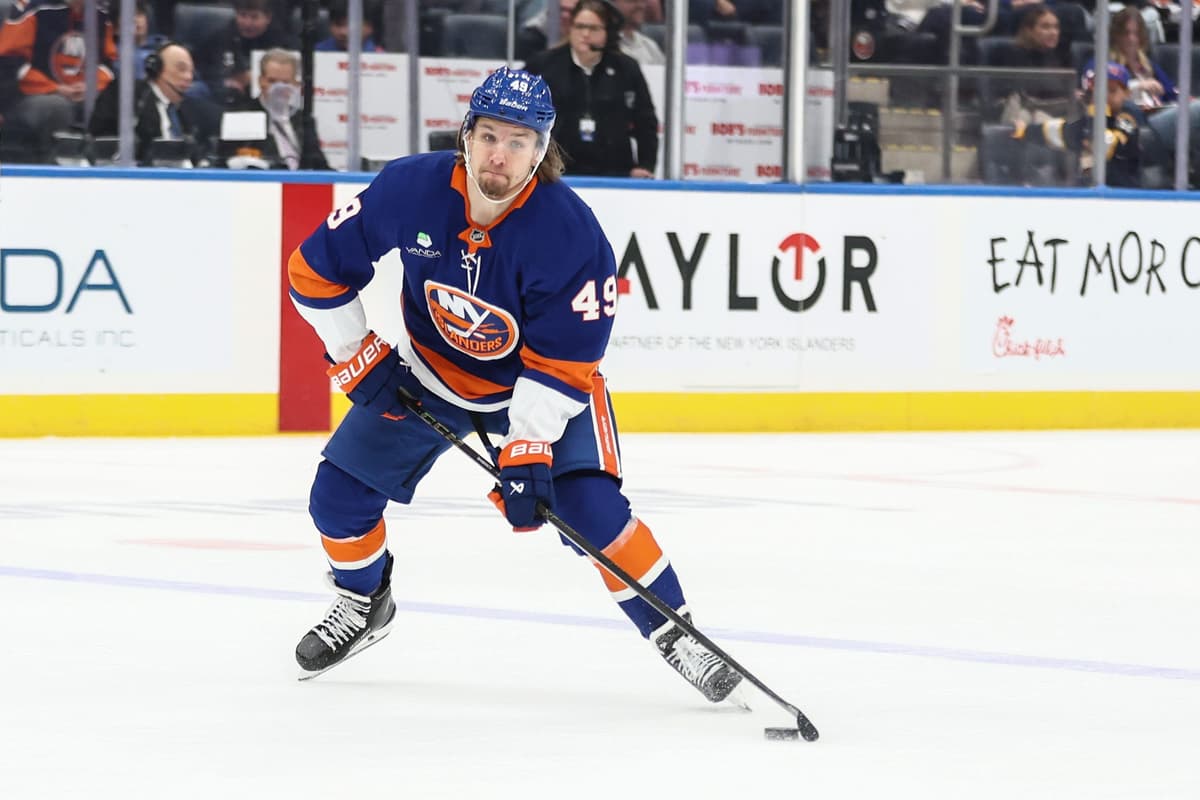
The Minnesota Wild signed Russian winger Maxim Shabanov to a one-year, $1.6 million deal on Thursday, moving quickly to fill forward depth after New York declined to tender a qualifying offer. The signing itself is low-cost and low-risk in absolute terms — the price tag and term suggest the Wild view Shabanov as organizational flexibility rather than a core piece — but the underlying productivity metrics demand scrutiny before any prop pricing inflates around him.
Shabanov's first NHL season with the Islanders produced 18 points in 44 games, a pace that extrapolates to roughly 33 points over a full 82-game slate. That's league-minimum territory for a forward getting regular ice time. The Islanders' decision not to match a QO is the market's clearest signal: they evaluated him over an entire season and determined his EV was below the salary floor. When a team with cap flexibility and playoff experience passes on retaining a player, it's rarely a gap in scouting — it's a hard no on future performance.
What matters now is Minnesota's coaching and system. The Wild made significant front-office changes, and new systems can reshape how effectively a player converts opportunities. Shabanov's shot volume, assist rate, and deployment patterns in New York are the baseline; whether Bill Guerin's iteration of the franchise can extract better results remains speculative. One season of sub-NHL-average production isn't disqualifying, but it's also not the profile that commands confidence in prop overs on points, goals, or assists until he proves otherwise in Minnesota's structure.
For bettors, Shabanov's integration into the Wild forward group creates a visibility problem. His ice time will depend entirely on injuries and performance early in training camp. If he earns third-line minutes, his 18-point-in-44-game pace would suggest single-digit prop ceilings on goals and assists — not attractive. If the coaching change and a full offseason in Minnesota unlock a material jump in efficiency, the props would likely have repriced upward already by puck drop. The real value, if it exists, is in fading overs on Shabanov's individual prop lines until he accumulates at least 20 games of data under his new system. The Islanders had him under a microscope for 44 games and declined the investment; Minnesota is betting they can do better on a trial contract. That's a gamble, not a conviction.
Monitor his preseason and early-season deployment. If he breaks camp on the second line or gets consistent power-play reps, line adjustments will follow, and short-term overs could carry value. Until then, the market's price on Shabanov is likely already generous relative to his demonstrable NHL production.