Aho and Svechnikov Need Space, Not Just Touches, to Shift Stanley Cup Final
By PropBetEdge Editorial Team ·
Carolina's stars flashed offensive intent in Game 3, but Vegas's zone defense is suffocating them where it matters most—and the Hurricanes' only path forward requires structural adjustment, not heroics.
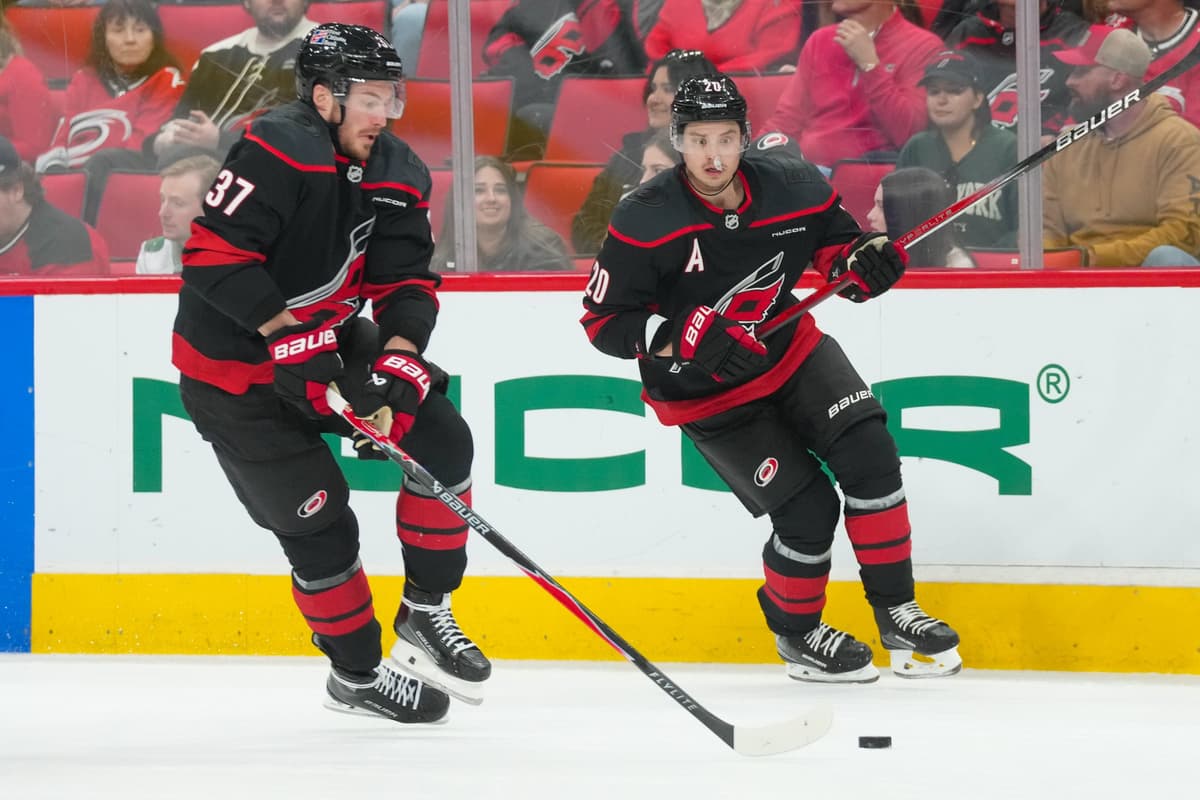
The Carolina Hurricanes trail 2-0 in the Stanley Cup Final against Vegas, and their two most dangerous forwards—Sebastian Aho and Andrei Svechnikov—delivered their most coherent offensive statement yet in Game 3, only to lose in overtime. Svechnikov scored on the power play to tie the game at 4-4 with under two minutes remaining in regulation; Aho registered two assists during a four-goal third-period surge. On paper, those numbers suggest momentum. In practice, they obscure a deeper problem: neither player has generated at even strength where it counts, and the offensive architecture keeping them out of scoring areas is systematic, not circumstantial.
The gap between Vegas's defense and Carolina's offensive design is instructive. Vegas operates a pure zone structure—defenders protect the front of the net and collapse toward the crease—while the Hurricanes prefer man-on-man coverage with aggressive upice pressure. That philosophical inversion creates a geometry problem for Aho specifically. He's a slot-oriented threat who depends on finding open ice in the mid-range areas to generate high-danger chances; Vegas's zone denies him that real estate. Svechnikov, meanwhile, thrives with room to operate along the perimeter and attack downhill. Against a defense that packs the interior, both players are forced into low-value perimeter play.
The actual solution—involving the defensemen more heavily in the offensive cycle—requires Carolina to change how it initiates. If Aho and Svechnikov continue to receive the puck in the same dead zones, more passes won't create more space. The Hurricanes need their backend to extend plays and open downhill lanes, essentially forcing Vegas to communicate and reset rather than camping in a fixed zone. Rod Brind'Amour is aware of the trap, but awareness and execution are different animals in a playoff series tied at 2-0 with Game 4 imminent.
For bettors, this is the fulcrum of the series. Aho's shot volume has been suppressed—he's averaging roughly 2.5 shots per game, well below his regular-season 3.1 per game—because he can't access the areas where his shot attempts originate. Svechnikov's even-strength point drought mirrors the same constraint. If Vegas continues to execute its zone-heavy system and Carolina sticks with perimeter-heavy offensive patterns, both players will remain underutilized relative to their line-quality role in the regular season. Conversely, if the Hurricanes rebalance and get Miller and their other defensemen into the offensive set plays, Aho's shot volume and Svechnikov's even-strength production could spike sharply, which would also correlate with higher team goal totals. The ceiling exists; it's a matter of structural alignment.
Game 4 is the inflection point. Vegas's zone defense is working, but it's not impenetrable—it requires disciplined positioning and active communication from all five skaters every shift. Any breakdown in that coordination opens lanes for exactly the kind of high-volume, high-danger play that Aho and Svechnikov are built to exploit. Carolina's adjustment window is closing fast. The stars won't come alive by accident.