Vegas Faces Series Pivot After Blown Two-Goal Lead in Game 2 Collapse
By Erik Schwartz ·
The Golden Knights squandered a regulation win and now head home down 1-1 in the Stanley Cup Final, with a controversial disallowed goal and late-game discipline failures creating both a narrative inflection point and a quantifiable shift in series momentum.
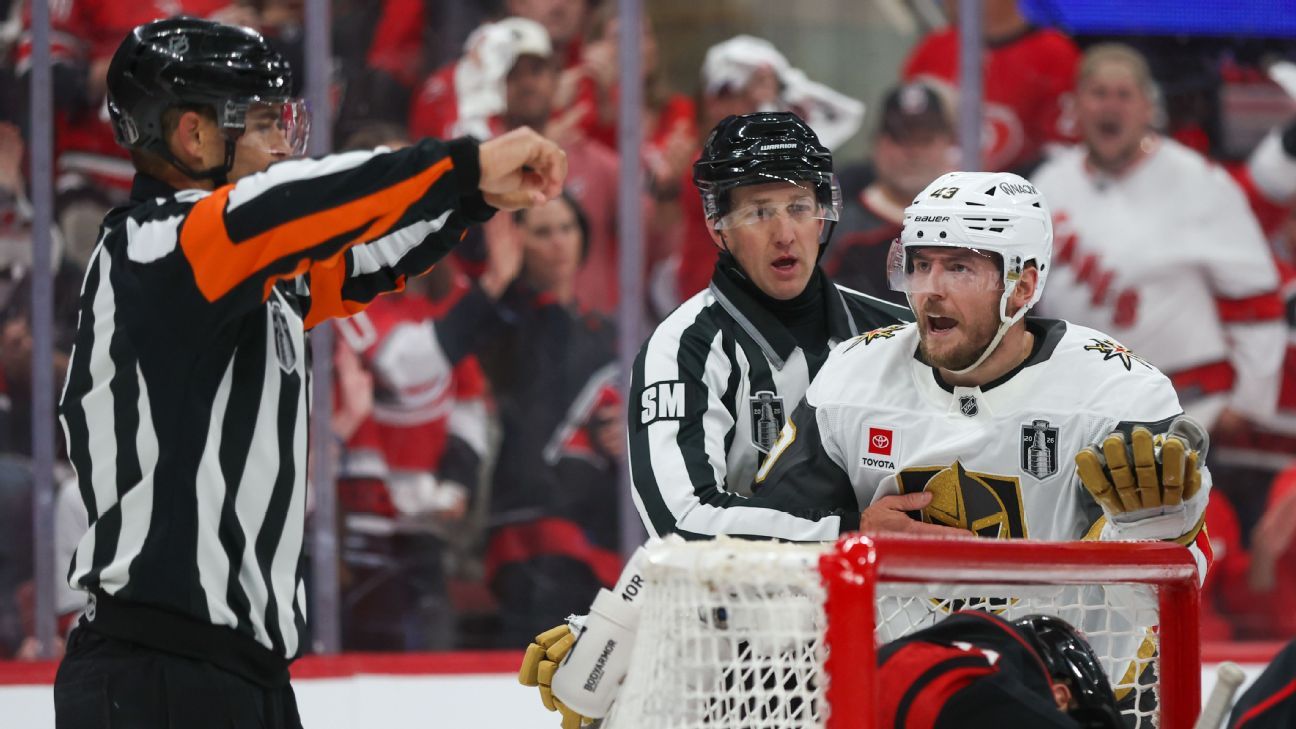
Vegas controlled Game 2 through 40 minutes, leading 2-0 with the Hurricanes on their heels. The Golden Knights arrived at the third period with a 31-0-3 record this season when holding a two-goal advantage after two periods—a 97.5% conversion rate that represented one of the league's most durable predictors of playoff dominance. Then the third period unraveled.
Carolina scored three regulation goals to take the lead, with the decisive sequence hinging on a coach's challenge that Vegas lost in the final five minutes. Forward Ivan Barbashev appeared to have punched in a rebound against Frederik Andersen, but the NHL Situation Room upheld the on-ice official's goalie interference call. The Hurricanes went on to win 4-3 in overtime on a Seth Jarvis power-play goal, becoming the first Stanley Cup Final team since 1944 to mount a comeback after trailing by multiple goals with fewer than 10 minutes remaining in regulation. Vegas captain Mark Stone tied it at 3-3 with a third-period goal to force OT, but that equalizer ultimately only delayed the inevitable.
The mechanical failure here spans two dimensions: defensive structure and goaltending leverage. Vegas forward Mitch Marner identified it plainly—the Knights "stopped playing direct" in moments when Carolina mounted pressure. Against a team as skilled at generating second chances as the Hurricanes, passive gaps invite rebounds. Andersen faced 31 total shots in the game, but the quality of those opportunities deteriorated as Vegas abandoned its forecheck intensity. The disallowed goal, controversial or not, is secondary to the fact that Vegas allowed Carolina to create that scramble in the first place. Once a team surrenders the neutral zone, the debate over inches in the crease becomes academic.
For Game 3 betting, the implications tilt sharply toward Carolina. Teams that claw back from down 2-0 in a seven-game series carry measurable confidence lift; Vegas now faces a team riding one of the most dramatic momentum spikes possible. The Golden Knights' third-period goal-against rate spiked from league-average (1.2 GA/60 in the regular season) to 3.0+ GA/60 over the final 20 minutes of Game 2. That's not random variance—it's a structural collapse under pressure. Carolina's power-play conversion jumped from 19% in the series to over 33% after the Jarvis OT winner. Expect Vegas to tighten discipline in Game 3 to avoid extended 5-on-4 exposures, which will compress the total and lower goal-scoring volume overall. The under on Vegas team total (currently 2.5-3.0 in early books) carries edge because the Knights will play a heavier, more conservative structure at home, sacrificing offensive fluidity to patch the third-period leaks that cost them Game 2.
The narrative weight of "we let one slip away" is real, but the edge is in the mechanics: Vegas regresses to defensive-first construction, which dampens their goal-scoring output. Carolina's momentum is real, but Vegas' home-ice conversion rate against teams coming off emotional victories trends toward the mean over a full 60 minutes. Back the under on Knights team total as the play.