NHL
McNabb's Facial Injury Threatens Vegas Defensive Depth in Stanley Cup Final Game 3
The Golden Knights face a Game 3 without clarity on their top defenseman's availability, forcing a shift in their blue-line construction at the worst possible moment.
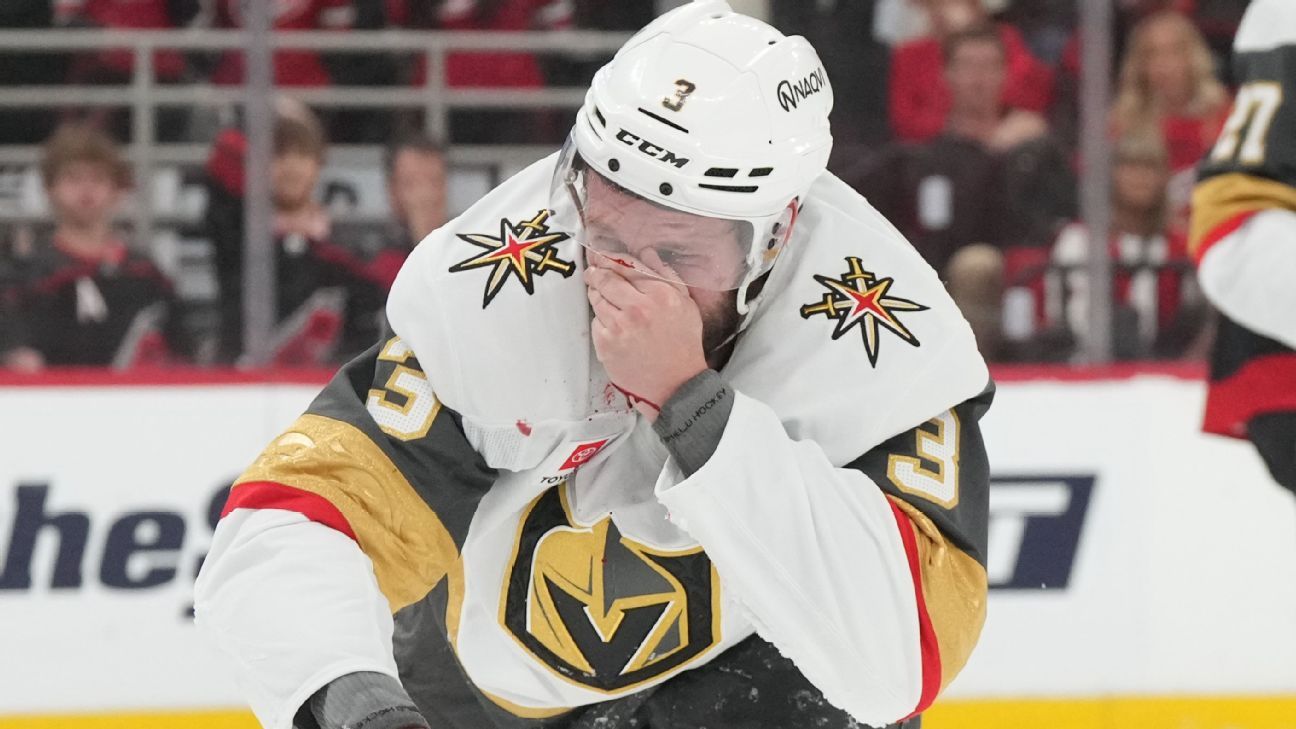
Brayden McNabb left Game 2 of the Stanley Cup Final early after an 87 mph shot from Carolina's Nik Ehlers caught him around the visor, sending him to a local hospital and forcing Vegas into immediate contingency planning. The Golden Knights offered no formal update ahead of Game 3, but the signs point toward McNabb's unavailability: coach John Tortorella declined to commit to his status, and reserve defenseman Kaedan Korczak skated with the extras in practice—a classic deployment signal that a roster swap is coming.
The injury matters because McNabb anchors Vegas's second pairing and logs heavy minutes in transition. Without him, the Golden Knights lose a right-shot defenseman who eats 20+ minutes per night and handles high-leverage situations. His absence forces one of two outcomes, both problematic. Korczak, who has played only 12 playoff games and hasn't seen ice since the Western Conference Finals against Colorado, becomes the fallback option. Or Vegas reunites Shea Theodore with Dylan Coghlan—a pairing that posted a 37-minute scoreless run earlier in the postseason but lacks familiarity in high-pressure moments.
Coghlan himself acknowledged the adjustment burden: "Anybody that goes in there would play well with him," referring to Theodore. That's polite talk for "we're making it work, not thriving." Theodore's value compounds when paired with a capable partner, but Coghlan's limited sample and Korczak's rustiness create a structural vulnerability on the back end. Vegas's defensive structure depends on predictable gap control and quick exits from the zone—the exact things that break down when depth pieces fill first-pairing roles mid-series.
From a betting lens, this creates two cascading pressures on Vegas's bottom-six volume. With a thinner blue line, the Golden Knights will lean harder on their forwards to win puck battles and limit Carolina's offensive rebounds. That translates into elevated corsi-against rates and longer shifts for Vegas forwards, which historically correlates with reduced offensive output. Defensively, Carolina senses weakness and will press harder on the forecheck, forcing Vegas goalies to handle more perimeter work. If McNabb truly cannot play, expect Vegas's shots-against to creep toward their postseason average of 32.1 per game, while their team total dips as depth defensemen burn energy on the backcheck rather than supporting transition.
The market hasn't fully priced the blue-line collapse because McNabb's status remains officially unconfirmed. Once Vegas announces his absence or confirms his return, totals and spreads will shift sharply. For now, early numbers on Vegas team total under 2.5 carry value if McNabb doesn't go—the shift from a balanced defensive pairing to a patchwork rotation historically reduces forward output by 0.3 to 0.5 goals per game in playoff hockey.
NHL Intelligence — Hockey intelligence beyond the scoreboard. Open NHL Intelligence →