McKenna's Sheltered Role Caps His Rookie Volume—and Fantasy Ceiling
By PropBetEdge Editorial Team ·
Toronto's deliberate second-line placement for its 18-year-old prospect signals long-term asset management, not immediate offensive load.
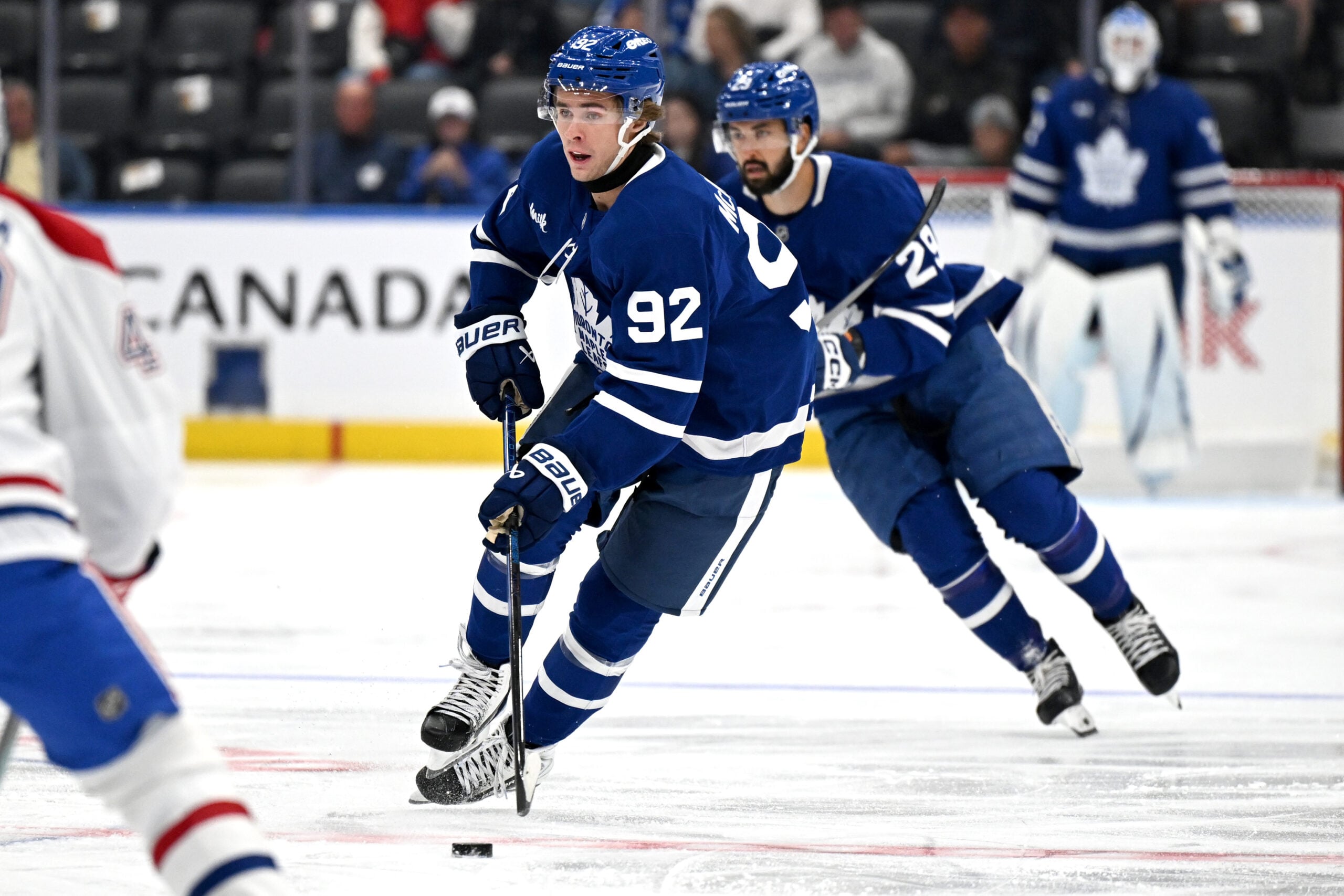
Gavin McKenna opened his NHL career on Toronto's second line alongside John Tavares and William Nylander, a placement that coach Jim Hiller framed as intentional development strategy rather than a demotion. The organization had weeks of speculation to manage expectations before training camp began, and the team's answer was explicit: sheltered minutes, secondary offensive role, space to acclimate. McKenna, who posted 51 points in 35 NCAA games before turning pro, impressed in his preseason debut with crisp hands and line-driving creativity—Tavares and Nylander struggled to match his pace—yet left scoreless.
That zero on the stat sheet is the canary. McKenna has the skill to play alongside Auston Matthews, and Toronto's brass clearly believes he will. But starting him there would invert the organization's stated priority: not to maximize his early-season point total, but to prevent the overwhelm that derails gifted teenagers in their first NHL season. At 18, moving from college pace to elite defensive pressure requires a runway. Sheltering him on a second line loaded with Tavares's playmaking gives McKenna permission to make mistakes without the defensive complexity of Matthews's line, where elite forechecking teams will hunt him relentlessly. This is sound player development, and it is also a hard ceiling on his volume.
From a prop perspective, this matters more than it appears. McKenna's rookie-season assist and point totals will be shaped by linemate quality and usage, not potential. Tavares and Nylander are crafted finishers; if McKenna becomes the primary creator on that line (early signs suggest he is), his assist floor rises. But his ceiling is clamped because he is not the focal point of the team's offense. He will not log the power-play deployment or the late-game high-leverage minutes that separate 55-point rookies from 75-point ones. Toronto has multiple players already occupying that oxygen—Matthews, Marner, Tavares himself. McKenna's role is to produce secondary output and gradually prove he deserves elevation.
The market will likely overshoot his full-season point total in the opening weeks, anchored to his college scoring rate and his obvious skill. His preseason performance will reinforce that bias. But the line deployment is not a rumor; it is public policy from the head coach. Any season-long prop on McKenna's total points or assists should reflect that the team intends to keep him on a short leash until mid-season at the earliest. If he performs, elevation will follow. If he struggles, the Leafs have hedged their bet by not overexposing a teenager. Either way, his volume is constrained by design.