Buchnevich to Detroit Solves a Red Wings Gap—But at What Cost to Line-Matching Depth
By Erik Schwartz ·
A Pavel Buchnevich trade to Detroit would plug the Wings' top-six void, but his declining shot volume and age-curve trajectory reshape offensive line betting for both clubs.
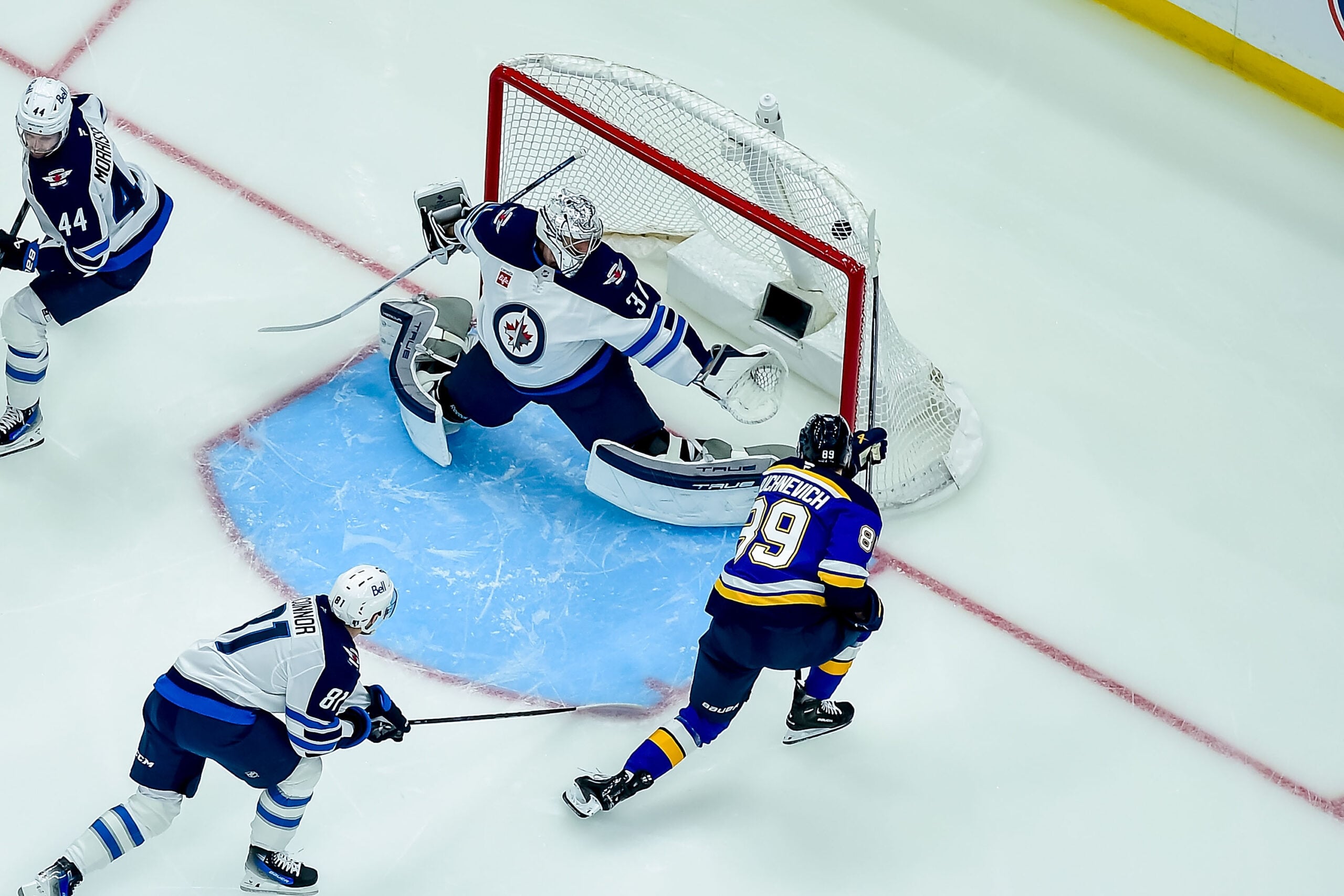
The Blues and Red Wings are separated by just enough cap space and prospect depth to make a mid-market trade work this offseason. Buchnevich—a 31-year-old left winger with a $8 million cap hit through 2031—has become expendable in St. Louis, where the organization wants to accelerate Otto Stenberg's development in the top six. For Detroit, already reeling from Dylan Larkin's expanded trade request and Patrick Kane's uncertain future, Buchnevich represents a familiar profile: a reliable 20-goal scorer who brings physicality and penalty-kill durability. The framework is straightforward—Detroit sends prospect defenseman Nikita Tyurin and a 2027 third-round pick; St. Louis retains 25% of Buchnevich's salary to ease the salary-cap squeeze on both sides.
What the trade actually signals is a divergence in organizational philosophy. The Blues are betting on Stenberg as a cost-controlled, higher-upside replacement. Buchnevich's 20-goal ceiling is real but receding; over his last two seasons, he's averaged 22 goals per 82 games, down from the 30-35 range when he hit 60+ points with the Rangers. His shots-per-game have compressed from 2.8 to 2.1, a meaningful decline that suggests declining offensive volume or tighter usage. Detroit, meanwhile, is in a rebuild triage moment. Larkin's departure strips the franchise of a franchise-pillar anchor. Kane's age and availability remain opaque. Adding Buchnevich doesn't solve the fundamental problem—Detroit still lacks a centerpiece to drive elite shot volume and playmaking—but it creates a floor: a 20-goal scorer who won't crater the team's possession metrics and can stabilize a depleted top six alongside Raymond and DeBrincar.
For betting purposes, the mechanical shift is in line deployment and offensive clustering. Buchnevich's addition to Detroit doesn't elevate the Wings' overall shot-generation profile; it redistributes existing offensive capital. Raymond and DeBrincar will likely see marginally higher assist totals because Buchnevich is a volume presence who finishes his chances—he's not a setup player. His 2.1 shots per game is pedestrian for a top-six forward, which means prop bettors chasing Detroit team totals will need to account for the fact that adding Buchnevich is a stabilization play, not an acceleration. St. Louis, shedding Buchnevich's 2.1 SPG and ceding 20 goals, faces a sharper creative bottleneck in the top six. Stenberg's rookie shot volume is an unknown; the organization is essentially betting that his upside (higher FRV per shot) outweighs Buchnevich's quantity. Early-season Blues team totals will carry higher variance as Stenberg acclimates.
The implication for prop betting is asymmetric: Detroit's offensive totals are more predictable but capped at a lower ceiling post-trade. Buchnevich's arrival stabilizes variance on Red Wings team goals but doesn't spike shot volume or assists. Blues team totals and individual goal props become higher-variance wagers during Stenberg's adjustment window. If you're evaluating Detroit forwards in the 2-3 weeks after the trade closes, lean toward assists (which benefit from Buchnevich's screen-and-cycle role) over shots (where individual line shotgun minutes will remain relatively flat despite the roster turnover). Blues team totals in the first month are inherently riskier—take unders on inflated preseason projections that don't account for Stenberg's rookie usage curve.