Sabres Trade for Zellweger to Fill Byram Void; Bet the Depth Defense Upside
By Ty Whitney ·
Buffalo moves prospect capital to acquire a puck-moving defenseman days after shipping out Bowen Byram, signaling a shift in roster construction that could unlock secondary scoring lanes.
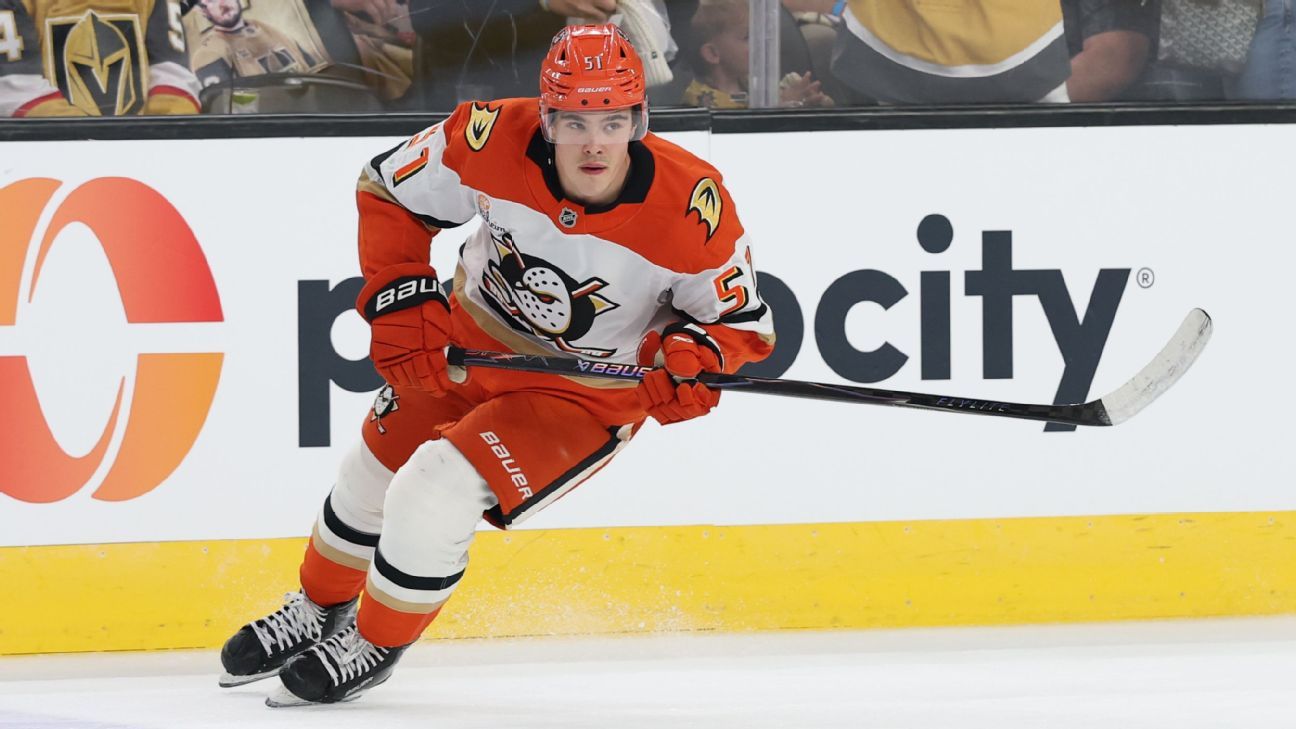
The Buffalo Sabres acquired Olen Zellweger from the Anaheim Ducks on Friday, sending prospect forward Anton Wahlberg and a second-round pick in exchange for a mobile rear-guard who may finally find consistent deployment after finishing last season as a healthy scratch alternative in Anaheim. The move comes three days after the Sabres traded Bowen Byram to Chicago, a departure that left a gap in their top-four depth and forced management to act quickly during draft week.
Zellweger's arrival fills a specific need: a puck-mover who can operate in transition and feed the rush. In 76 games with the Ducks last season, he posted 22 points (7 goals, 15 assists) while averaging 18:47 of ice time—constrained by an organizational logjam that pushed him to third-pairing minutes. The Ducks owned too many top-four options, and Zellweger fell behind Drew Helleson and Radko Gudas in the pecking order. In Buffalo, he slots into a second-pairing role beside one of Rasmus Dahlin or Owen Power, an immediate upgrade in minutes and leverage that projects to unlock both his assist rate and shot volume. The Sabres possess $13.8 million in cap space and have only three defensemen under contract, meaning Zellweger will be their architectural anchor on the back end before free agency opens June 30.
The underlying trade math reveals Buffalo's faith in a specific defensive archetype. By surrendering only a prospect and a mid-round pick—modest currency in a draft heavy with depth—the Sabres bet that Zellweger's assist potential was suppressed by circumstance, not talent. His 15 assists in 76 games (0.197 per game) sits well below league average for a puck-mover, but that's a function of third-pairing deployment and limited power-play exposure (the Ducks rolled four defensemen ahead of him on special teams). Give him second-pairing minutes and regular PP time in Buffalo's system, and the assist rate should climb measurably—potentially into the 0.35–0.45 per-game range if he becomes a consistent entry-pass operator.
For prop bettors, Zellweger's arrival creates a direct arbitrage against pre-trade lines that haven't yet absorbed his role upgrade. If the market priced his assists based on last season's 22-point pace over a full slate (roughly 0.22 per game at standard minutes), any season-long or game-by-game assist props should now carry value on the over. This isn't volatility chasing—it's a structural change in ice time and leverage. Zellweger will play 22+ minutes per night in Buffalo; he averaged 18:47 in Anaheim. The power-play shift is similar. In a second-pairing role with a desperate offense (the Sabres rank 20th in goals per game), he becomes a primary transition outlet, lifting his touch rate on scoring chances. For the remainder of the 2026-27 season, any preseason or early-season Zellweger assists prop set at under 0.5 per game represents a fade of his new role, not his talent.
The durable edge here is that Zellweger's assist ceiling was never reflected in Anaheim's ecosystem but will be in Buffalo's. Teams that trade for mid-tier depth pieces during draft week often move the player before markets fully repriced for role. Buffalo didn't acquire Zellweger as a lottery pick or a rental—they acquired him as a core depth piece they'll deploy immediately. The tape (22 assists, puck-mover skill set, restricted free agent status allowing contract certainty) doesn't change. The usage environment does. Lean assists props on Zellweger for games immediately following his first week in a Sabres uniform, before the market corrects for the 4+ minute per-night increase in deployment.