NHL · transaction
Rangers Bet Everything on Miller's Reboot as Zibanejad Ages Into a Deadline Risk
New York traded away its third-line center to gamble on J.T. Miller's recovery from a down year, but the roster construction leaves little margin for error at forward.
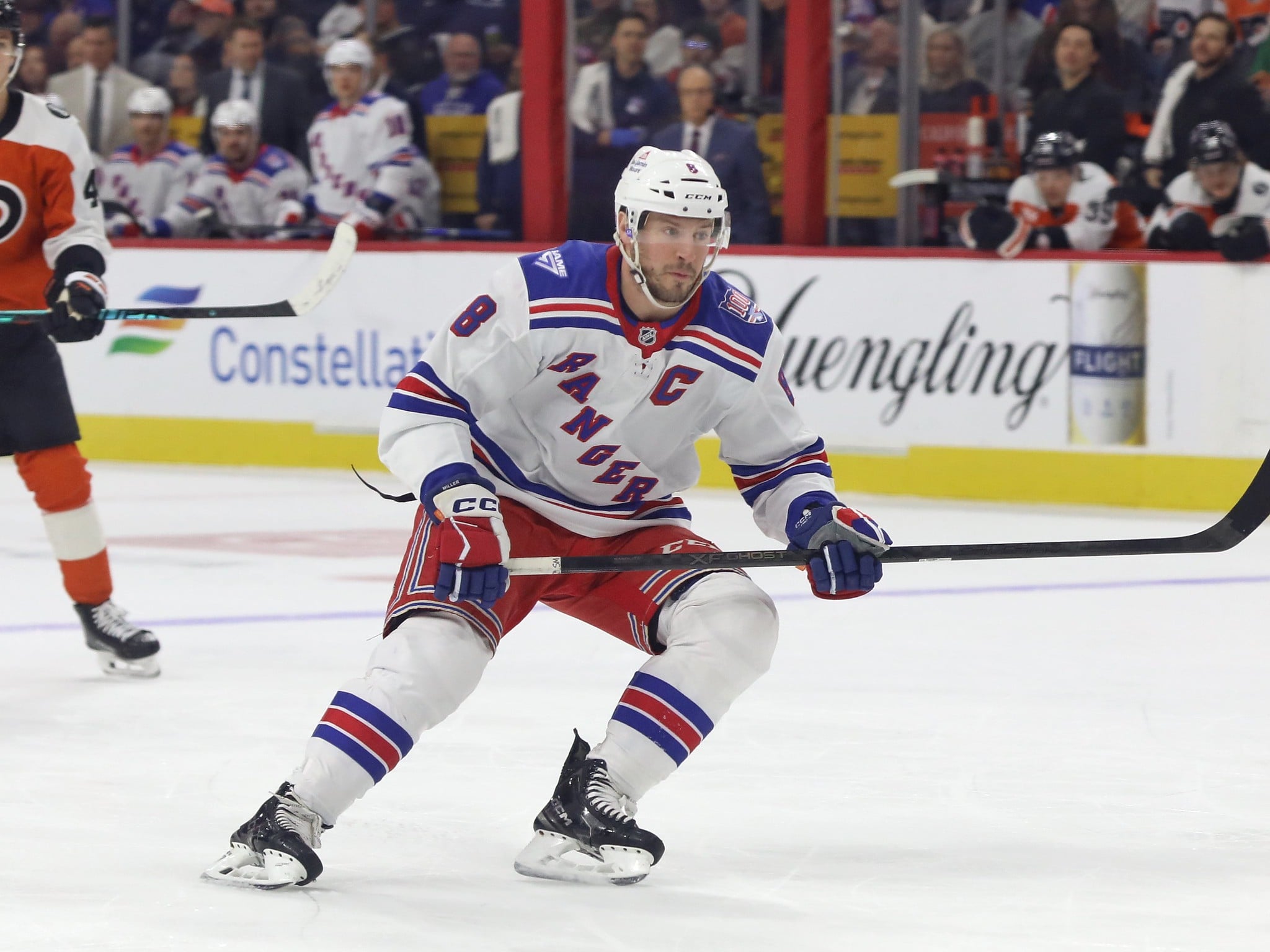
The Rangers made a bold structural choice this offseason: they moved Vincent Trocheck, a reliable two-way center who produced at a 1.17 points-per-game pace last season, to clear salary and offensive responsibility for a Mika Zibanejad–J.T. Miller tandem that will now carry far more weight than it did when Trocheck provided secondary scoring depth. New York added depth on the blue line (Sean Durzi, Marcus Pettersson) and on the wing (Pavel Dorofeyev, Oliver Bjorkstrand), but the franchise's offensive ceiling rests almost entirely on how those two veteran centers perform.
Zibanejad delivered last season in a way that softened the sting of his 2024-25 collapse. He finished with 78 points in 81 games, led the team in both goals (34) and assists (44), and rebuilt his defensive credibility after a season of uncharacteristic turnovers and poor positioning. His faceoff win rate (52.5%) and power-play production (16 goals, 19 assists) were elite-level. At 33, the question is whether last season represented a return to form or a spike he cannot sustain. The Rangers are betting on continuity, but a player his age operating at that usage rate—he was their primary center for six months—faces regression risk simply from volume and age.
Miller, by contrast, is the organizational bet that matters more. Named captain in the offseason following a strong stretch after his mid-season trade from Vancouver, he then cratered in 2025-26 with 17 goals and 36 assists in just 68 games. He was sloppy defensively, took unnecessary penalties, and failed to convert high-danger chances. The 33-year-old's faceoff work remained excellent (61.5%), but his offensive inconsistency and injury troubles signal a player who cannot be relied upon to produce at his earlier standard. For Miller to justify the captain's designation and the salary commitment, he needs to rediscover the 103-point pace he hit in Vancouver two seasons ago—a span of four years ago from today. That's not a minor variance play; that's a near-complete career rebirth at an age when players typically decline.
For prop purposes, Zibanejad's points total should be treated as a fade-and-fade-deeper proposition if it's priced anywhere near last season's 78-point pace. He may repeat it, but the mechanism that produced last season's output (high usage, elite faceoff work, power-play leverage) is front-loaded into the market already. If the line sits at 75+ points, the edge belongs to the under; if it drops to 65-70, the market has already corrected for aging-center risk and there is no clear angle. Miller's assists line is the sharper play. His assist rate dropped to 0.53 per game last season (down from 0.89 in Vancouver two seasons ago) and his shooting efficiency fell below career norms. If the Rangers book his assist total at 48-50 for a full season, lean under. The mechanism is simple: he was sloppy last season, took penalties that reduced power-play time, and lost chemistry with his wingers. New coaching or fresh linemates might help, but a 33-year-old captain with defensive lapses doesn't typically bounce back to 90-point seasons. The real test is whether he can stabilize at 55-60 points over a full 82 games—serviceable, not spectacular, and certainly not worth the organizational lever the Rangers have placed on his shoulders.
NHL Intelligence — Hockey intelligence beyond the scoreboard. Open NHL Intelligence →