McDavid and Dickinson Played Through Foot and Ankle Fractures in Oilers-Ducks Series — What It Means Going Forward
By PropBetEdge Editorial Team ·
The best player in hockey was broken — literally — and still suited up every night, which raises serious questions about how to price his props heading into next season.
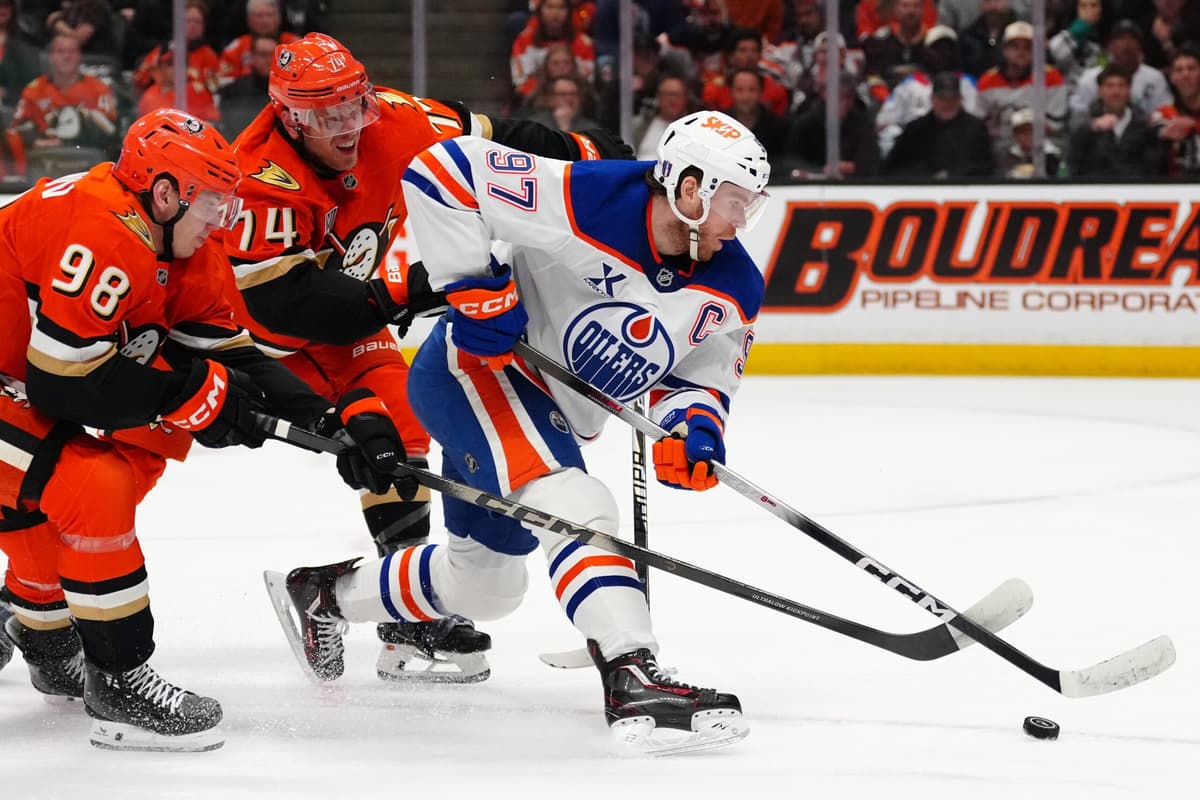
As TSN's Ryan Rishaug reported from Edmonton's end-of-season availability, Oilers head coach Kris Knoblauch confirmed that Connor McDavid and forward Jason Dickinson both competed through fractures in the foot and ankle area during the team's first-round playoff series against the Anaheim Ducks. The revelation reframes what many observers read as a soft performance from McDavid in spots — and it demands a harder look at how structural injury context gets baked into player props.
McDavid's ankle issue first surfaced visually during Game 2 against Anaheim, when he appeared to be moving with less than his usual explosive authority. That's a meaningful tell for a player whose entire offensive game is built on acceleration and the ability to create separation in a half-step. Lower-body fractures don't just limit skating speed — they alter weight transfer, shot mechanics, and the willingness to drive the net or absorb contact in high-danger areas. McDavid still produced, because he's McDavid, but the underlying numbers almost certainly suffered in ways the box score obscured.
Dickinson's situation is a separate but reinforcing data point. He's a depth forward whose value comes from physical engagement — board battles, shot-blocking, forecheck pressure. A fractured foot fundamentally compromises every one of those contributions. That both players were quietly shelved from full health while the team managed public messaging around "lower-body" designations is a reminder that playoff injury disclosure in the NHL remains one of the sport's most systematically exploitable information gaps.
For bettors, the retrospective here carries a forward-looking edge. McDavid's shots-on-goal numbers during the Ducks series should be treated as a floor baseline, not a ceiling, for any future prop pricing — he was generating offense on a fractured ankle. When he returns to full health in 2026-27, the market will reset his lines off recent sample data that was quietly suppressed by injury. His points and assists props in early-season games, before sharp money adjusts, are likely to be underpriced. Conversely, if there's any carry-over structural concern into training camp or the season opener, his shots-on-goal and anytime goal props deserve a fade until he demonstrates full explosiveness.
The broader takeaway is process-oriented: when the NHL's offseason availability cycle surfaces fracture confirmations like this, go back and audit the game logs. McDavid averaged his points under duress. A healthy McDavid in a normal series would have pushed those numbers higher. File this one away — the line-setters will forget by October.