Yzerman's Exit Opens Door on Larkin's Detroit Future—And Contract Comps Reshape the Flyers' Entire Payroll
By Erik Schwartz ·
Steve Yzerman's stepping down as Detroit's GM creates uncertainty around Dylan Larkin's trade request, while the Flyers face a cascade of salary comps that could push their star forwards into the $9-10 million range.
The NHL's offseason contract market is fragmenting along a single axis: what Leo Carlsson's $18 million offer sheet actually means for the tier of stars below the franchise core. Trevor Zegras and Jamie Drysdale now sit in a repricing vortex, and every dollar they ink will reshape the Flyers' forward and defensive construction for the next four seasons. But the real pivot lies in Detroit, where Steve Yzerman's departure as general manager introduces a variable that could flip Dylan Larkin's willingness to remain.
Start with Zegras. Before Carlsson's offer sheet, his camp was circling $9 million. Now, with Philadelphia having already committed $18 million AAV to a younger center, Zegras' agent Pat Brisson has structural leverage. The player finished last season one point behind Travis Konecny (the team's current cap anchor at $8.75 million AAV). A long-term deal in the $9.5-10 million range is now the floor, not the ceiling. Drysdale sits even more compressed: the Flyers wanted him at Cam York's $5.15 million mark months ago. Bowen Byram's recent mega-deal with Chicago lifted that expectation overnight. Drysdale, coming off a playoff run, will land in the $6.5 million AAV band on a three or four-year term. Between Zegras' raise and Drysdale's new floor, the Flyers have burned through roughly $3-4 million of fresh cap space they didn't anticipate losing.
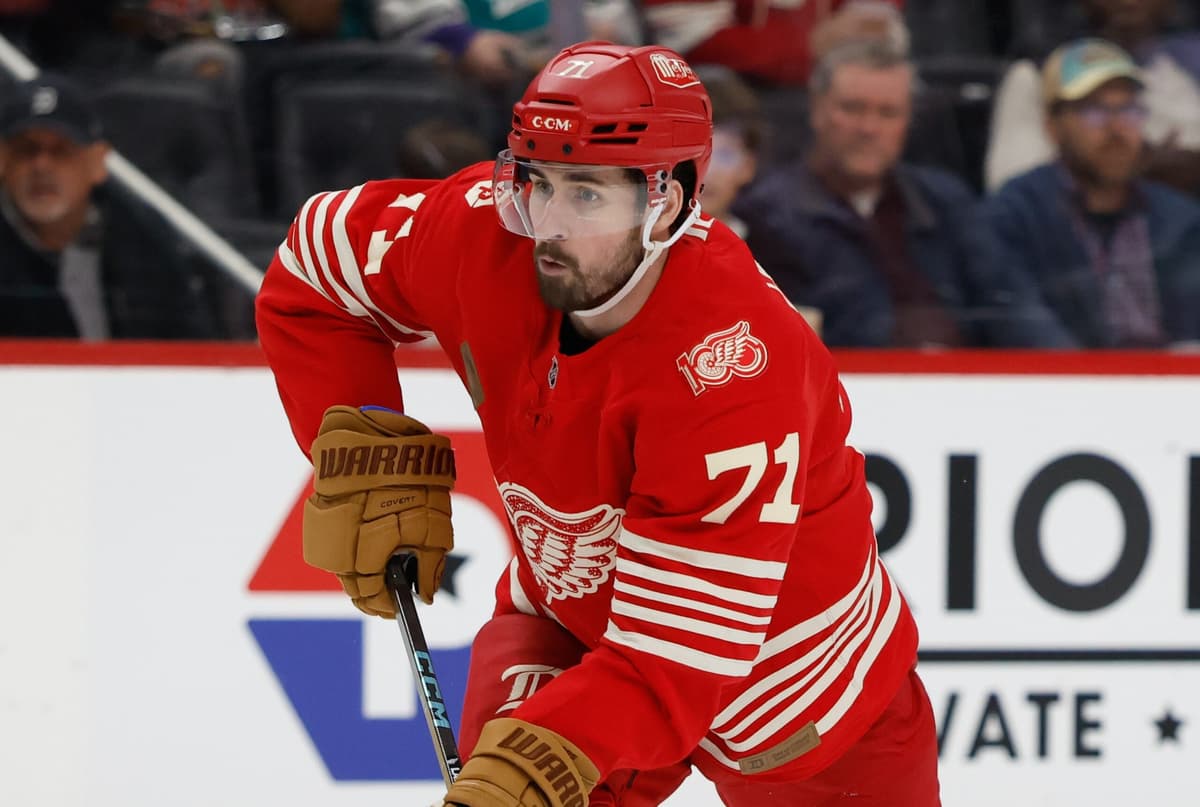
Detroit's situation carries longer tail. Larkin, under contract through 2028, filed a trade request tied to organizational dysfunction under Yzerman. The GM's departure signals change—but to whom and in what direction remains opaque. If the incoming Detroit brass charts a different course (or if organizational stability simply returns by default), Larkin's motivation to force out evaporates. A player of his caliber (1.03 points per game over the last three seasons) doesn't leave a stable organization willing to build around him. The market will initially assume Larkin stays put, pricing his futures—assists, points, games played—as a full-season Red Wing. If Detroit signals competence under new management before the trade deadline, that assumption holds. If chaos persists, the market reprices fast.
For bettors, the Zegras repricing is immediate and observable. His contract talks will resolve within days; the line on his AAV moves in real time. The Drysdale comp follows the same track. But Larkin's edge is timing-dependent. Early-season lines on his point totals and game-log props may still price him as a departing asset (reduced consistency, potential mid-season deadline impact). If Detroit's new GM establishes a credible plan in the first 10 games, those lines fail to capture his full offensive ceiling. A team that settles its core uncertainty tends to produce more consistent individual contributor performance.
The Flyers' cascade is the more durable angle because it's arithmetic. Konecny, Zegras, and Drysdale now form three of the top four salary slots, leaving minimal room for secondary scoring upgrades. The team's forward depth is constrained; production must come from existing, lower-cost anchors like Noah Cates and Christian Dvorak. Their workload and assist rates should rise relative to last season. Cates, in particular, moves closer to full-line minutes in a tighter roster, making him a candidate for elevated point production relative to his historical pace.