Yurov's Rookie Blueprint: Why Minnesota's 27-Point Freshman Maps to Sustained Upside
By Erik Schwartz ·
A self-aware rookie who logged 73 games in his first season while carving out chemistry with established Russian vets signals the Wild have a reliable mid-tier scorer entering year two.
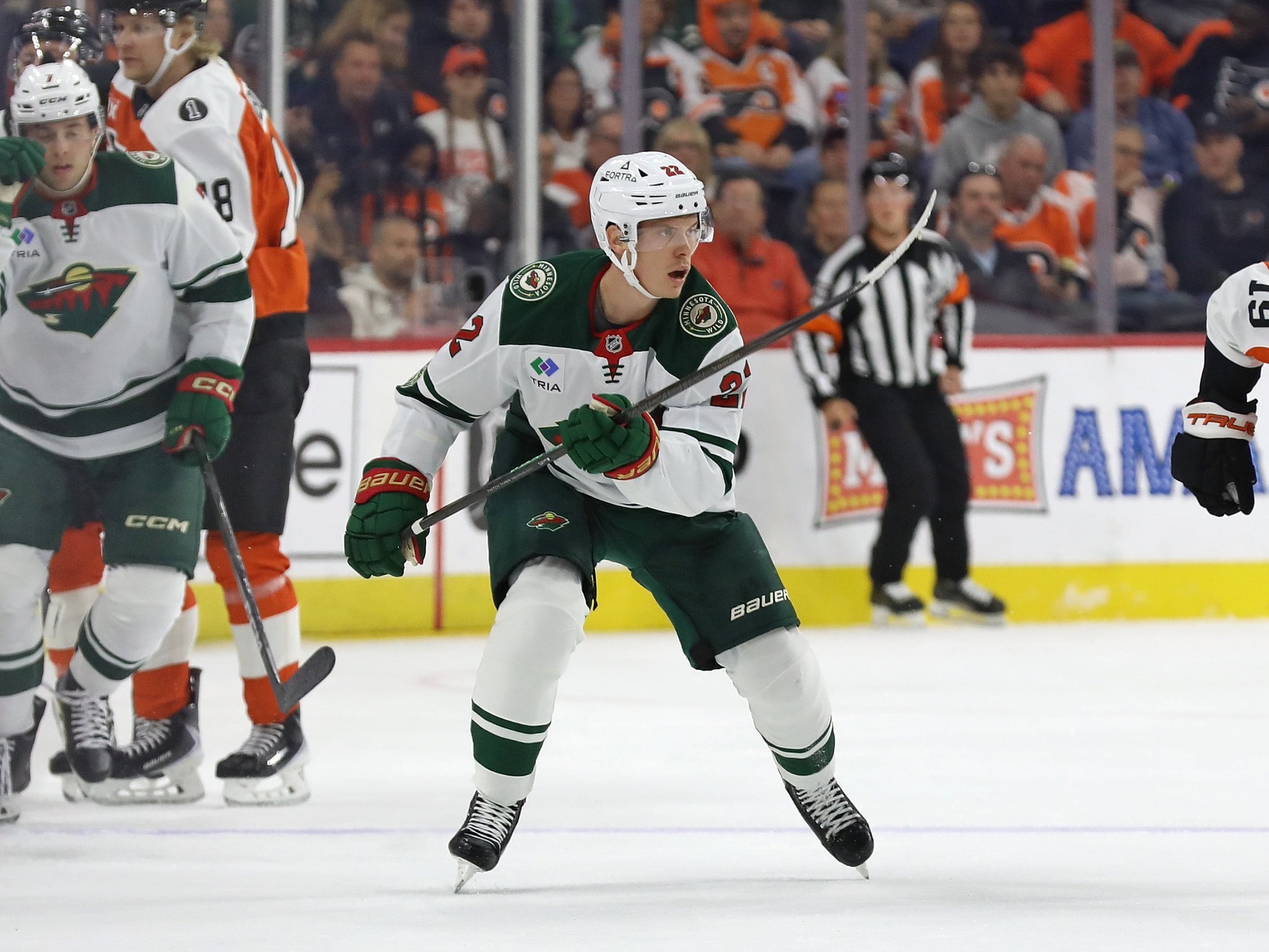
Danila Yurov finished his maiden NHL season with 27 points across 73 regular-season games for the Minnesota Wild, then added one goal and two assists in nine playoff appearances. The 24th overall pick from the 2022 draft spent much of his rookie year on a learning curve—limited to seven or eight minutes per night early on, working through the shock of North American pace and schedule—yet still produced at a rate that suggests he's settling into a functional role rather than chasing lottery outcomes.
What separates Yurov from the noise of typical first-year forwards is his positioning within Minnesota's infrastructure. He wasn't an isolated talent grinding through anonymity; he operated inside a Russian-language enclave that included Kirill Kaprizov, Vladimir Tarasenko, and Yakov Trenin. That cluster mattered. Yurov acknowledged the cultural and linguistic buffer it provided—easier communication, faster trust-building, simplified problem-solving mid-game. Tarasenko and Kaprizov functioned as de facto mentors, coaching him through the psychological shock of restricted ice time and the tactical adjustments required at the NHL level. By season's end, Yurov was confident enough to self-assess his campaign as a 4-out-of-5, meaning he's already absorbed the core lesson: there's mechanical room to grow without wholesale system changes.
The Wild's commitment to playing Yurov alongside his countrymen in stretches—an all-Russian line that generated "really good" chemistry according to Yurov himself—carries organizational signal. The team didn't hide him; they embedded him in a structure where communication overhead dropped and on-ice instinct could develop naturally. That deployment pattern, combined with his willingness to acknowledge five-to-seven left-point upside from year one, suggests Minnesota views him as a complementary scorer with a clear ceiling: the third-line winger who can swing between 50 and 65 points across a 82-game season depending on role inflation or injury displacement.
For prop bettors, this matters because Yurov's performance trajectory is no longer variance-driven. He's moved past the "what will he actually do at this level" phase and into the "what role does the team give him" phase. If the Wild suffer forward injuries or upgrade their third-line depth, Yurov's ice time and offensive output expand in a predictable direction—more minutes, more opportunities, higher point totals. If Minnesota stays healthy and upgrades elsewhere, his baseline holds: a 0.35-to-0.45 points-per-game floor across a 65-73 game sample. That reliability is worth monitoring in two-week rolling windows. A rookie who self-corrects and plays within a trusted system rarely experiences the catastrophic regression that torpedoes season-long bets.
Enter next season watching Yurov's early ice-time allocation and his pairing assignments. If the Wild continue the Russian-line experiment and he logs 12-14 minutes per night consistently, his 50-point projection carries low variance. If he drops below 10 minutes or gets shuffled into a fourth-line role, fade his season totals. The edge here isn't about whether he'll be good—the sample already confirms he's functional—it's about the team's commitment to his offensive deployment relative to the market's expectations at open.