McMann's Six-Year Deal Locks in Seattle's Top-Line Depth—and Signals Offensive Stability for the Kraken
By Erik Schwartz ·
Bobby McMann's contract extension rewards a late-season surge and cements the Kraken's commitment to sustained offensive production alongside Beniers and Eberle.
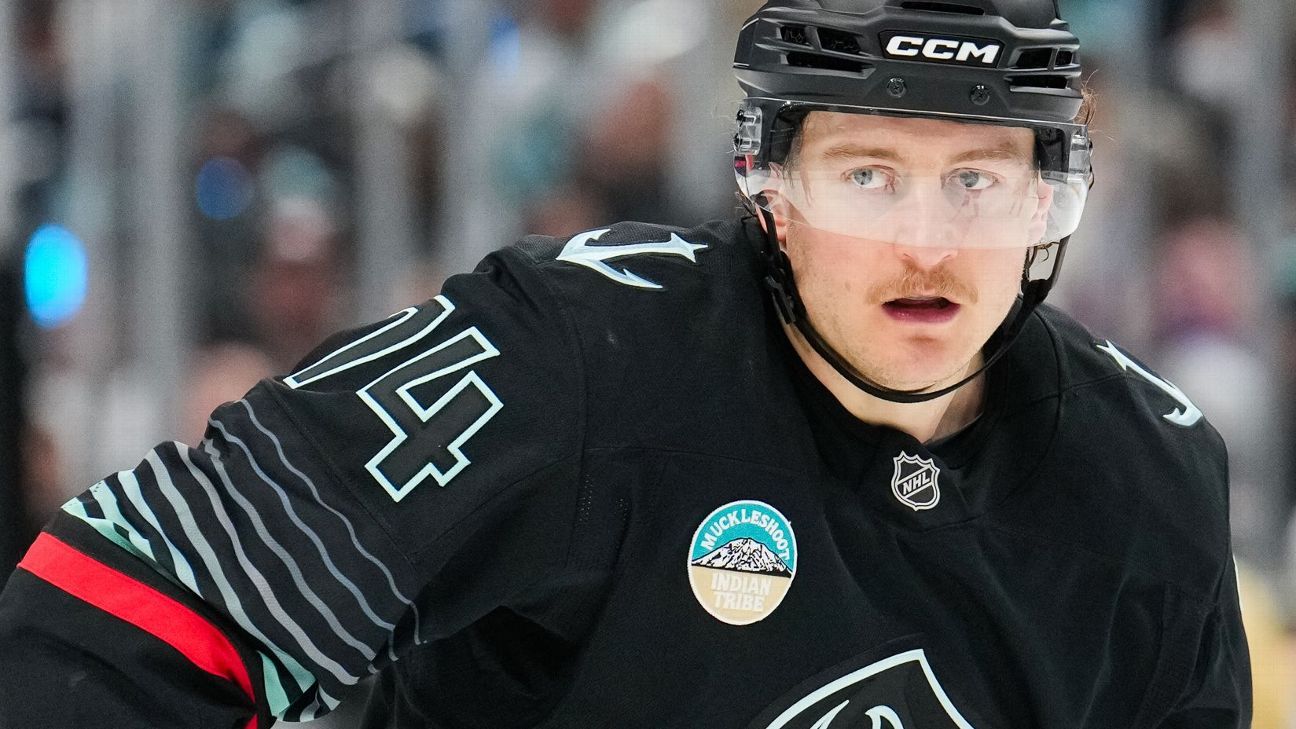
The Seattle Kraken signed forward Bobby McMann to a six-year deal Sunday, keeping the 30-year-old left wing in place after a career-defining 2025-26 campaign. McMann finished with 29 goals and 46 points—both career highs—after arriving from Toronto at the trade deadline, and the contract reflects the Kraken's confidence that his production floor has genuinely lifted, not merely spiked on opportunity.
The arc matters here. McMann spent two seasons under his previous Toronto contract at a $1.35 million cap hit before the deadline deal sent him west. With Seattle, he logged 17:57 per night on the top line with Matty Beniers and Jordan Eberle, collecting 14 points in 18 games. That pace (17.9 points per 82 games) vastly outpaced his career trajectory, but the consistency of deployment—top-line minutes, high-leverage situations, consistent linemates—signals the Kraken aren't betting on a fluky half-season. They're betting on a player finally handed the role and personnel to sustain elevated output. At 30, McMann's window is compressed, which likely accelerated the team's decision to lock in term now rather than test free agency.
The Kraken's broader summer moves deepen this bet. The same day McMann signed, Seattle acquired young winger Mackie Samoskevich from Florida for the 25th overall pick and a 2027 second-rounder. Samoskevich, at 24, is a reclamation project with elite tools but inconsistent application—the kind of prospect a team acquires when it believes its infrastructure (coaching, linemates, role clarity) can unlock dormant talent. Combined with McMann's extension, the Kraken are explicitly investing in continuity and incremental forward depth rather than star acquisition. That's a organizational statement: Lane Lambert's system is trusted, and the team believes it compounds returns on floor-level talent.
For prop bettors, this crystallizes a key pricing question. McMann's 46-point 2025-26 season will anchor season-long prop lines for 2026-27; the market will likely place his over-under in the 42-48 range, reflecting last year's total with modest uncertainty. But the mechanism for last season's production—top-line deployment, linemate stability, increased role—is now guaranteed through the length of the deal. The Kraken aren't cycling him to a third or fourth line; they've just committed $37+ million (estimated at $6.17M AAV, pending official cap confirmation) to keep him exactly where he was most productive. That removes a key downside tail risk that typically deflates season-long player props: role compression or linemate churn. If you fade McMann's points under due to skepticism about repeat production, you're now fighting a team-level bet, not a whim.
Conversely, overs on McMann's season point total at 44-46 carry lower variance than they would have as a rental or on a low-AAV deal. The Kraken just paid to preserve his context. The risk isn't role loss; it's injury or unexpected system change. That's a cleaner, more durable edge than betting on a journeyman's random hot streak.