Draft-Day Overvaluation in 2026-27: The Players Priced Above Upside
By Erik Schwartz ·
Fantasy hockey's consensus ADP rankings are overloading five name-brand players with durability red flags and statistical outliers that won't repeat—a pattern bettors can exploit by targeting their real-world props at discount.
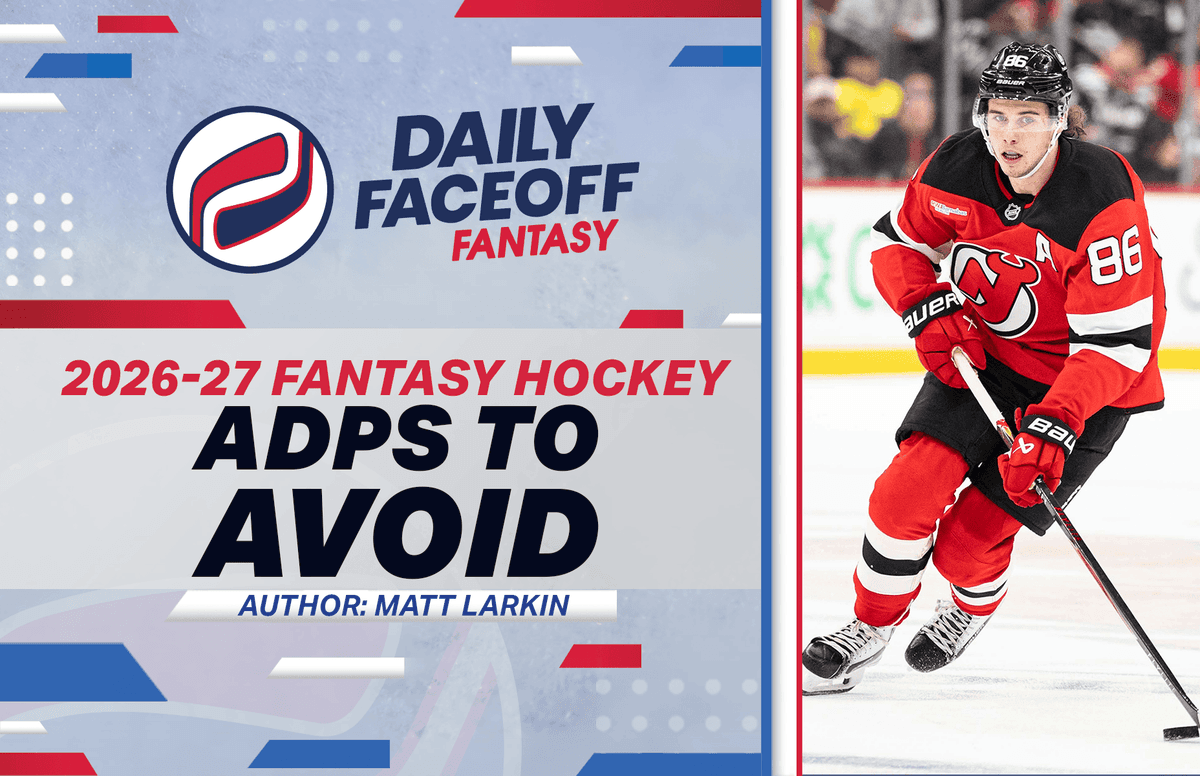
Every September, fantasy drafts reprice talent based on recency and narrative. The 2026-27 season is no exception. As Daily Faceoff's analytics identified, five established names carry ADPs that leave no margin for variance—and in hockey, variance comes in the form of injury, regression, and ice-time compression. This isn't about predicting career collapses. It's about recognizing when draft-day enthusiasm has already priced in ceiling performances, a tell that extends directly into how books will initially line single-game props on these players.
Jack Hughes sits atop the avoid list for a structural reason: he's missed 20+ games in four of his past five seasons, yet continues to go in the top 20 of most drafts. A 60-game projection at a top-five cost means zero margin for profit even if he stays healthy. The injury history is well-documented—it's not being underestimated by the fantasy community—but it's also not being priced into the ADP in any meaningful way. That same logic applies in real time: when Hughes lines enter at season-high prop ceilings despite a demonstrated pattern of missed time, the corrective bet is to fade overs on his shot, assist, and point totals until his games-played count stabilizes. Similarly, Jakub Zacha broke his career mold last season with a 30-goal output on a 22.9% shooting percentage against a 11.8% career average. A 9+ percentage-point efficiency spike over 131 shots is an outlier, not a baseline. Books will initially price Zacha's point and goal totals as if last year's conversion rate persists; the mechanistic edge is to target unders on goals and points until his actual shot volume and efficiency recalibrate toward historical norms.
Anton Stralman McAvoy carries a six-game suspension to open 2026-27 on top of a nine-season injury history where he's breached 70 games only twice and never played a full 80. His 2025-26 season delivered the best offensive output of his career—a probable outlier given the durability constraints. Donovan Mantha, age 33, just inked a free-agent deal despite averaging only 53 games per year over the past six seasons and sustaining a 21.7% shooting percentage (sky-high variance for a player of his type). His 33-goal season is unlikely to repeat when game availability alone tends to compress to 60 contests. Books will shade his goal and point totals high out of the gate, but the edge shifts as injury reports confirm his unavailability across the first month.
Ben Hutson represents the purest mis-pricing case: a hyped young defenseman drafted ahead of established, durable producers like Mikhail Sergachev despite being locked into the second power-play unit and third pair on the Washington Capitals. He's played 14 NHL games. The consensus expects 50+ points immediately. That's a ceiling scenario, not a baseline. His ADP inflation will cascade into early-season prop pricing that assumes PP1 usage and pairing time he won't receive. The mechanistic edge is to fade assists and points props on Hutson until Washington's actual deployment (second pair, PP2) becomes market-priced, which typically lags real-world deployment by 2-3 weeks. Books assume top-pair usage longer than ice time warrants.