McNabb's Ejection Tilts Vegas Game 5 as Poehling's Status Clouds Anaheim's Offensive Math
By PropBetEdge Editorial Team ·
A five-minute major and game misconduct in the first period leaves Vegas shorthanded and Anaheim scrambling to replace a center who was producing at a 0.4 goals-per-game clip in the playoffs.
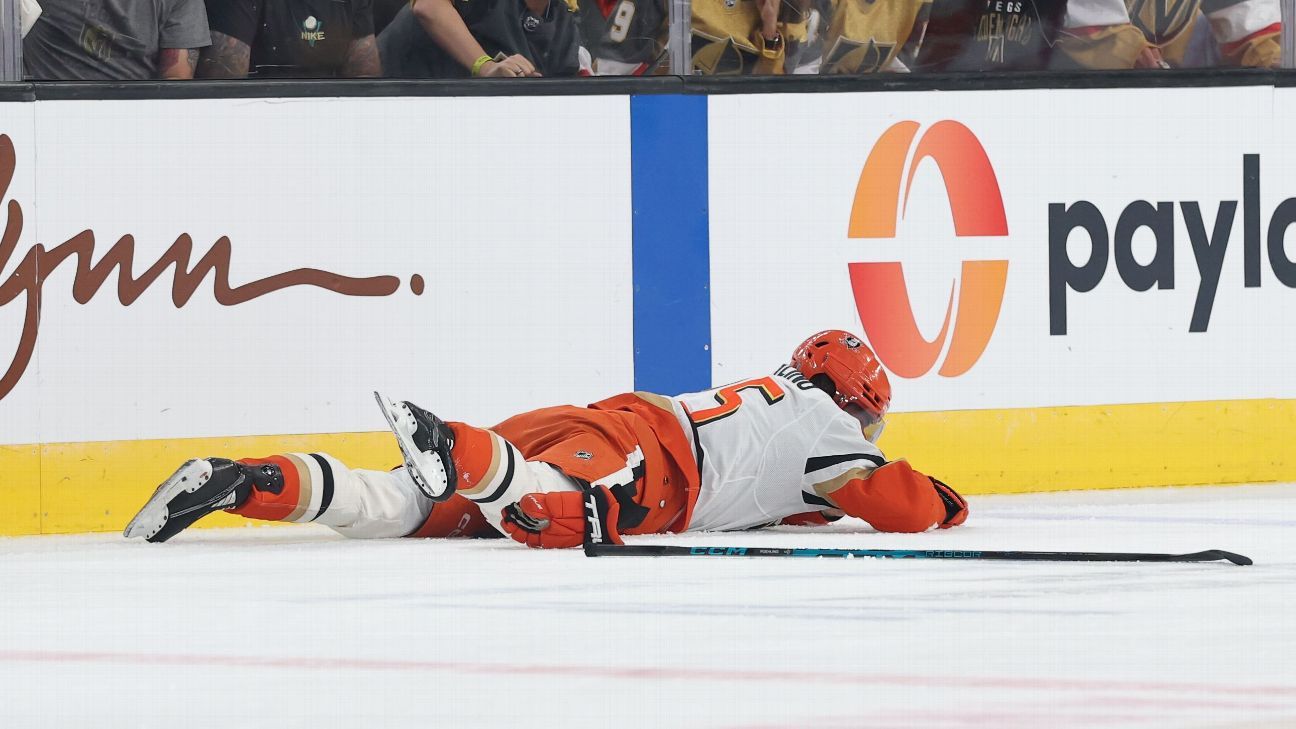
Brayden McNabb's shoulder check sent Ryan Poehling to the dressing room 8:36 into Game 5 on Tuesday, and the Golden Knights defenseman followed him there moments later. McNabb received a five-minute major for interference and was ejected with a game misconduct, leaving Vegas to finish the second-round contest without one of its top four defensemen in a tied series. Poehling, the Ducks center, took the brunt of the contact into the boards—specifically the back of his head against the glass—and failed to regain his feet on the first attempt. He was helped off and did not return, diagnosed with an upper-body injury.
The immediate tactical cost favors Anaheim in the near term. Poehling's absence is painful for Ducks depth, but it came with a five-minute power play that Anaheim cashed immediately: Beckett Sennecke converted a rebound with 7:24 left in the first, extending his own goal streak to four games. That power-play goal narrowed what had been Vegas's structural advantage—the Knights entered Game 5 with the series tied 2-2, and goaltending and shutdown depth had been the margin in their wins. Poehling had posted four goals and one assist in ten playoff games, a 0.4 goals-per-game rate that placed him in the middle tier of the Ducks' scoring hierarchy, behind the top line but ahead of role players. Losing him mid-series is a real subtraction, but the immediate benefit was a man-advantage that Anaheim executed.
Vegas's loss is structural. McNabb plays 20+ minutes per night in these playoffs and handles assignment flexibility—he can shadow opposing top lines or operate from the second pairing depending on game state. His ejection forces the Knights to either compress their defensive rotation or lean harder on their third pair in high-leverage situations. If McNabb is suspended, the math gets worse. Vegas's depth on the back end becomes a bottleneck: they lose penalty-kill flexibility, and their power-play defense—already tested in this series—thins further.
For prop bettors, the angle is asymmetric. Sennecke's four-game goal streak and his performance on the power play (he scored off a rebound, suggesting he's finding soft ice in the crease) suggests Anaheim's offensive unit will hunt for more advantage situations if Vegas remains short-handed. Monitor Sennecke's ice time and shot volume in the remainder of Game 5; if he's getting extended looks on the power play, his anytime goal probability climbs substantially. The inverse holds for Vegas: McNabb's absence compresses their offensive rhythm because they'll be defending more, not generating from the back end at the rate they were before the ejection. Team totals should shift downward for the Knights unless they can steal a win via goaltending theft—a high-variance outcome in a best-of-seven where game state matters more each contest.
Poehling's status for Game 6, if the series extends, is the hidden variable. Concussion protocol and upper-body injuries are evaluated day-to-day, and the Ducks' center depth is thin enough that his return matters on a slot-by-slot basis. Anaheim's fourth-line production and defensive pairing assignments change shape without him. That flow uncertainty is exactly what creates volatility in the moneyline market for the next game: the team that benefits from lineup stability usually outperforms the one forced to improvise. Vegas may face the longer adjustment window if McNabb draws supplementary discipline.