Colorado's Playoff Physicality Pivot Reshapes Defensive Matchup Math
By Erik Schwartz ·
The Avalanche have engineered a second-layer identity in the playoffs—nearly doubling their hit rate—and that structural shift rewires how to price their defensive prop exposure.
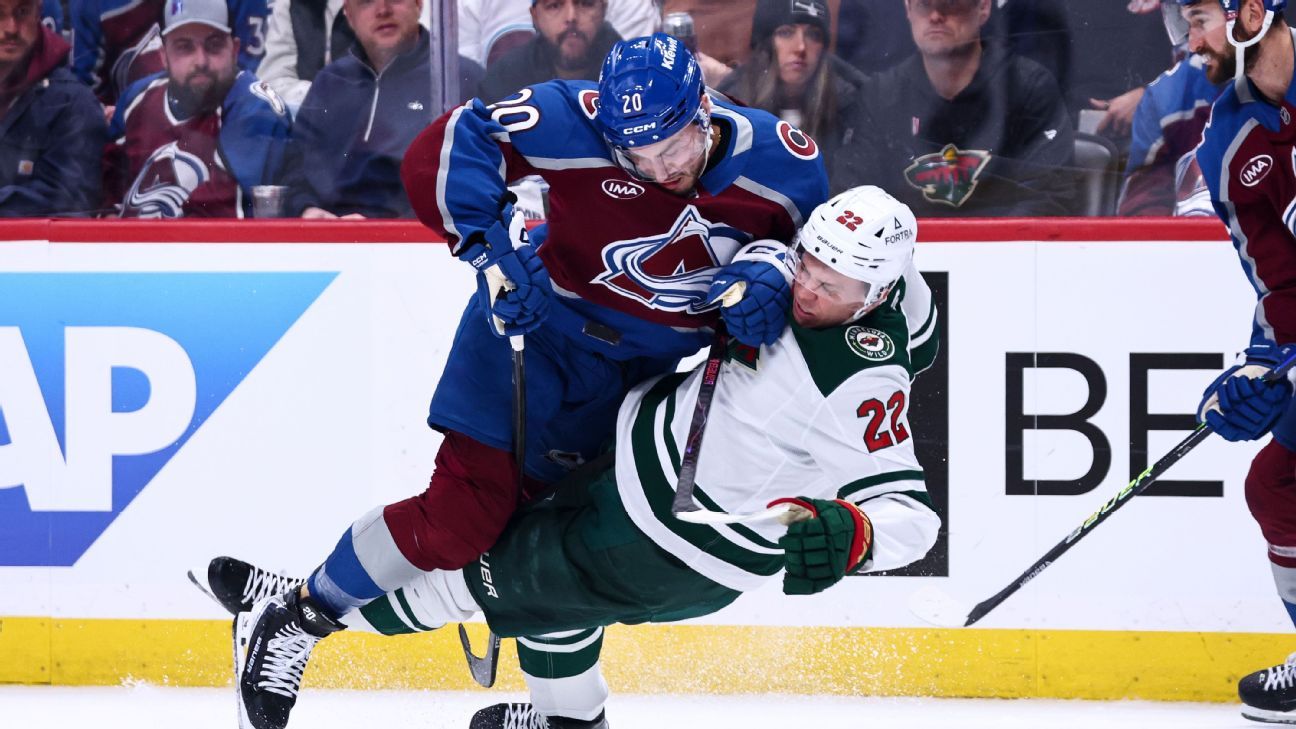
Colorado finished the regular season 31st in hits per game at 15.4, a deliberate choice by Jared Bednar that prioritized puck control and transition speed. In the playoffs, that calculus inverts. The Avalanche are averaging 35.6 hits per playoff game over the past four seasons—more than double their regular-season floor—and Game 4 against Minnesota pushed that to 32 hits in a single contest. The shift isn't random. Bednar restructured defensive pairings and forward lines specifically to tighten coverage and establish physical presence in tight spaces where speed advantage erodes. Fewer opportunities exist to create separation through skating alone when playoff teams compress their formations. Physicality becomes the tool to reclaim loose pucks and disrupt opponent rhythm.
What makes Colorado's approach distinct is the sustainability of the toggle. This isn't a single-game spike or a response to one opponent's style. The Avalanche have maintained this dual identity—skill-first regular season, contact-heavy playoffs—across four consecutive postseason runs. Gabriel Landeskog's framing is revealing: physicality isn't an explicit tactical instruction but rather an inevitable response to playoff density. The message filters down as acceptance rather than adjustment. When a team that ranks in the bottom five in regular-season hits seamlessly doubles that output in elimination hockey, coaching structure and player buy-in are clearly aligned.
The personnel mix deepens the angle. Colorado retained nine players from their 2022 Stanley Cup roster—institutional memory of what works when stakes tighten. Those veterans aren't experimenting with physicality; they're executing a proven formula. Bednar's lineup changes reinforce this: he's not inserting enforcer-type depth; he's repositioning his core defensemen into more direct contact roles. That's a design choice, not a roster swap. The shift lands heaviest on teams that built their game plan around Colorado's regular-season play style. Minnesota, for example, was likely scouted and prepared for a Avalanche team that plays perimeter-to-interior and generates separation through first-step quickness. A 32-hit performance disrupts that entire defensive framework.
For prop bettors, Colorado's physical escalation signals two pricing inefficiencies. First, blocked shots totals for Colorado opponents may not yet reflect the increased defensive traffic. A team averaging 35.6 playoff hits is generating more contested pucks, more deflections, more opportunities for their own defensemen to block shots in transition. If the market prices Minnesota or the next opponent's blocked-shot line based on regular-season frequency, playoff density will push that number higher. Second, Colorado's own shot volume on net—particularly from close range—should contract relative to first-round averages. They've taken 25 hits per game through their first seven playoff matches; sustained physical engagement reduces clean offensive opportunities. The Avalanche offset this with goaltending (another structural decision: Bednar shifted to a different starter, signaling confidence in playoff-specific strength) and secondary scoring, but their lead shot-taker profiles will see fewer high-danger looks.
The edge is structural, not ephemeral. When a team implements a 20-hit-per-game swing and that swing is rooted in coaching philosophy proven over four playoff cycles, the market doesn't correct it in 48 hours. It persists. Bet accordingly.