Kulich's 18-Month Health Recovery Sets Up Sabres' Top-Six Gamble
By Erik Schwartz ·
Buffalo's young center returns fully healthy for the first time since a blood clot halted his 2025-26 season, but his prop value hinges on whether team depth—and a year away from game speed—matter more than upside.
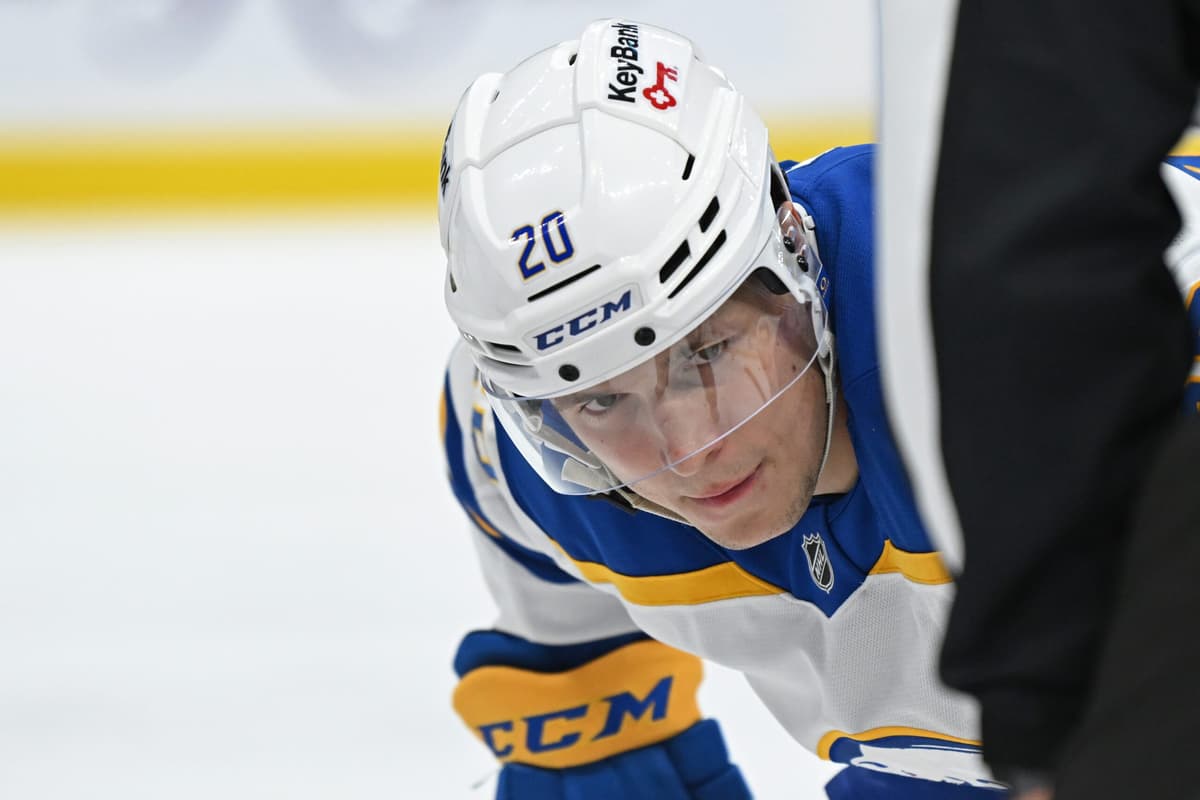
Jiri Kulich has spent the last 18 months learning what it means to disappear from your own life. On November 1, 2025, the 21-year-old Sabres forward took one shift in the third period against Washington and felt nothing—not pain, not fatigue, just absence. A CT scan revealed a blood clot. He wouldn't play another game that season.
The clot's origin traces back to March 2025, when Vegas's Brett Howden delivered a hit that sent Kulich into concussion protocol. What followed was a slow accumulation of dizziness, fatigue, and cognitive fog that worsened through the summer and into training camp. By the time he suited up for that final game in November, Kulich was already operating on fumes. An operation in March 2026 removed the clot. For the first time in nearly a year and a half, he's fully healthy and cleared to skate without medical supervision.
The Sabres' organizational context matters here. Buffalo won the Atlantic Division last season and clinched a playoff spot for the first time in 15 years—without Kulich. The team built depth, established chemistry, and proved it could compete at a high level. Now Kulich, who has 18 goals in 75 NHL games entering 2026-27, slots into that winning roster, but he's not the same prospect who left the ice in November. He missed most of a full season at a critical development stage. His last competitive game action was over 10 months ago. The Sabres are counting on him to slot into the top six immediately, but integration risk is real.
For prop bettors, this creates a timing trap. Early-season Kulich totals (goals, assists, points) will likely price him as a young star returning to an established playoff team—a narrative that sells. But the line doesn't fully account for the gap between practice conditioning and game speed after a 10-month absence. His assist rate and shot volume in October and November will almost certainly come in below his per-game baseline because he'll need 5-10 games to find his legs. The market has already moved on from his injury; it will treat him as an active player, not a recovering one. Lean under on his early-season point totals through Game 10, particularly if the line assumes he'll hit 0.5 points per game or higher. Once Thanksgiving arrives and he's played 15-20 games, reassess—the mechanical edge fades as game context normalizes.