Hurricanes-Canadiens Game 3: Why the Over at 5.5 Goals Has Real Teeth
By Ty Whitney ·
Carolina and Montreal are primed for a high-scoring playoff intensity clash, and the scoring models don't lie—especially after the first two games signaled which defenses are cracking.
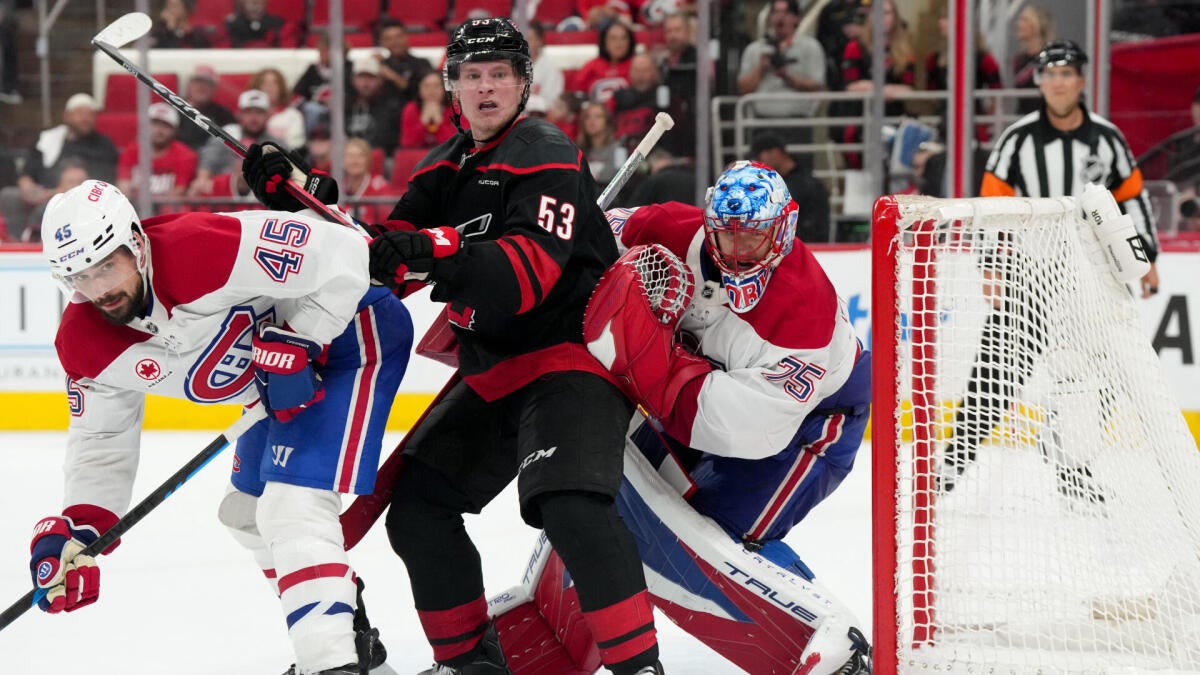
The Hurricanes and Canadiens square off in Game 3 of the Eastern Conference Finals at Bell Centre on Monday night with the series tied 1-1 after Carolina's 3-2 overtime escape on Saturday. This is not a matchup built for defensive stalemates. Both teams—the 1-seed Hurricanes at 113 regular-season points and the 3-seed Canadiens at 106—lean heavily on offensive depth, and the playoff intensity so far has done little to clamp down shot volume or second-chance creation.
The opening two games offer the clearest lens: high-event games with multiple lead changes and overtime football don't happen by accident. They reflect two offenses that maintain pressure through cycles and a pair of blue lines that are getting stressed when Carolina or Montreal transition the puck with speed. The Hurricanes' depth forwards—Jarvis, Niederreiter, Svechnikov—have generated consistent xG in both wins and losses this postseason. Montreal's secondary scoring around Cole Caufield has been active, and their forechecking has forced Carolina into multiple extra skaters and deep-zone dumps rather than clean exits. When you see that pattern in a best-of-seven, the Over becomes the structural play, not the recency play.
The model's simulation output reveals the scoring mechanism explicitly: Carolina is projected to allow 2.78 goals while generating enough expected offense to cross 3.0, and Montreal's defense is modeling similarly permeable (2.78 against). The combined expected total of 5.9 goals sits above the 5.5 line by a meaningful margin—nearly half a goal in expectancy terms. More granularly, Seth Jarvis and Cole Caufield's per-game projection (0.39 and 0.51 goals respectively) aggregates across the team's forward groups into a high-frequency scoring environment. Frederik Andersen projects to face 21.6 shots per game and Jakub Dobes 25.0. Those workloads are not typical of tight defensive hockey; they indicate sustained offensive pressure and multiple Grade-A looks per period.
Historical context reinforces the edge: the Over has landed in four of the last six head-to-head matchups between these franchises, a 67% clip that persists because the roster composition hasn't shifted. Montreal still skates small and aggressive in the offensive zone. Carolina still generates mid-range volume through Jarvis and linemate Teuvo Teravainen's playmaking. When two teams with those structural tendencies meet in a tied playoff series, they don't suddenly play 2-1 hockey. The over-under at 5.5 is priced as though one of these offenses will collapse—a bet against the data.
The real marginal advantage here isn't betting the total in isolation; it's recognizing that Carolina, as the -136 favorite, has to play with a lead and margin of safety. That creates a specific opening for Montreal in the second and third periods—trailing teams get more offensive deployment, which paradoxically pushes the total higher by forcing Carolina to match pace rather than sit on a one-goal edge. The Hurricanes can't play a 2-1 game if the Canadiens are going full-throttle to equalize. Over 5.5 is the play that survives both scenarios.