Montreal's Home-Ice Drought and the Andersen Problem: Game 3 Betting Lines Miss Structural Weakness
By PropBetEdge Editorial Team ·
The Canadiens have surrendered their Game 1 road dominance to Carolina's overtime mastery, but the real concern—Andersen's fragile play and Montreal's top-line shot creation at home—offers an edge on total and player props that oddsmakers have yet to fully reprice.
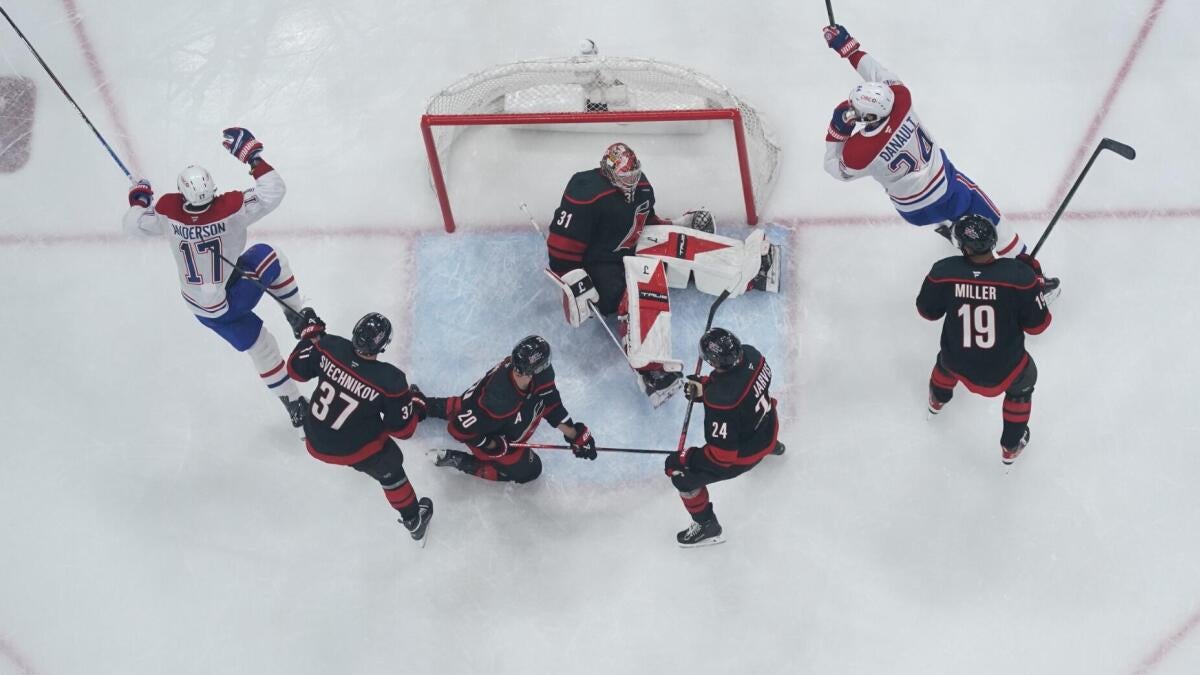
The Hurricanes stole Game 2 in overtime on Saturday, erasing Montreal's Game 1 highway robbery and resetting the series at even. Nikolaj Ehlers' go-ahead goal at 3:29 of OT capped a 3-2 victory in Raleigh, marking Carolina's sixth straight playoff overtime win—a scorching run that propelled them to -205 series favorites despite surrendering Game 1 at home. But the series swings to Bell Centre on Monday night, and Montreal's home-ice advantage in best-of-7 play before the Cup Final carries real historical weight: 22-2 all-time with the lead. That context matters. What matters more for bettors: the structural vulnerabilities exposed in Game 2 are visible to the naked eye but not yet fully reflected in the market's adjusted prop totals.
Frederik Andersen's performance has deteriorated from concerning to alarming. In the 6-2 Game 1 loss, he was porous. In Game 2's victory, he stopped only 10 of 12 shots—a 83.3% save rate—on a light 26 shots on goal from Carolina. For a goaltender who entered these playoffs at a 92.1% save percentage, this is not variance; this is a measurable decline in positioning and rebound control. Andersen is now a +600 third choice for Conn Smythe, a market signal that sharp money has already begun to worry about his durability as the postseason deepens. Carolina's coach Rod Brind'Amour deployed his top defensive pairing directly against Montreal's elite first line—Suzuki, Caufield, Slafkovský—throughout Game 2, and it worked. That line generated one scoring chance and four shots on goal in regulation, a stunning collapse from a Game 1 performance where they dictated the pace. More damning: the Canadiens managed zero power-play shots across two man-advantage opportunities, suggesting systems breakdown under playoff pressure, not talent deficiency.
Montreal's home shroud this postseason is real, though the narrative often overstates it. The Canadiens have indeed struggled at Bell Centre relative to their road form, but the composition matters: they've faced elite defensive systems and have been unable to generate quantity when forechecking leverage flips. At home, they regain last line change—a critical edge that Brind'Amour exploited away. Suzuki's split tells a sharper story: 13 points in 13 playoff wins, two points (both assists) in seven losses. This is not randomness; this is a player whose offensive gravity collapses when the Canadiens' structure breaks. Game 2 forced Montreal into a reactive posture, and Andersen's weakness became Carolina's path to overtime. Game 3 reverses both dynamics: the Habs dictate matchups, and Andersen faces a Montreal offense that scored 21 goals in four regular-season meetings this year against the same opponent.
The market has adjusted Game 3 odds toward Carolina (-205 series, implying roughly 67% series win probability), but the prop totals—particularly Andersen's save line and Montreal's team shot volume—have not caught the full depth of what Saturday revealed. Andersen's next outing should carry elevated save-total volatility: if the Canadiens generate 30+ shot attempts (fully plausible at home), his save percentage will be tested against a goaltender now statistically vulnerable. Conversely, if Montreal's top line regains its Game 1 dominance with last-line-change control, Suzuki's assist line becomes a high-leverage play; his playoff assist rate jumps to 1.0 per game in wins versus 0.29 in losses. The underlying mechanism is clear: when Montreal owns the first shift against Carolina's defensive line, Suzuki sees more slot touches and more secondary playmaking opportunities.
The dangerous tell for bettors chasing unders on Game 3 total goals: that reasoning rests entirely on Montreal playing bad again. But the Canadiens were not bad in Game 1; they were methodical and clinical at 5v5 (outshot 21-10 over the season series). Game 2 bad came from defensive-line deployment that now flips to Montreal's favor. The Hurricanes' overtime mastery masks an underlying weakness—Andersen's struggling play—that home ice and last-line-change leverage will expose across 60 minutes of regulation. The question for oddsmakers is whether they've priced in that structural flip or merely reacted to the series result.