Carolina's Top Line Is Bleeding High-Danger Chances Against Vegas—and the Market Hasn't Priced the Adjustment
By PropBetEdge Editorial Team ·
Svechnikov, Aho, and Jarvis generated only 45 percent of expected goals in Game 1 despite heavy ice time, a drastic departure from their 56 percent regular-season baseline that opens a clear prop-targeting window.
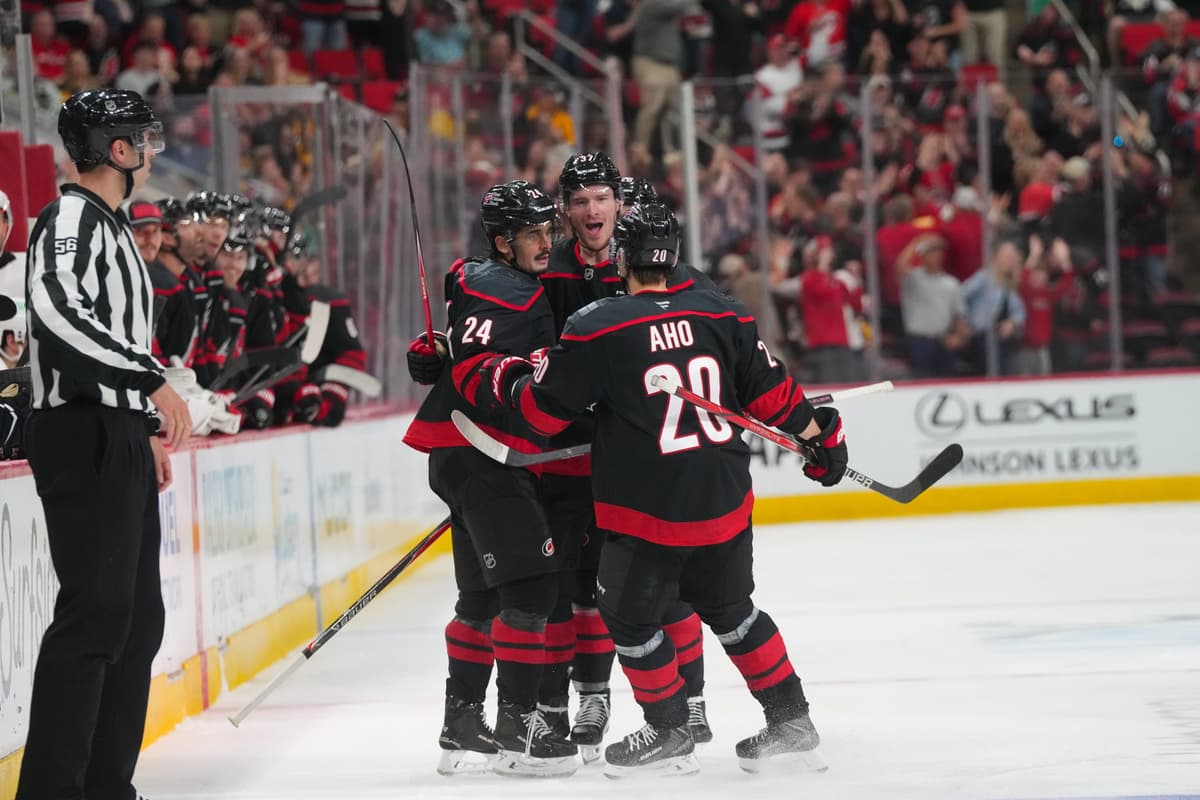
Carolina's top line entered the Stanley Cup Final as the backbone of the Hurricanes' offensive identity. Andrei Svechnikov, Sebastian Aho, and Seth Jarvis combined for clutch moments throughout the playoffs—an overtime winner, five points in five games, series-clinching goals—but in Game 1 against Vegas, they registered only four points combined across 5-on-5 play while being outscored 4-2 when skating together. That's the surface. The underlying damage cuts deeper: when that trio was on the ice in Tuesday's 5-4 loss, Vegas held a 54.53 percent expected goal share, flipping the Hurricanes' regular-season dominance (56.21 percent xG%) into a territory where Carolina's elite scorers became net defensive liabilities.
The mechanism isn't randomness or a single bad night. Vegas constructed a gameplan specifically designed to blunt Carolina's stretch-pass forecheck and force plays in the defensive end rather than the attacking end. The Golden Knights' sweep of Colorado—the regular season's most dominant team—proves they've mastered the science of suffocating top-tier offensive talent. Against Svechnikov-Aho-Jarvis, Vegas generated high-danger chances at nearly double their expected volume. Seth Jarvis was robbed on a late-third-period glove save that could have shifted momentum, but that single near-miss masks a larger truth: the line wasn't generating the volume it needs to sustain championship-level production. A 39.32 percent expected goal share in one game is noise; sustained below 45 percent in a seven-game series becomes a trend card.
Rod Brind'Amour faces a tactical decision that will ripple through the prop markets. Keeping the line intact assumes they'll regress upward to their baseline (unlikely against a Vegas defense that now holds film). Splitting them offers variance—Aho paired with a different winger might chase better matchups, Svechnikov could hunt one-on-ones in transition. Either way, their individual shot volume and goal-creation rates will contract if the line's xG% stays compressed. The market opened with standard playoff-line pricing: Aho 1.5 assists, Svechnikov 1.5 points, Jarvis 0.5 goals. Those lines were built on postseason performance (where the trio averaged 0.5 PPG per player) and regular-season baseline (where they were 56% xG%). The book didn't price for the specific Vegas-scheme adjustment that hollowed out their chance quality in Game 1.
The edge exists on the UNDER side of both assists and points for this line in Game 2, assuming the line stays together and Vegas repeats its defensive structure (which they will—it worked). Vegas will not retreat to a neutral forecheck. Carolina will not suddenly generate clean looks from distance. Jarvis, Svechnikov, and Aho are still elite players; that doesn't change their assignment difficulty. The prop line movement will lag the underlying shift in expected output. If the books haven't already adjusted assists totals down by 0.3-0.5 per player, there's dead money in fading the assists over at current numbers through the first 48 hours after Game 1. This isn't a fade on talent. It's a fade on the assumption that postseason baseline plus regular-season ceiling still applies when a team with sweep-level defensive chops has video evidence that it doesn't.