Joel Nystrom's Defensive Metrics Signal a Durable Depth Addition for Carolina's Blue Line
By PropBetEdge Editorial Team ·
A rookie defenseman's elite underlying numbers suggest the Hurricanes have found a reliable third-pair option, which matters for their shutdown efficiency and goalie workload.
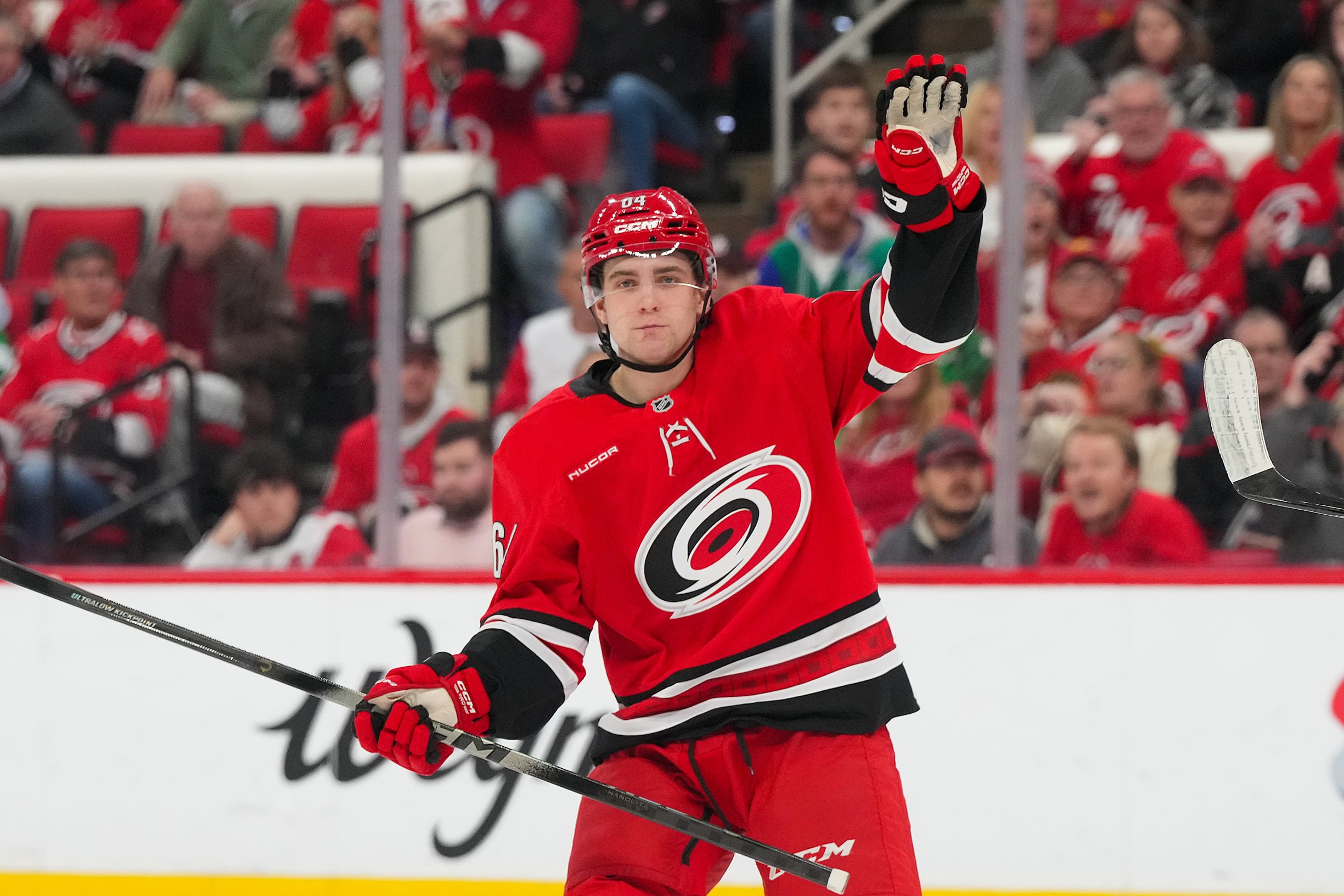
Joel Nystrom has secured an NHL roster spot with the Carolina Hurricanes after a 38-game cameo last season that exposed a rare combination of analytical excellence and grit. His xGA/60 of 2.32 at even strength ranked best among all Hurricanes defensemen to log 200+ minutes—a defensive ceiling that didn't require sheltering or inflated save percentages to sustain. The fact that only Mike Reilly posted a lower GA/60 (1.80 to Nystrom's 1.95) in Carolina's elite defensive ecosystem signals this wasn't a variance spike; the underlying suppression was real.
What makes Nystrom's profile valuable to the Hurricanes' system is his assignment profile. He spent 219 minutes alongside Alexander Nikishin on the third pairing and 112 minutes with Reilly, meaning his elite shot-suppression numbers didn't emerge from shelter—they emerged despite playing meaningful minutes in a complementary role. That distinction matters. A defenseman who holds elite xGA/60 while paired with weaker partners is less likely to collapse when matched against tougher competition, because the responsibility isn't being artificially tilted. The Hurricanes, built on defensive foundation and goaltender protection, don't need Nystrom to score (his 1 goal and 9 assists in 38 games confirms that expectation). They need him to suppress volume.
The deeper signal lies in contract valuation. A four-year deal for a rookie defenseman with one partial season of sample suggests the organization has already priced in persistence—that 2.32 xGA/60 looks sustainable to their analytics staff, not a one-season anomaly. Nikishin and Reilly are established; Nystrom's addition increases Carolina's depth on the back end, which raises the floor on games where the top-four defensemen face fatigue or matchup constraints. The Stanley Cup run last season put miles on every player; a reliable third-pair option reduces leverage situations for the franchise's minute-allocation strategy.
For bettors tracking Hurricanes goalie workload and team defense totals, Nystrom's elevation matters because it increments the total expected defensive play-suppression minutes available to the team. Last season, Carolina allowed 1.95 GA/60 with Nystrom in the lineup at even strength. Across the full season with a deeper blue line, that efficiency baseline is more likely to hold even when the first and second pairs face heavier demand. Teams that efficiently suppress shots from the back out tend to move moneyline and spread numbers more predictably because the variance band tightens. A defenseman who posted 2.32 xGA/60 doesn't guarantee lower-variance games, but he shifts the probability distribution.
The edge here isn't a single-game prop call; it's a season-long positioning statement. Hurricanes totals—both team goals and goals against—should be approached with recognition that Carolina's defensive depth is meaningfully improved from the regular-season roster that won the Cup. If the market hasn't yet repriced Carolina's defensive ceiling upward for 2026-27, any movement toward tighter team-total unders carries limited edge because the data will move it the opposite way. The real value emerges when Carolina's opening-night totals are set; bettors should monitor whether that four-year Nystrom contract signals a defensive commitment that Vegas has priced conservatively.