Blown Leads Define Stanley Cup Final: Why Volatility Props Matter More Than Series Trends
By Ty Whitney ·
Every game in the 2-2 series has featured a multi-goal meltdown, signaling that momentum swings—not steady execution—will dictate the outcome.
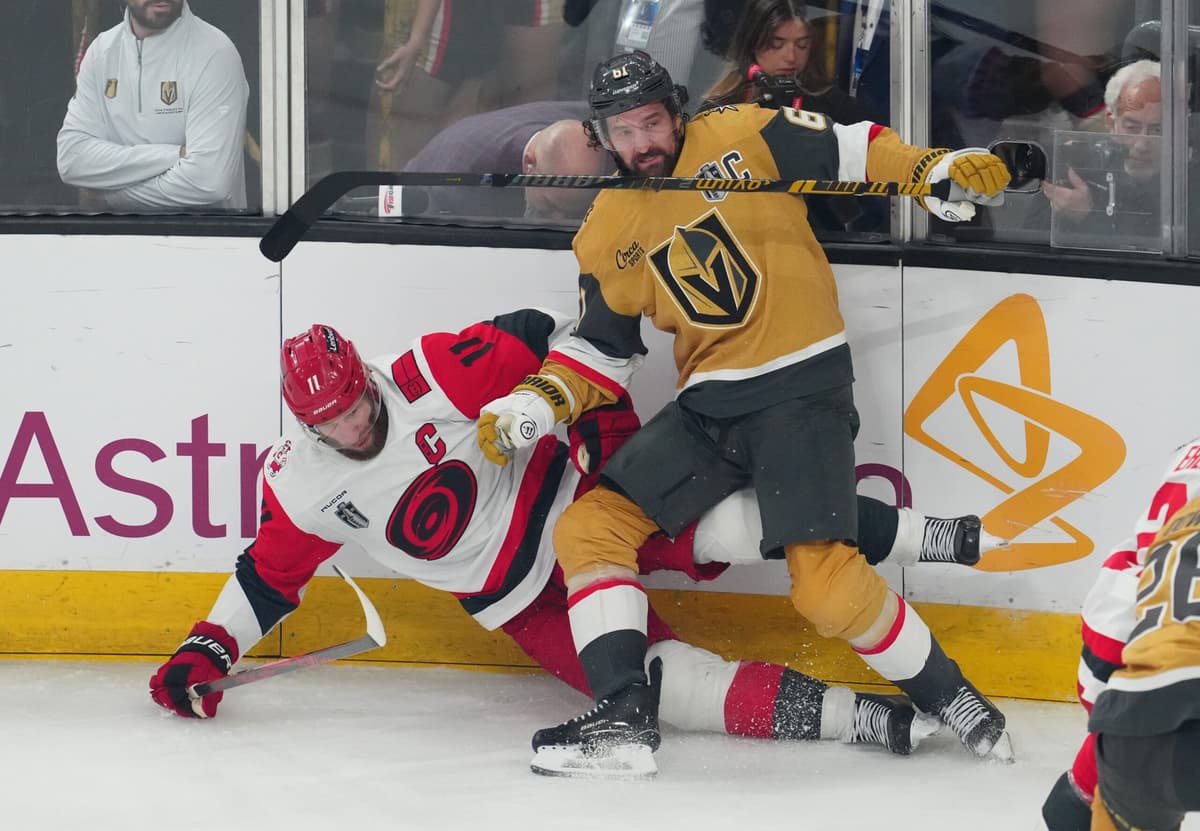
The Carolina Hurricanes tied the Stanley Cup Final at 2-2 on Tuesday with a 5-3 win over Vegas, but the scoreline masks the deeper pattern emerging from four games of hockey that resembles a violent pendulum rather than sustained dominance. All four contests have featured a team surrendering a multi-goal lead, which means neither offense has held ground once the opponent seized the momentum. This isn't tight hockey masquerading as volatile—it's a genuine structural feature of how these teams play, and it has direct implications for how to bet the remaining games.
The Hurricanes and Golden Knights don't grind opponents down through incremental possession edges or shot volume. Carolina overwhelms through relentless wave forechecking that tilts the ice for 10-minute stretches, forcing Vegas into reactive hockey. When the Knights regain their footing, they deploy their star power and two-way depth—Mark Stone's physical presence, Shea Theodore's evolution into a legitimate threat on both ends, Brett Howden's surprising elevation to a scoring role—to reestablish control. The result is a series where taking a two or three-goal lead feels provisional rather than commanding. Both teams possess the structural tools to flip the ice quickly, and they've proven willing to execute those flips repeatedly across 240 minutes of play.
This dynamic creates a specific volatility signature for Game 5 and beyond. Teams that lead early will face a Hurricanes forecheck designed to neutralize that advantage through suffocation rather than a counter-attack. Vegas, conversely, will lean on transition and skilled playmaking to create space in chaos. Neither team has shown the defensive discipline or shot-blocking concentration required to protect a lead for a full period. The pattern holds: one team takes over, the other team answers, the lead evaporates, a new lead emerges.
For prop bettors, this translates into a narrow but actionable edge. Totals in Games 5 and 6 should be priced assuming defensive stability and period-by-period momentum retention—the typical market assumption for Conference Finals and Cup Finals hockey. Instead, the evidence suggests goal clustering: once one team scores to seize the lead, the opposing team's score within the same period or early in the next one with above-average frequency. This pattern reduces the value of overs or unders at static totals and increases the value of in-game live betting on goal scorers and power-play conversion during turnovers. Specifically, lean toward goal-scoring props for both teams during the first five minutes after a power play—the Hurricanes' forecheck creates loose pucks that Vegas converts on the rush, and Vegas's star-driven transition creates clean looks that Carolina's speed game can't recover from. This isn't a multi-game trend; it's a series-structural signature that will fade once one team establishes defensive discipline, but it holds through Game 7 if this pattern persists.