Tuch's Exit Reshapes Buffalo's Offensive Load—and Your Prop Angles
By Erik Schwartz ·
With Alex Tuch heading to free agency, the Sabres' remaining wings face a massive volume spike that could inflate both their individual totals and team scoring projections.
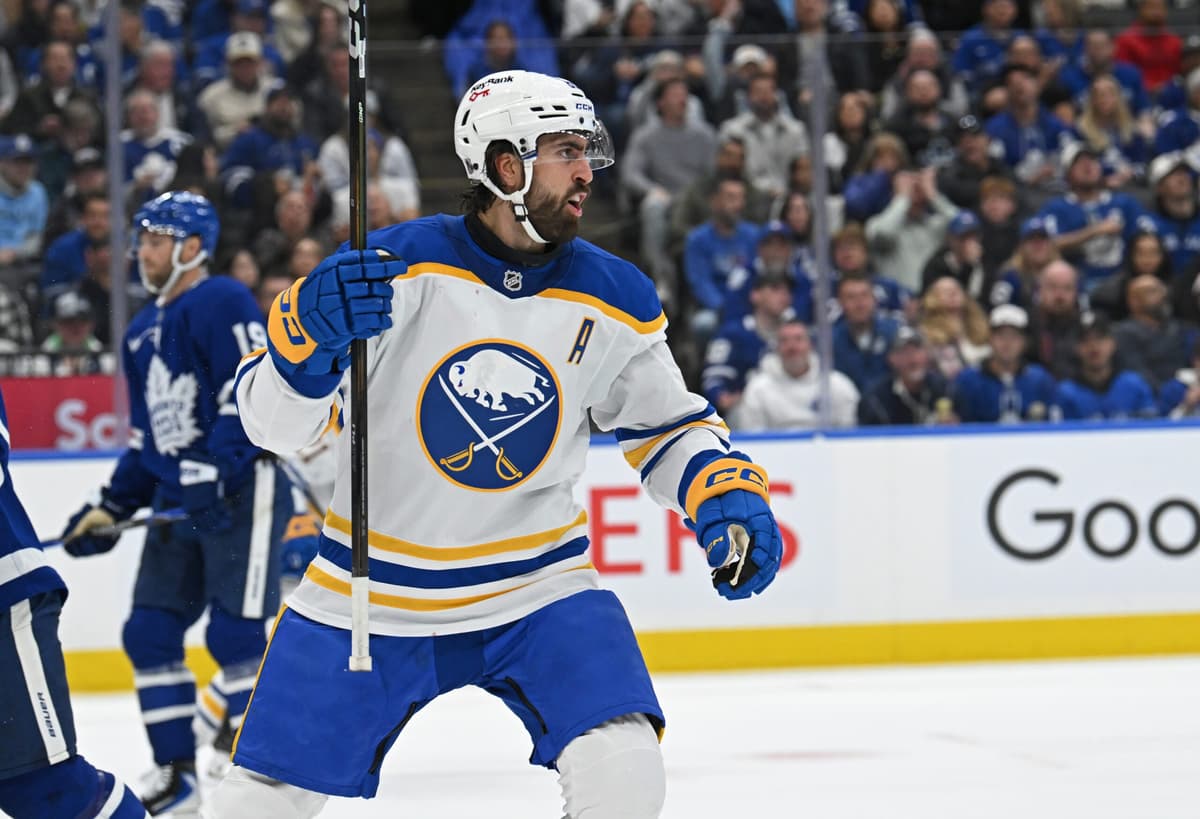
Buffalo's front office confirmed Wednesday that Alex Tuch will not return on a contract extension, with GM Jarmo Kekalainen acknowledging the veteran winger's departure as the Sabres pivot toward a rebuild. Tuch produced 66 points across 79 games this season—a credible 0.84 PPG pace—but Kekalainen's refusal to extend him signals the organization's calculation that retaining him conflicts with their asset-allocation priorities, especially after trading Bowen Byram and Jordan Greenway to Chicago for draft capital (Nos. 4 and 45 picks plus defenseman Louis Crevier). The open market awaits on July 1, though a sign-and-trade to Washington is being explored.
What matters for prop bettors is the mechanical consequence: 66 points no longer distributed across Buffalo's roster means his ice time, offensive touches, and primary assist opportunities evaporate. Last season, Tuch logged roughly 18:30 per game with consistent third-line or second-line deployment depending on injury fluctuation. That's not replacement-level depth; that's top-six responsibility. The Sabres' remaining offensive core—Jeff Skinner, Tage Thompson, Dylan Cozens—now absorb his shift load and secondary scoring opportunities. Skinner and Thompson already command 50+ shots per season; adding Tuch's plate to their net creates a measurable assist-rate lift.
Cozens, in particular, functions as a conditional play. If Kekalainen deploys him as a de facto second-line winger or co-sniper with Thompson (rather than his traditional center role), his shots-on-goal floor climbs and assist volatility rises. Thompson and Skinner also see their team-total-points-scored expectancy tick upward relative to the same defensive matchups, because more of Buffalo's possessions flow through clearer primary scorers. The backfill is either a depth acquisition or an internal promotion—neither scenario replicates Tuch's shot volume or finish rate.
For live market angles: Buffalo team total season projections should compress slightly (Tuch at 0.84 PPG leaves a 66-point gap that a replacement-level winger closes by maybe 35-40 points). However, individual player props for Skinner, Thompson, and Cozens may not fully adjust immediately, because sportsbooks often price departures as pure subtraction without re-weighting the beneficiary load. If Thompson opened the offseason at 85 points but Tuch's vacancy adds 4-6 expected points of secondary assist flow to his total, books may not price that uptick until sharp action forces a move. The edge persists until lines move, which typically occurs within the first two weeks of preseason exposure or once season-opener odds surface.
Kekalainen's stated preference for a sign-and-trade (rather than letting Tuch walk) also telegraphs the organization's asset hunger—they're willing to absorb an outbound asset departure (future pick/condition) to recoup cap relief sooner and lock in a trade return. That behavior confirms the GM's rebuild mandate is live and non-negotiable. For Sabres props specifically, expect elevated volatility in team totals and secondary scoring lines until the July 1 market settles and the roster shape clarifies.